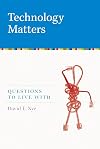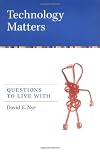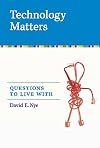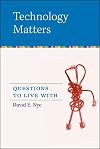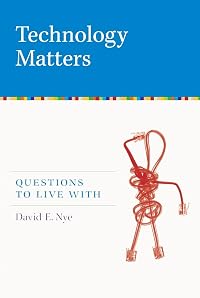
Technology Matters: Questions to Live With
by David E. Nye
On This Page
Description
Discusses in nontechnical language ten central questions about technology that illuminate what technology is and why it matters.Tags
Recommendations

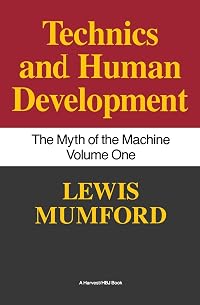
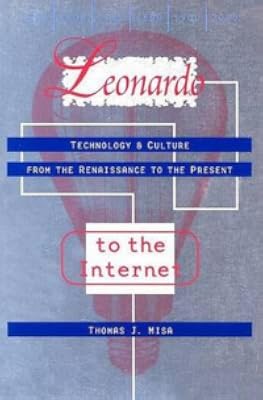
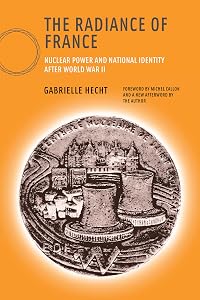
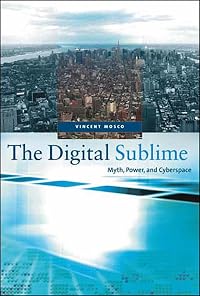
Member Reviews
I wish that I'd read this a few years ago before I started teaching STS--that's my main thought. This is a wonderful primer and in-depth discussion on matters and thoughts related to technologies and their development alongside society (global, but with a focus on America). While I've already got a strong background in STS (Science and Technology in Society), this was still a worthwhile read. It takes the familiar and forces serious consideration, all the while giving readers time to think instead of attempting to argue a particular viewpoint. It is well-written, engaging, and thoughtful.
If you're remotely interested in the way that technology (and humanity's perception of technology) has shaped and interacted with the building of our show more society and culture, I'd recommend it highly. Even if you just want an interesting nonfiction read that you can pick up in fits and starts, this is worthwhile and engaging. If you're looking for something to learn from and think about that applies to your every day life, this is a good choice. show less
If you're remotely interested in the way that technology (and humanity's perception of technology) has shaped and interacted with the building of our show more society and culture, I'd recommend it highly. Even if you just want an interesting nonfiction read that you can pick up in fits and starts, this is worthwhile and engaging. If you're looking for something to learn from and think about that applies to your every day life, this is a good choice. show less
It's now available as an ebook on the MITpress portal http://mitpress-ebooks.mit.edu/product/technology-matters
Ratings
Members
- Recently Added By
Author Information

27 Works 661 Members
David E. Nye (Ph.D. in American studies, University of Minnesota) is professor and chair at the Center for American Studies, Odense University, Denmark. Paul Brassley studied agricultural economics at the University of Newcastle and agricultural history at Oxford. He is senior lecturer in agricultural history and policy in the Seale-Hayne Faculty show more of the University of Plymouth. James Dickinson (Ph.D. in sociology, University of Toronto) teaches at Rider University. Jacob Wamberg (Ph.D. in art history, Copenhagen University) is assistant professor at the Institute of the History of Art, Aarhus University, Denmark. Tadeusz Rachwal is associate professor of English, University of Silesia, Poland. Stuart Kidd, until recently director of American Studies at the University of Reading, is now Warden of Bulmershe Hall. Christopher Bailey (B.A. in art history, University of East Anglia) is professor and head of the Department of Historical and Critical Studies, University of Northumbria. Stephen Mosley (Ph.D. in history, University of Lancaster) is a member of the history department, University of Birmingham, Westhill. Barbara Allen (architect, Columbia University; Ph.D. in Science and Technology Studies, RPI) holds the Contractors Educational Trust Fund Chair in Architecture at the University of Southwestern Louisiana. Mark Luccarelli (Ph.D. in American studies, University of Iowa) is associate professor in the Department of British and American Studies at the University of Oslo. Thomas Zeller (Ph.D. in history, Munich) is visiting assistant professor in the School of History, Technology and Society at Georgia Institute of Technology. He has also been a research associate in science and technology at the Deutsches Museum. Stephen Bending (Ph.D. in English, University of Cambridge) is a lecturer at the University of Southampton. Pia Maria Ahlback is a doctoral student and teacher at the department of English at Abo Akademi University, Turku, Finland. Peter Goin (M.F.A., University of Iowa) is professor of art in photography and video at the University of Nevada, Reno. Elizabeth Raymond (Ph.D. in American civilization, University of Pennsylvania) chairs the Department of History at the University of Nevada, Reno. show less
Awards and Honors
Awards
Common Knowledge
- Original publication date
- 2006
- Quotations
- The mainstream media can be so compelling that they define the limits of debate. Thus arises ‘repressive tolerance,’ in which all views can be permitted because most protests and many practical suggestions will be overloo... (show all)ked. In allowing expression of all views, the government shows it is not repressive. As Herbert Marcuse put it, “the exercise of political rights (such as voting, letter writing to the press, to Senators, etc., protest-demonstrations with a priori renunciation of counter-violence) in a society of total administration serves to strengthen this administration by testifying to the existence of democratic liberties which, in reality, have changed their content and lost their effectiveness.”Under a regime of repressive tolerance only a minority of the population follows the news closely, and dissidents, minorities and eccentrics have no impact if permitted to speak freely, since major newspapers and television networks ignore them. The Internet may yet illustrate this process, despite its democratic promise. Initially, it seemed to empower individuals and grassroots organizations. Yet the older media have successfully transferred their brand names to the Internet, where large newspapers and television networks continue to define and disseminate much of the news. Whether this new medium turns out to be an instrument of democracy or an example of repressive tolerance remains to be seen.
Classifications
Statistics
- Members
- 117
- Popularity
- 279,426
- Reviews
- 2
- Rating
- (3.67)
- Languages
- English
- Media
- Paper, Ebook
- ISBNs
- 5
- ASINs
- 2