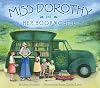
Miss Dorothy and Her Bookmobile
by Gloria Houston
On This Page
Description
Dorothy has always wanted to work in a library like the red brick one of her girlhood, but after moving to rural North Carolina she discovers that the type of library is less important than the books and the people who read them.Tags
Recommendations











Member Recommendations
by bookel
Member Reviews
Author Gloria Houston and illustrator Susan Condie Lamb, who collaborated on the marvelous My Great-Aunt Arizona, join forces once again in Miss Dorothy and Her Bookmobile, which follows the story of a young woman who longs to become a librarian, and work in a stately red brick building, just like the one in her hometown in Massachusetts. But when Miss Dorothy, all grown up and graduated from college, falls in love and gets married, her life takes her to rural North Carolina, to a town where there is no library. The eventual solution - a bookmobile that she can use to bring books to the people - isn't what she envisioned as a girl, but is just what her new neighbors need...
Like the earlier book about Aunt Arizona, Miss Dorothy and Her show more Bookmobile is based on the life story of someone the author knew as a girl - the real Miss Dorothy used to bring her bookmobile to the store operated by Houston's family, stopping by every two weeks with her treasure - and offers a tribute to a very important profession: the librarian. I liked the story itself, with its message of adapting to the circumstances in which one finds oneself, and I liked that it was a real person (something made plain in the author's brief afterword) being depicted. I also greatly enjoyed the artwork, which I thought was just lovely, although the social critic in me couldn't help but wonder, looking at the happily integrated community, whether this was an accurate portrait of how the townspeople looked, in 1930s (I think it was 1930s?) Appalachia.
Still, leaving that issue of historical realism aside - and really, I'm not sure just how I feel about it: whether I think it is better to be inclusive (a good thing, generally) and draw more children into the story, or whether I feel that, by obscuring the realities of segregation, in the past, we are doing children a disservice - this is a wonderful book. Recommended to young bibliophiles and library lovers, and to anyone looking for children's stories set in Appalachia. show less
Like the earlier book about Aunt Arizona, Miss Dorothy and Her show more Bookmobile is based on the life story of someone the author knew as a girl - the real Miss Dorothy used to bring her bookmobile to the store operated by Houston's family, stopping by every two weeks with her treasure - and offers a tribute to a very important profession: the librarian. I liked the story itself, with its message of adapting to the circumstances in which one finds oneself, and I liked that it was a real person (something made plain in the author's brief afterword) being depicted. I also greatly enjoyed the artwork, which I thought was just lovely, although the social critic in me couldn't help but wonder, looking at the happily integrated community, whether this was an accurate portrait of how the townspeople looked, in 1930s (I think it was 1930s?) Appalachia.
Still, leaving that issue of historical realism aside - and really, I'm not sure just how I feel about it: whether I think it is better to be inclusive (a good thing, generally) and draw more children into the story, or whether I feel that, by obscuring the realities of segregation, in the past, we are doing children a disservice - this is a wonderful book. Recommended to young bibliophiles and library lovers, and to anyone looking for children's stories set in Appalachia. show less
When Miss Dorothy graduates from Radcliffe College, she intends to become a librarian in charge of a "fine brick building just like the one ... in her home town in Massachusetts." But when Miss Dorothy marries, she and her husband move to a farm "at the base of high Mount Mitchell in the Blue Ridge Mountains of North Carolina" where there are no larger towns and cities and thus, no fine brick libraries. However, Miss Dorothy and the townspeople soon organise a bookmobile (a moving library), and Miss Dorothy does, indeed, become a librarian, a different type of librarian than she had envisioned, but a librarian nonetheless.
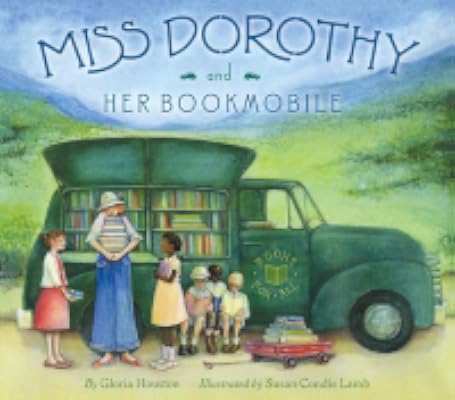
Miss Dorothy and her Bookmobile (written by Gloria Houston and illustrated by Susan Condie Lamb, who also show more collaborated on the equally wonderful and evocative My Great-Aunt Arizona is based on the true story of Dorothy Thomas, who operated a green bookmobile in the rural area where author Gloria Houston lived as a child, there being no actual, physical library building (for more information, see the informative author's note, which is as much of a paean, a dedication to Miss Dorothy and her bookmobile as the narrative, the story itself).
With a flowing, evocative text (and equally lush and descriptive illustrations, which capture not only the feel of the time, but the feel of the countryside, as well as the moods, the personalities of the people, the characters) Miss Dorothy and her Bookmobile is not only a glowing general tribute to librarians. It is specifically and especially a tribute to those librarians who did not work and often still do not work in traditional library buildings, but who brought and sometimes still bring the joy of reading, the joy of books to people, to their patrons, using bookmobiles, horses, mules, boats, often spending not only many hours, but also uncomfortable, possibly even possibly dangerous hours out and about to make books, reading, and literacy possible and accessible in and to under and undeveloped areas.
Beside the loving homage to librarians, there is also a wonderful message of community demonstrated in this story (it takes the whole community to furnish, to provide Miss Dorothy with a bookmobile, and I just love the fact that as soon as the small town where Miss Dorothy and her husband have settled, decides on getting a bookmobile, everyone, and I mean everyone helps to make said bookmobile a possibility, donating money, time, and of course, books). But even more importantly (at least for me), Miss Dorothy and her Bookmobile shows that although a person's aspirations might have to change, they can still be made a reality, they can still be pursued. Dorothy had wanted to become a librarian, and in the end, she does become a librarian (a different type of librarian than she had originally envisioned for herself, but still a librarian). Her dreams, her hopes might have had to adjust, but basically they have remained the same (the change is, in effect, only cosmetic, the heart of her aspirations, becoming a librarian, has not changed).
Like my LT friend Abigail, I also somewhat wonder at the fact that the small North Carolina town where Miss Dorothy settles seems surprisingly integrated for the 1930s (personally, I appreciate the fact that the illustrations, especially, show an integrated community, but I do have to wonder how historically accurate this is). That is not to say, that I consider an integrated community in 1930s North Carolina a complete and utter impossibility, but I have to admit that I have some doubts (especially considering the recent history of the Southern States). But other than that little caveat, I absolutely adored Miss Dorothy and her Bookmobile and highly recommend it to and for children interested in books, libraries and librarians. show less
Miss Dorothy and her Bookmobile (written by Gloria Houston and illustrated by Susan Condie Lamb, who also show more collaborated on the equally wonderful and evocative My Great-Aunt Arizona is based on the true story of Dorothy Thomas, who operated a green bookmobile in the rural area where author Gloria Houston lived as a child, there being no actual, physical library building (for more information, see the informative author's note, which is as much of a paean, a dedication to Miss Dorothy and her bookmobile as the narrative, the story itself).
With a flowing, evocative text (and equally lush and descriptive illustrations, which capture not only the feel of the time, but the feel of the countryside, as well as the moods, the personalities of the people, the characters) Miss Dorothy and her Bookmobile is not only a glowing general tribute to librarians. It is specifically and especially a tribute to those librarians who did not work and often still do not work in traditional library buildings, but who brought and sometimes still bring the joy of reading, the joy of books to people, to their patrons, using bookmobiles, horses, mules, boats, often spending not only many hours, but also uncomfortable, possibly even possibly dangerous hours out and about to make books, reading, and literacy possible and accessible in and to under and undeveloped areas.
Beside the loving homage to librarians, there is also a wonderful message of community demonstrated in this story (it takes the whole community to furnish, to provide Miss Dorothy with a bookmobile, and I just love the fact that as soon as the small town where Miss Dorothy and her husband have settled, decides on getting a bookmobile, everyone, and I mean everyone helps to make said bookmobile a possibility, donating money, time, and of course, books). But even more importantly (at least for me), Miss Dorothy and her Bookmobile shows that although a person's aspirations might have to change, they can still be made a reality, they can still be pursued. Dorothy had wanted to become a librarian, and in the end, she does become a librarian (a different type of librarian than she had originally envisioned for herself, but still a librarian). Her dreams, her hopes might have had to adjust, but basically they have remained the same (the change is, in effect, only cosmetic, the heart of her aspirations, becoming a librarian, has not changed).
Like my LT friend Abigail, I also somewhat wonder at the fact that the small North Carolina town where Miss Dorothy settles seems surprisingly integrated for the 1930s (personally, I appreciate the fact that the illustrations, especially, show an integrated community, but I do have to wonder how historically accurate this is). That is not to say, that I consider an integrated community in 1930s North Carolina a complete and utter impossibility, but I have to admit that I have some doubts (especially considering the recent history of the Southern States). But other than that little caveat, I absolutely adored Miss Dorothy and her Bookmobile and highly recommend it to and for children interested in books, libraries and librarians. show less
The fabulously wimsical story is based on the librarian from the author's childhood. The dedicated Miss Dorothy determines to bring books to the people of the Blue Ridge Mountains of North Carolina. She raises funds to buy a green bookmobile, hauling books up and down into her basement and delivering them over hill and dale. Eventually the town purchase's a library building which Miss Dorothy operates the library from. She receives letters from people she has inspired over the years. A beautifully illustrated and charming tale, especially delightful for librarians everywhere who all work towards enriching people's lives with books.
Gloria Houston tells the true story of one of her personal heroes, Dorothy Thomas. Dorothy wanted to be a librarian in a big brick library, but instead her husband wanted to live in the country where there was no library. So Dorothy created a bookmobile that traveled from place to place and brought books to people who had no books.
Each paragraph is like a small poem. Each illustration is like a small poem. A beautiful little story of service.
“If her readers could not come
to the bookmobile,
Miss Dorothy took books to them.
When elderly Mrs. Maumey
had read all her books,
she hung her husband’s
red flannel drawers
on the line,
and Miss Dorothy climbed the hill
with more books to share
with her reading friend.”
Each paragraph is like a small poem. Each illustration is like a small poem. A beautiful little story of service.
“If her readers could not come
to the bookmobile,
Miss Dorothy took books to them.
When elderly Mrs. Maumey
had read all her books,
she hung her husband’s
red flannel drawers
on the line,
and Miss Dorothy climbed the hill
with more books to share
with her reading friend.”
The big idea of this book s that if you only wish for the greener grass on the other side of the fence, then you may not notice or appreciate just how beautiful your own lawn is. I like this book because it encourages readers to think about different perspectives. Miss Dorothy often comments that she thought she would be "a real librarian, in a fine brick library, just like the one in the center of the square in her hometown." She fails to realize that a librarian is a librarian because of their love of books and wanting to share that love with other people; but eventually comes to the understanding that her town appreciates her and she develops a new understanding of what a librarian is. It encourages you to not be stuck with one show more stereotype and to be able to accept that not everything fits into a specific definition or category! I also think that the illustrations are a great complement to the setting and characters. Their warm, slightly washed-out colors and water-color style add to the laid back, country feel of the rural setting. They give the book a calm feel, as opposed to being brightly and vividly printed in bold contrasting colors. For example, on the fourth and fifth page, I actually believed I could almost feel the warmth from the sunset from the way the warm reds and cool blues were splashed across the ground and even reflected off of the car as they made their way into the mountains. The pictures definitely engaged me more in the text as I read. show less
In this book, Gloria Houston tells the story of Miss Dorothy, a woman who dreams of becoming a librarian in a “fine brick building” like the one in her hometown, but instead operates a bookmobile in a rural area in the Blue Ridge Mountains after finding that there are no libraries around. As Houston states in her author’s note, this book is based upon the story of one of her childhood heroes – Dorothy Thomas – who used to drive a bookmobile to deliver books in Houston’s childhood neighborhood. The colorful, whimsical illustrations in this book support and extend the text, providing children with depictions of the time period in which Miss Dorothy drives her bookmobile. Reading this book to children helps teach them about the show more value of working together (the neighbors worked together to get the bookmobile up and running) and of staying true to one’s dreams no matter the circumstances (Dorothy wanted to be a librarian and was one, although not in the library she had envisioned). It could also be used during a classroom unit on fact versus fiction, as children could be asked to think, based upon the author’s note, how much of the story may have been more influenced by the author’s memories than by actual fact. show less
Miss Dorothy loves books, and has since she was a little girl. She always dreamed of being a librarian at a big beautiful library in her hometown in Massachusetts. But she fell in love and her husband moved to a farm in the Blue Ridge Mountains. Because there wasn't enough money for a library the citizens decided to pitch in enough money for a bookmobile that traveled around to the small towns and let children and community members trade books.
A truly charming story that is based on the life of a true librarian, Dorothy Thomas who ran a bookmobile for the author, Gloria Houston when she was a child.
I want a bookmobile now!! Maybe I can make one for my classroom one day. :)
A truly charming story that is based on the life of a true librarian, Dorothy Thomas who ran a bookmobile for the author, Gloria Houston when she was a child.
I want a bookmobile now!! Maybe I can make one for my classroom one day. :)
Members
- Recently Added By
Lists

At the Library ::: Children's Picture Books about Libraries
103 works; 6 members

Youth: Social Values
194 works; 1 member
Author Information

12 Works 4,177 Members
All Editions
Awards and Honors
Awards
Distinctions
Classifications
Statistics
- Members
- 187
- Popularity
- 175,198
- Reviews
- 14
- Rating
- (4.02)
- Languages
- English
- Media
- Paper
- ISBNs
- 2