On This Page
Description
Ruby 1.9 was a major release of the language: it introduced multinationalization, new block syntax and scoping rules, a new, faster, virtual machine, and hundreds of new methods in dozens of new classes and modules. Ruby 2.0 is less radical--it has keyword arguments, a new regexp engine, and some library changes. This book describes it all. The first quarter of the book is a tutorial introduction that gets you up to speed with the Ruby language and the most important classes and libraries. show more Download and play with the hundreds of code samples as your experiment with the language. The second section looks at real-world Ruby, covering the Ruby environment, how to package, document, and distribute code, and how to work with encodings. The third part of the book is more advanced. In it, you'll find a full description of the language, an explanation of duck typing, and a detailed description of the Ruby object model and metaprogramming. The book ends with a reference section: comprehensive and detailed documentation of Ruby's libraries. You'll find descriptions and examples of more than 1,300 methods in 58 built-in classes and modules, along with brief descriptions of 97 standard libraries. Ruby makes your programming more productive; it makes coding fun again. And this book will get you up to speed with the very latest Ruby, quickly and enjoyably. show lessTags
Recommendations

Member Reviews
A tour de force journey through the dynamic, object-oriented language known as Ruby, with over 200 pages of new material and full descriptions of all the standard library modules. Covers strings, classes, blocks, and regular expressions with thorough examples. This book has such a reputation as the definitive reference for learning Ruby that it is simply called "The Pickaxe Book" in the programming community. There are many Ruby tutorials and references on the web, but the beauty of this book is that it is both well-written and provides a compendium of what you really need to know about Ruby that can't be easily sourced and collected. This is the ultimate book for both learning Ruby and use as a desk reference.
This book is pretty well laid out and keeps things simple, I think that might be as much a testament to the design of Ruby as to Dave's penmanship. Anyway, it is all there and easily accessible and understandable. If you are doing it with Ruby, this is the book to have. The back half is just a listing of the Ruby documentation so... you know, whatever.
This was my first foray into such a dynamic language. For a quick introduction to the language I don't think you can beat this book. After reading this book the biggest concern I have about using a language like Ruby would be the fact that it is dynamically typed. It just seems like this would lead to you not finding out you passed the wrong object to some code until you did a test run. Coming from a C background where we are taught to have the compiler check for errors like this, this is a reasonable worry. It definatly looks like a fun and productive language though. I also liked that fact that the first edition is available online at Programming Ruby.
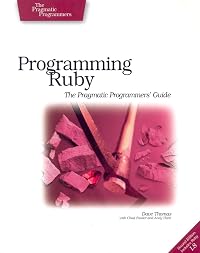
Solid how-to and reference book. Dubbed the "Pickaxe" book by Ruby programmers because of the cover photo. Programming Ruby is how I learned Ruby, now my favorite programming language. I can't get past the author's name though. Every time I notice it on my shelf I think, "So that's what he's been up to since SCTV."
An excellent, comprehensive book on Ruby. For experienced programmers, you don't want to wade through all of the beginning programming stuff. Just tell me how the language works and define all of the constructs. This book accomplishes that. It looks to me like the Pragmatic Bookshelf as a publisher is doing top notch work!
Ratings
Members
- Recently Added By
Author Information

8 Works 2,899 Members
Series

Belongs to Publisher Series
Common Knowledge
- Canonical title
- Programming Ruby
- Original publication date
- 2001
Classifications
- Genres
- Technology, Nonfiction, General Nonfiction
- DDC/MDS
- 005.133 — Computer science, information & general works Computer science, knowledge & systems Artificial Intelligence/Virtual Reality Software development Computer programming Specific programming languages
- LCC
- QA76.64 .T494 — Science Mathematics Mathematics Instruments and machines Calculating machines Electronic computers. Computer science
- BISAC
Statistics
- Members
- 1,451
- Popularity
- 16,160
- Reviews
- 6
- Rating
- (3.94)
- Languages
- English, German, Japanese, Korean
- Media
- Paper
- ISBNs
- 9
- UPCs
- 4
- ASINs
- 1