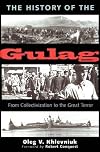
The History of the Gulag: From Collectivization to the Great Terror
by Oleg V. Khlevniuk
On This Page
Description
"The human cost of the Gulag, the Soviet labor camp system in which millions of people were imprisoned between 1920 and 1956, was staggering. Aleksandr Solzhenitsyn and others after him have written movingly about the Gulag, yet never has there been a thorough historical study of this unique and tragic episode in Soviet history. This book presents the first comprehensive, historically accurate account of the camp system. Russian historian Oleg Khlevniuk has mined the contents of extensive show more archives, including long-suppressed state and Communist Party documents, to uncover the secrets of the Gulag and how it became a central component of Soviet ideology and social policy."--Jacket. show lessTags
Recommendations













































Member Reviews
Oleg Khlevniuk's Russian archive work on researching the true extent of the destruction of humans under Stalin is by far the best work in the field. By painstakingly analyzing secret reports, top secret letters between Commissars, censuses, official data, the Chrushchov era KGB research, etc. he is capable of giving an authoritative and absolutely fair analysis of exactly what went on in the GULAG system in particular and Stalinism as a whole, how many people were affected and how, and what this means for the accuracy of the 'popular view' of Stalin's crimes.
Contrary to Conquest, Malia, Montefiore etc. etc. he presents the facts and the documents as they are and lets them speak for themselves, instead of going on and on about the show more moral/sentimental issues without any thorough factual backing, as almost all such popular writers on the USSR do. Certainly no fan of Stalin either, he manages to present the simple facts in such a clear and well-evidenced way that he does justice to all involved. An impressive achievement considering the political meaning of the subject. show less
Contrary to Conquest, Malia, Montefiore etc. etc. he presents the facts and the documents as they are and lets them speak for themselves, instead of going on and on about the show more moral/sentimental issues without any thorough factual backing, as almost all such popular writers on the USSR do. Certainly no fan of Stalin either, he manages to present the simple facts in such a clear and well-evidenced way that he does justice to all involved. An impressive achievement considering the political meaning of the subject. show less
Die Reihe "Annals of Communism" publiziert regelmäßig Dokumente aus Partei- oder Staatsarchiven, die von großem Wert für die Historiographie des Kommunismus sind.Khlevniuk legt mit dieser Quellensammlung, die in Zusammenarbeit mit dem Staatsarchiv der Russländischen Föderation (GARF) entstand, eine Dokumentation exemplarischer Quellen der einzelnen Phasen des Straflagersystems zwischen 1929 und 1941 vor. Es empfiehlt sich jedoch zum Beispiel Stettner über die Gulags aus 1996 parallel zu lesen, um die nötigen Hintergrundinformtionen zu erhalten.
Jun 27, 2007German
Ratings
Members
- Recently Added By
Author Information

8 Works 351 Members
Oleg V. Khlevniuk is a leading research fellow at the National Research University Higher School of Economics (HSE) International Center for the History and Sociology of World War II and Its Consequences and senior research fellow at the State Archive of the Russian Federation. His previous Yale books include The History of the Gulag, Master of show more the House: Stalin and His Inner Circle, and several collections of Stalin's correspondence. show less
All Editions
Some Editions
Series
Belongs to Publisher Series
Annals of Communism (2004)
Common Knowledge
- Canonical title
- The History of the Gulag: From Collectivization to the Great Terror
- Original publication date
- 2004
- First words
- The Stalinist penal system was formed and entrenched during the 1930s - more precisely, between 1929 and 1941.
- Original language
- Russian
Classifications
- Genres
- Nonfiction, History, Politics and Government, General Nonfiction
- DDC/MDS
- 365.45 — Society, government, & culture Social problems and social services Punishment Institutions for specific classes of inmates Institutions for political prisoners and related groups of people
- LCC
- HV8964 .S65 .K48 — Social sciences Social pathology. Social and public welfare. Criminology Social pathology. Social and public welfare. Criminal justice administration Penology. Prisons. Corrections
- BISAC
Statistics
- Members
- 53
- Popularity
- 565,988
- Reviews
- 2
- Rating
- (4.50)
- Languages
- English
- Media
- Paper, Ebook
- ISBNs
- 3
- ASINs
- 1