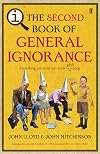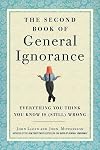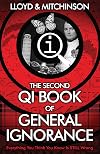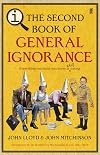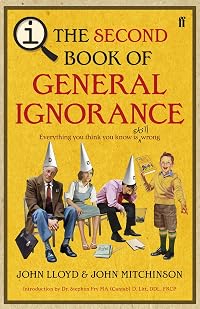
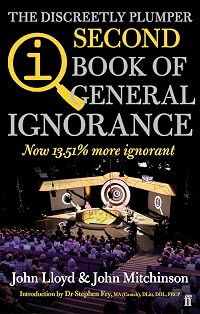
QI: The Second Book of General Ignorance
by John Lloyd, John Mitchinson (Author)
QI Book of General Ignorance (2)
On This Page
Description
From the brains behind the New York Times' bestseller, The Book of General Ignorance comes another wonderful collection of the most outrageous, fascinating, and mind-bending facts, taking on the hugely popular form of the first book in the internationally bestselling series.Just when you thought that it was safe to start showing off again, John Lloyd and John Mitchinson are back with another busload of mistakes and misunderstandings. Here is a new collection of simple, perfectly obvious show more questions you'll be quite certain you know the answers to. Whether it's history, science, sports, geography, literature, language, medicine, the classics, or common wisdom, you'll be astonished to discover that everything you thought you knew is still hopelessly wrong.
For example, do you know who made the first airplane flight? How many legs does an octopus have? How much water should you drink every day? What is the chance of... show less
Tags
Recommendations






Member Reviews
QI -- for "Quite Interesting" -- is one of those weird, delightful British comedy/quiz shows where the aim is less to win and more just to have a fun and entertaining time. The format of this one is that all the comedians are asked a question which likely has an obvious answer. That answer is usually wrong, or at least not the one that's required -- those are generally much weirder, trickier, more obscure, or even downright unfair.
This book, like The First Book of General Ignorance before it, is a collection of such questions with their answers (and, as on the show, sometimes vaguely related tangents, as well). An example: Where is the largest known lake? No, geography buffs, it's not the Caspian Sea! We never said it had to be on show more Earth, did we? Or that it had to be filled with water. And it turns out there's a really big methane lake on Titan.
This stuff, admittedly, is nowhere near as hilarious and entertaining in book form as it is on TV, but as trivia books go, these are definitely high-quality, full of interesting little tidbits, and very readable. I also found myself admiring the structure of this one. Every question somehow manages to feel at least vaguely related to the one before, and yet they end up covering a very wide range of subject matter. One moment you're reading about Roman history, and before you know it, you've somehow seamlessly slid onto the topic of organ transplants. show less
This book, like The First Book of General Ignorance before it, is a collection of such questions with their answers (and, as on the show, sometimes vaguely related tangents, as well). An example: Where is the largest known lake? No, geography buffs, it's not the Caspian Sea! We never said it had to be on show more Earth, did we? Or that it had to be filled with water. And it turns out there's a really big methane lake on Titan.
This stuff, admittedly, is nowhere near as hilarious and entertaining in book form as it is on TV, but as trivia books go, these are definitely high-quality, full of interesting little tidbits, and very readable. I also found myself admiring the structure of this one. Every question somehow manages to feel at least vaguely related to the one before, and yet they end up covering a very wide range of subject matter. One moment you're reading about Roman history, and before you know it, you've somehow seamlessly slid onto the topic of organ transplants. show less
As someone with an unquenchable thirst for trivia and obscure knowledge I always enjoys books like this; lots of short entries delivering oddball facts that I like to squirrel away in the recesses of mind (usually displacing unimportant information like my date of birth or similar).
Looking at random entries, I see that the coldest temperature ever recorded in England was -26.1 degrees Celsius at Newport, Shropshire on 10 January 1982. Never been there but I'll be sure to pack an extra jumper if I ever do.
Similarly I find that the scientific term for creaking joints is "crepitus", a word I'm required to use with ever increasing frequency these days. And a shout-out to Lord Howard of Effingham, who led the English fleet against the show more Spanish Armada but for some reason it's Drake that gets the plaudits. show less
Looking at random entries, I see that the coldest temperature ever recorded in England was -26.1 degrees Celsius at Newport, Shropshire on 10 January 1982. Never been there but I'll be sure to pack an extra jumper if I ever do.
Similarly I find that the scientific term for creaking joints is "crepitus", a word I'm required to use with ever increasing frequency these days. And a shout-out to Lord Howard of Effingham, who led the English fleet against the show more Spanish Armada but for some reason it's Drake that gets the plaudits. show less
Termino questo testo e mi rendo conto che la mia vita e' sempre stata mossa da poca curiosità, rispetto a quella che ha pervaso i due John autori.
In questo secondo - come nel primo - apprezzo la capacità dell'editor di rendere facile e istruttiva la lettura, grazie anche alle frequenti indicazioni etimologiche dei termini. Poi sapere che Pocahontas e' morta a 22 anni ed e' stato il primo americano ad essere seppellito in Gran Bretagna è straziante... Per non parlare del peso delle nuvole, o del rapporto tra alcool e antibiotici - nullo, come i miei esperimenti mi avevano sempre confermato :-)
In questo secondo - come nel primo - apprezzo la capacità dell'editor di rendere facile e istruttiva la lettura, grazie anche alle frequenti indicazioni etimologiche dei termini. Poi sapere che Pocahontas e' morta a 22 anni ed e' stato il primo americano ad essere seppellito in Gran Bretagna è straziante... Per non parlare del peso delle nuvole, o del rapporto tra alcool e antibiotici - nullo, come i miei esperimenti mi avevano sempre confermato :-)
Allereerst, de Nederlandse titel is verkeerd en geeft een verkeerde indruk van de inhoud van het boek. De originele titel is 'The Second Book of General Ignorance: Everything You Think You Know Is (Still) Wrong', en moest dus vertaald worden als, bijvoorbeeld, 'algemene onwetenheid', aangezien er feitjes worden behandeld die je vroeger wel geleerd hebt, maar nu niet meer weet (en ontkracht worden) of die, afhankelijk van de omstandigheden, triviaal of irrelevant zijn. Maar in elk geval zijn veel van de vermelde items wel nuttig om te weten.
Het boek is een uitloper van het quizprogramma QI, waarin allerhande weetjes worden opgeworpen, al dan niet beantwoord met en humoristische inslag. Wetenschap, geschiedenis, en dergelijke meer komen show more aan bod. In Vlaanderen hadden we een vergelijkbare show: 'Scheire en de Schepping'.
Behandelde weetjes zijn bijvoorbeeld:
- Wie maakte de eerste vlucht in een vliegtuig?
- Wat is de hardste stof?
- Welke kleur draag je het best om koel te blijven?
- Wie vermoordde Jeanne d'Arc?
- Waar komt de Schotse ruit vandaag?
- Wat is de oorzaak van tintelingen?
- Hoe weet je wanneer de zon onder is?
- Welk deel van het eten wordt in de magnetron het eerst gaar?
- enz...
Natuurlijk wordt er niet diep ingegaan per item, daarvoor bestaan andere boeken. Maar het wakkert wel je interesse en aandacht aan om het leven anders te gaan bekijken. Dergelijke Q&A-boeken, net zoals deze van bijv. [a:New Scientist|3179|New Scientist|https://s.gr-assets.com/assets/nophoto/user/u_50x66-ccc56e79bcc2db9e6cdcd450a4940d46.png], zijn leuke toevoegsels aan je collectie en handig om tussendoor eens te lezen of te herlezen. show less
Het boek is een uitloper van het quizprogramma QI, waarin allerhande weetjes worden opgeworpen, al dan niet beantwoord met en humoristische inslag. Wetenschap, geschiedenis, en dergelijke meer komen show more aan bod. In Vlaanderen hadden we een vergelijkbare show: 'Scheire en de Schepping'.
Behandelde weetjes zijn bijvoorbeeld:
- Wie maakte de eerste vlucht in een vliegtuig?
- Wat is de hardste stof?
- Welke kleur draag je het best om koel te blijven?
- Wie vermoordde Jeanne d'Arc?
- Waar komt de Schotse ruit vandaag?
- Wat is de oorzaak van tintelingen?
- Hoe weet je wanneer de zon onder is?
- Welk deel van het eten wordt in de magnetron het eerst gaar?
- enz...
Natuurlijk wordt er niet diep ingegaan per item, daarvoor bestaan andere boeken. Maar het wakkert wel je interesse en aandacht aan om het leven anders te gaan bekijken. Dergelijke Q&A-boeken, net zoals deze van bijv. [a:New Scientist|3179|New Scientist|https://s.gr-assets.com/assets/nophoto/user/u_50x66-ccc56e79bcc2db9e6cdcd450a4940d46.png], zijn leuke toevoegsels aan je collectie en handig om tussendoor eens te lezen of te herlezen. show less
Entertaining enough as it clears up common misconceptions—a centurion only commanded 80 men, not a hundred, for instance, and there is no such thing as a “fish” (so many different animals are included that the term is scientifically meaningless).
This book is more of the same; more myth-busting, more correcting history. I didn't enjoy this book as much as I did the first book, feeling like the authors were stretching it a bit to find enough information for a sequel. Then 'chatter' at the end of each chapter is silly and I could have done without.
Very similar to the first book. The idea wears thin after a while but was still interesting enough to get me through. I think I'll wait a while before I read the animal edition.
Members
- Recently Added By
Author Information

55+ Works 10,666 Members
John Lloyd produced Not the Nine O'Clock New, the Blackadders, and Spitting Image. (Publisher Provided)

Some Editions
Series

Belongs to Publisher Series
Work Relationships
Common Knowledge
- Original title
- The Second Book of General Ignorance
- Original publication date
- 2010
- People/Characters
- Lord Howard of Effingham
- Important places
- Newport, Shropshire, England, UK
- Important events
- Spanish Armada
- Related movies
- QI (2003 | IMDb)
- Epigraph
- "Everybody is ignorant, only on different subjects." Will Rogers (1879-1935)
Everybody is ignorant, only on different subjects.
Will Rogers (1879-1935) - First words
- Who made the first flight in an aeroplane?
- Last words
- (Click to show. Warning: May contain spoilers.)We will make no further claims, except to say interestingness lasts longer and contains no bones.
Classifications
- Genres
- Reference, Nonfiction, General Nonfiction, Science & Nature, History
- DDC/MDS
- 001.96 — Computer science, information & general works Computer science, knowledge & systems Knowledge and learning in general Aliens/UFOs Errors, delusions, superstitions
- LCC
- AG195 .M58 — General Works Dictionaries and other general reference works Dictionaries and other general reference works
- BISAC
Statistics
- Members
- 651
- Popularity
- 44,665
- Reviews
- 7
- Rating
- (3.80)
- Languages
- 6 — Dutch, English, German, Italian, Portuguese, Turkish
- Media
- Paper, Audiobook, Ebook
- ISBNs
- 19
- ASINs
- 5