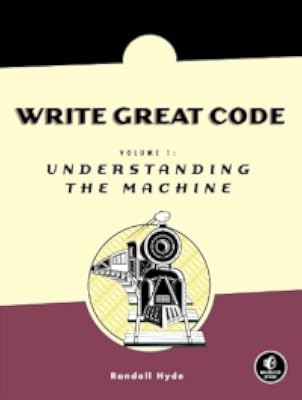
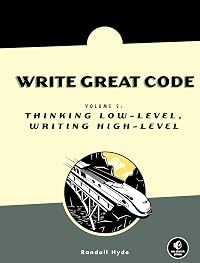
Write Great Code: Volume 1: Understanding the Machine
by Randall Hyde
On This Page
Description
Write Great Code, Volume 1 teaches machine organization, including numeric representation; binary arithmetic and bit operations; floating point representation; system and memory organization; character representation; constants and types; digital design; CPU, instruction set, and memory architecture; input and output; and how compilers work.Tags
Recommendations
Member Reviews
This book may be useful to people who do generic computer programming and are interested in how the high-level code that they write gets funneled down to perform specific machine instructions. Generally speaking, computer programming does not frequently take place in assembly language, so there is a great disconnect between how a computer is physically built to carry out instructions, and how programmers write code.
However, I found this book, due to its emphasis on computer programming, to be not at all helpful or informative on improving embedded programming skills. Because of the great differences between the two paradigms, those who program embedded devices are generally already aware of peripheral usage, memory capacity, and the like.
However, I found this book, due to its emphasis on computer programming, to be not at all helpful or informative on improving embedded programming skills. Because of the great differences between the two paradigms, those who program embedded devices are generally already aware of peripheral usage, memory capacity, and the like.
This book serves as a very nice introduction to computer architecture and hardware. Programmers are the target audience and much of the focus is how the information presented can help with writing more efficient code. Some programming knowledge is required to get the most of the book, with C probably being the most useful, but examples are given in a variety of low-level languages and the code snippets are fairly well-explained in the text anyway. This is an appropriate book for someone just getting into programming professionally, a student, or a motivated enthusiast.
Ratings
Members
- Recently Added By
Author Information

9 Works 694 Members
Randall Hyde has taught assembly language at the university level for over a decade and has developed several commercial software systems
Classifications
- Genres
- Technology, Nonfiction, General Nonfiction
- DDC/MDS
- 005.1 — Computer science, information & general works Computer science, knowledge & systems Artificial Intelligence/Virtual Reality Software development
- LCC
- QA76.6 .H94 — Science Mathematics Mathematics Instruments and machines Calculating machines Electronic computers. Computer science
- BISAC
Statistics
- Members
- 266
- Popularity
- 120,235
- Reviews
- 2
- Rating
- (3.61)
- Languages
- English, Japanese
- Media
- Paper, Ebook
- ISBNs
- 7
- UPCs
- 1
- ASINs
- 2