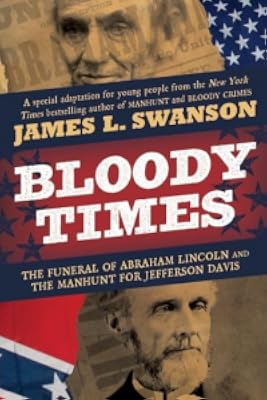
Bloody Times
by James L. Swanson
On This Page
Description
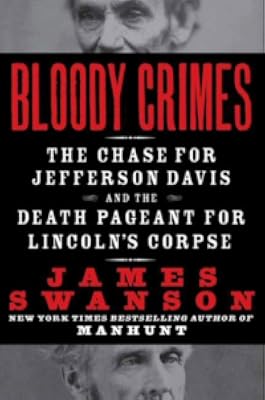
On the morning of April 2, 1865, Jefferson Davis received a telegram from General Robert E. Lee. There is no more time--the Yankees are coming, it warned. That night Davis fled Richmond, setting off an intense manhunt for the Confederate president. Two weeks later, President Lincoln was assassinated, and the nation was convinced that Davis was involved in the conspiracy that led to the crime. Lincoln's murder, autopsy, and White House funeral transfixed the nation. His final journey began show more when soldiers placed his corpse aboard a special train that would carry him home to Springfield, Illinois. It was the most magnificent funeral pageant in American history. show lessTags
Recommendations


















Member Reviews
This book is a telling of the two Civil War president's actions as the war and both of their lives come to an end. Swanson tells a historic account using many original sources in the novel. From Lee's surrender, to Lincoln's assasination, and all the way to Davis' capture, this story is rooted in historical facts.
This would be a good book to use in an 8th grade classroom when the students are learning about the Civil War. I wouldn't particularly use this in an English classroom, but it would be a good tool in a Social Studies class. This book could easily be paired with "Huckleberry Finn" or for a high school class Kate Chopin's "The Awakening."
I liked this book because of its history and I learned a lot that I didn't know about the show more Civil War and the parallels between Lincoln and Davis. I had a hard time reading this book because it read a lot like that of a history textbook. I wish the story could have been told through a more interesting narrative while still staying true to the facts. I think nonfiction is hard for English teachers because the nonfiction they are used to reading is literary criticism, rather than the retelling of historical events. show less
This would be a good book to use in an 8th grade classroom when the students are learning about the Civil War. I wouldn't particularly use this in an English classroom, but it would be a good tool in a Social Studies class. This book could easily be paired with "Huckleberry Finn" or for a high school class Kate Chopin's "The Awakening."
I liked this book because of its history and I learned a lot that I didn't know about the show more Civil War and the parallels between Lincoln and Davis. I had a hard time reading this book because it read a lot like that of a history textbook. I wish the story could have been told through a more interesting narrative while still staying true to the facts. I think nonfiction is hard for English teachers because the nonfiction they are used to reading is literary criticism, rather than the retelling of historical events. show less
Alternating chapters of the story of Lincoln’s last days as a living and then martyred President with the story of Jefferson Davis’ attempt to keep the Confederacy alive make for a fascinating glimpse into history. The details of Lincoln’s funeral train, and the throngs of mourners as it travels to Springfield, Illinois, are interspersed with Davis’s journey to save the south as well as avoid arrest.
I really liked learning more about Jefferson Davis who, as Swanson notes, has been lost in history. Also good was the focus on a the activities during the last days of the war and the number of quotes from diaries and pictures.
Details the manhunt for Jefferson Davis, the President of the Confederate States of America.
Ratings
Members
- Recently Added By
Lists

Mensa for Kids Excellence in Reading Award Program (Nonfiction)
54 works; 4 members
Author Information

23 Works 8,073 Members
James L.Swanson is the Edgar Award winning author of the New York Times bestseller Manhunt: The 12-Day Chase for Lincoln's Killer. In 2009 in Newsweek magazine, Patricia Cornwell named Swanson's Manhunt and Truman Capote's In Cold Blood as the two best nonfiction crime books ever. In 2006, Entertainment Weekly magazine named Manhunt one of the ten show more best books of the year. Swanson has degrees in history from The University of Chicago, where he was a student of John Hope Franklin, and law from the University of California, Los Angeles. He has held a number of government and think-tank posts in Washington, D.C., including at the United States Department of Justice. He serves on the advisory council of the Ford's Theatre Society. His other books include the acclaimed photographic history Lincoln's Assassins: Their Trial and Execution, as well as Chasing Lincoln's Killer, and adaptations of Manhunt and Bloody Crimes for young readers. In 2014 his title, The President Has Been Shot!: The Assasination of Joh F. Kennedy, made The New York Times Best Seller List. James L. Swanson was born on Lincoln's birthday. (Publisher Provided) show less
Awards and Honors
Common Knowledge
- Canonical title
- Bloody Times
- Important events
- American Civil War 1861-1865
- First words
- Prologue: In the spring of 1865, the country was divided in two: the Union in the North, led by Abraham Lincoln, fighting to keep the Southern states from seceding from the United States.
- Last words
- (Click to show. Warning: May contain spoilers.)In the spring of 1865, an era of bloody times had reached its climax.
- Disambiguation notice
- This is the children's edition; please do not combine with the adult edition.
Classifications
Statistics
- Members
- 324
- Popularity
- 98,234
- Reviews
- 4
- Rating
- (3.69)
- Languages
- English
- Media
- Paper, Ebook
- ISBNs
- 6
- ASINs
- 3