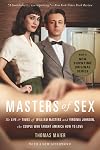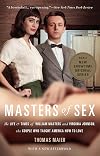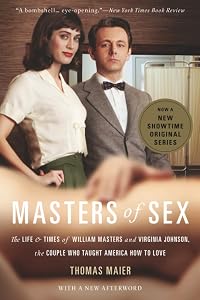
Masters of Sex: The Life and Times of William Masters and Virginia Johnson, the Couple Who Taught America How to Love
by Thomas Maier
On This Page
Description
This critically acclaimed biography offers an unprecedented look at William Masters and Virginia Johnson, their pioneering studies on intimacy, and their lasting impact on the love lives of today's men and women..
Tags
Recommendations


























Member Reviews
Aside from my difficulty finding the book at B&N and having to ask a teenaged boy clerk for "Masters of Sex," this was a really smooth read. I grew up in St. Louis and, until reading this book, had no idea Masters & Johnson were as influential as Thomas Maier illustrates. Back in the 70's, all I knew about sex was what I learned from game shows--my carnal knowledge was filtered through Gene Rayburn and Paul Lynde. Scary thought. I wish I'd known then such history was being made just down the road from my house. I REALLY wish I'd have known Barbara Eden was five minutes away getting treatment for sexual dysfunction in her own marriage, while I sat at home watching "I Dream of Jeannie" reruns on KPLR-TV...Talk about opportunity lost. show more Amazingly, Washington University, where this duo did most of their groundbreaking sex research, is so blinded by its efforts to be thought of as proper Ivy League-calliber, it fails to offer any recognition whatsoever to Bill Masters and Virginia Johnson. Today I went in search of Masters & Johnson's St. Louis and found very little left: Their famous private sex cliic on Forest Park Avenue has been razed and is now part of the Siteman Cancer Center. They do have a star on the St. Louis Walk of Fame, not far from Phyllis Diller and Yogi Berra, for whatever that's worth. These days the author says, Virginia Johnson is intensely private, seemingly bitter and a recluse, of sorts, in a St. Louis nursing home. She has changed her name and apparently wants nothing to do with her past life as a world renowned sex researcher. I'd love to find her and visit often. After all, anyone who has witnessed 10,000 orgasms HAS to have some interesting stories to share. "Now tell me Virginia....tell me about #9,347. What was that one like?" show less
Sometimes in life, two people will find each other and together make history. While each one may be remarkable on their own, together they are extraordinary. Bill Masters and Virginia Johnson were two such people. When they got together, they did more than improve themselves and each other - they gave something to the rest of us too. When I first saw this book, I was surprised at myself for not having heard of them before. These two did more for sex research than anyone up to that time. They not only researched it, they practically invented it and paved the way for the future.
Bill Masters was a world-renown fertility doctor when he enlisted Virginia Johnson to assist him with his longtime dream - to research sexuality. She began as a show more secretary but quickly became his research partner. As one can imagine, this was an uneasy transition for someone who didn't even have a bachelor's degree, but her own confidence and her confidence in Masters helped her succeed. Eventually, their work proved their worth to the medical community. Of course, it helped that they began on the verge of the sexual revolution in a society increasingly open to matters of sexuality. He gave her the credentials, and she gave him the human touch and feminine perspective.
As people, these two were not always understood. They were walking contradictions. Amazingly, after years of working together and allegedly having intercourse, Bill Masters left his wife and married Virginia Johnson. This was probably the downfall of their relationship. In addition, they failed to see how they fit into the future of sex research and lost countless opportunities to play a larger role in the professionalization of the field. While those they worked with were sage advisors, they neglected to see the big picture.
As a testament to the personality of Masters, he basically woke up one day and wanted a divorce. As it turns out, he was reunited with a sweetheart from his youth and, he claims, his one true love. Despite her surprise, Johnson was not one to dwell. In fact, she had been considering divorcing Bill for some time. I think what stung her most was that he beat her to the punch.
Despite all of this, they continued to work together. However, Bill's failing health made this more and more difficult, and without Bill, Virginia lost her clout. The Masters and Johnson brand was amazing while it lasted. Some were appalled and decried that some of their research was unethical. In the long run, though, they were able to vastly augment the knowledge of sexual intimacy regardless of their methods. It's just a shame that they were unable to do the same for emotional intimacy.
Maier is a superb biographer. He tells a human story rather than a story about humans. This was a pleasure to read - insightful, well-researched, approachable, and gripping. show less
Bill Masters was a world-renown fertility doctor when he enlisted Virginia Johnson to assist him with his longtime dream - to research sexuality. She began as a show more secretary but quickly became his research partner. As one can imagine, this was an uneasy transition for someone who didn't even have a bachelor's degree, but her own confidence and her confidence in Masters helped her succeed. Eventually, their work proved their worth to the medical community. Of course, it helped that they began on the verge of the sexual revolution in a society increasingly open to matters of sexuality. He gave her the credentials, and she gave him the human touch and feminine perspective.
As people, these two were not always understood. They were walking contradictions. Amazingly, after years of working together and allegedly having intercourse, Bill Masters left his wife and married Virginia Johnson. This was probably the downfall of their relationship. In addition, they failed to see how they fit into the future of sex research and lost countless opportunities to play a larger role in the professionalization of the field. While those they worked with were sage advisors, they neglected to see the big picture.
As a testament to the personality of Masters, he basically woke up one day and wanted a divorce. As it turns out, he was reunited with a sweetheart from his youth and, he claims, his one true love. Despite her surprise, Johnson was not one to dwell. In fact, she had been considering divorcing Bill for some time. I think what stung her most was that he beat her to the punch.
Despite all of this, they continued to work together. However, Bill's failing health made this more and more difficult, and without Bill, Virginia lost her clout. The Masters and Johnson brand was amazing while it lasted. Some were appalled and decried that some of their research was unethical. In the long run, though, they were able to vastly augment the knowledge of sexual intimacy regardless of their methods. It's just a shame that they were unable to do the same for emotional intimacy.
Maier is a superb biographer. He tells a human story rather than a story about humans. This was a pleasure to read - insightful, well-researched, approachable, and gripping. show less
This is one case in which the TV series must be an improvement on the book, at least if you are interested in the couple's scientific advancements and how Masters & Johnson reached them. Maier isn't a science writer. Well, perhaps you say: the achievements are so well known and this is “the life and times” after all. I’d disagree with the first part: what may have been widely known about them in 1970 isn’t true now.
Furthermore, there’s not too much to say about the couple. Maier pretty quickly brings them to St. Louis and the start of the clinic. Masters was a cold, philandering fish emotionally but he did give enormous public credit to the un-degreed Johnson. In fact, that’s probably why he insisted that their occasional show more extra-marital affair (on his part) be turned into marriage to secure her cooperation in their partnership.
Yet while we are told again and again (and again) that Johnson’s warmth and insights were invaluable to the research, I’ll be damned if he gave any specifics. Perhaps because he is loath to get into the nitty gritty of the scientific process. If Maier were really a journalist, wouldn’t he be asking/looking for, “Is there an example of that?” (Either from Johnson herself , interviews with associates or case studies mentioned in the books; very late in the game, we learn Johnson destroyed all the films and tapes of actual patients).
For example, so Masters started by filming solo masturbators, Virginia joined the clinic and they worked up to couples (not sure about homosexual ones). Despite the 10,000s of couplings filmed … we never learn if the couples were given advice or suggestions. Were they told to perform certain acts, do more foreplay, etc? How was research advanced? What were Virginia’s contributions?
Given the seminal first book only mentioned “fellatio” once, I’m kind of doubtful about cunnilingus. With those masks on, there was no kissing? How were contraception and STDs handled? The major revelation of that first book appears to have been the physiological mechanics of orgasms.
Then we move onto the next book dealing with couples with intimacy problems and the M & J treatment with gradual “sensate touching.” Now, this is the standard treatment today (perhaps modified? How?), so very significant. But how did they get here from the initial research, films, etc. ? Nothing! Then, with fame, people with all sorts of problems, including fetishes, start coming to the clinic. Including a man who preferred sex with his dog to his wife. OK: so how were fetishes and bestiality treated? Nothing! (Not to mention the scant attention to ethical issues). Now we know that fetishes are primarily a male thing and apparently impossible to eradicate. Maybe M & J are the ones that discovered this, but you’ll never find out from this book.
I have blathered in considerable detail in my notes re the lack of follow-up re licensing of therapists, fetishes, surrogates, federal funding and Master's possible fabrication of homosexual interviews and data but ...
All in all, a disappointing and frustrating read. And the selected references are so skimpy and overloaded with contemporary journalism that you shouldn't look to them to answer any of the glaring questions this book doesn't even scratch. show less
Furthermore, there’s not too much to say about the couple. Maier pretty quickly brings them to St. Louis and the start of the clinic. Masters was a cold, philandering fish emotionally but he did give enormous public credit to the un-degreed Johnson. In fact, that’s probably why he insisted that their occasional show more extra-marital affair (on his part) be turned into marriage to secure her cooperation in their partnership.
Yet while we are told again and again (and again) that Johnson’s warmth and insights were invaluable to the research, I’ll be damned if he gave any specifics. Perhaps because he is loath to get into the nitty gritty of the scientific process. If Maier were really a journalist, wouldn’t he be asking/looking for, “Is there an example of that?” (Either from Johnson herself , interviews with associates or case studies mentioned in the books; very late in the game, we learn Johnson destroyed all the films and tapes of actual patients).
For example, so Masters started by filming solo masturbators, Virginia joined the clinic and they worked up to couples (not sure about homosexual ones). Despite the 10,000s of couplings filmed … we never learn if the couples were given advice or suggestions. Were they told to perform certain acts, do more foreplay, etc? How was research advanced? What were Virginia’s contributions?
Given the seminal first book only mentioned “fellatio” once, I’m kind of doubtful about cunnilingus. With those masks on, there was no kissing? How were contraception and STDs handled? The major revelation of that first book appears to have been the physiological mechanics of orgasms.
Then we move onto the next book dealing with couples with intimacy problems and the M & J treatment with gradual “sensate touching.” Now, this is the standard treatment today (perhaps modified? How?), so very significant. But how did they get here from the initial research, films, etc. ? Nothing! Then, with fame, people with all sorts of problems, including fetishes, start coming to the clinic. Including a man who preferred sex with his dog to his wife. OK: so how were fetishes and bestiality treated? Nothing! (Not to mention the scant attention to ethical issues). Now we know that fetishes are primarily a male thing and apparently impossible to eradicate. Maybe M & J are the ones that discovered this, but you’ll never find out from this book.
I have blathered in considerable detail in my notes re the lack of follow-up re licensing of therapists, fetishes, surrogates, federal funding and Master's possible fabrication of homosexual interviews and data but ...
All in all, a disappointing and frustrating read. And the selected references are so skimpy and overloaded with contemporary journalism that you shouldn't look to them to answer any of the glaring questions this book doesn't even scratch. show less
I got this because I have so enjoyed Masters of Sex on Showtime. I also have worked for many years in HIV and STD prevention in public health, so Masters and Johnson's work is in my wheelhouse as well as a clear popular influence during my adolescence and young adult years. (I was a graduate student when Masters and Johnson published Crisis.)
I have to say that I rate this around a 3.5. I gave it 4 because it is well written and engaging, but for content it deserves something closer to a 3.
I am struck my the disparities in the biographies of Johnson and Masters. The first sexual experiences of Masters are not detailed, nor is the emphasis quite as resolutely focused on relationships for Masters as for Johnson. Some of this may be show more because the author was able to interview Johnson and worked only posthumously with materials left by Masters. I was struck by how little rounded the portrait of Johnson was (especially in the early days) aside from her relationships with men.
I didn't think that Maier did much to put Johnson, specifically, into context as a female clinician (already marginalized in her time), in a marginalized field. My mother, a married sociology graduate student around the same time, was forbidden to teach when she was pregnant as this was considered inappropriate for university students to see. Female students and clinicians were not common, were often not well supported and not provided with the mentorship and opportunities afforded to their male counterparts; and husband and wife teams were not uncommon in academia in that time where men had the credentials and women put in enormous amounts of labor without the credentials or credibility of their husbands. Theirs is an amazing story of the rise of famous and influential clinicians, but not an uncommon scientific partnership for the era.
I was also disturbed by Maier's apology for Crisis, which in fact did not prove out its main arguments. The driving force in HIV in the US and in most developed countries has not been a general heterosexual epidemic, and the "support" that Maier provides for this out of context and inaccurate. We do not need to further misunderstandings about HIV transmissions. Indeed, Maier appears to limit himself to popular accounts and sources and does little to put the biography into a scientific or clinical context. In some ways this is understandable because Masters and Johnson had enormous popular influence, and in other ways, it provides a shallow look into their work.
Still, in spite of all the complaining above, I found Masters of Sex to be well written and engaging. The conflicts between celebrity, fame, nepotism, science and good clinical work were clearly drawn, as well as a lack of "business" vision that doomed Masters and Johnson's clinic to ultimate failure. The relationship between Masters and Johnson was fascinating; regardless of how much love and affection there was between them, it was a true symbiotic partnership that transcended their marriage. show less
I have to say that I rate this around a 3.5. I gave it 4 because it is well written and engaging, but for content it deserves something closer to a 3.
I am struck my the disparities in the biographies of Johnson and Masters. The first sexual experiences of Masters are not detailed, nor is the emphasis quite as resolutely focused on relationships for Masters as for Johnson. Some of this may be show more because the author was able to interview Johnson and worked only posthumously with materials left by Masters. I was struck by how little rounded the portrait of Johnson was (especially in the early days) aside from her relationships with men.
I didn't think that Maier did much to put Johnson, specifically, into context as a female clinician (already marginalized in her time), in a marginalized field. My mother, a married sociology graduate student around the same time, was forbidden to teach when she was pregnant as this was considered inappropriate for university students to see. Female students and clinicians were not common, were often not well supported and not provided with the mentorship and opportunities afforded to their male counterparts; and husband and wife teams were not uncommon in academia in that time where men had the credentials and women put in enormous amounts of labor without the credentials or credibility of their husbands. Theirs is an amazing story of the rise of famous and influential clinicians, but not an uncommon scientific partnership for the era.
I was also disturbed by Maier's apology for Crisis, which in fact did not prove out its main arguments. The driving force in HIV in the US and in most developed countries has not been a general heterosexual epidemic, and the "support" that Maier provides for this out of context and inaccurate. We do not need to further misunderstandings about HIV transmissions. Indeed, Maier appears to limit himself to popular accounts and sources and does little to put the biography into a scientific or clinical context. In some ways this is understandable because Masters and Johnson had enormous popular influence, and in other ways, it provides a shallow look into their work.
Still, in spite of all the complaining above, I found Masters of Sex to be well written and engaging. The conflicts between celebrity, fame, nepotism, science and good clinical work were clearly drawn, as well as a lack of "business" vision that doomed Masters and Johnson's clinic to ultimate failure. The relationship between Masters and Johnson was fascinating; regardless of how much love and affection there was between them, it was a true symbiotic partnership that transcended their marriage. show less
A really interesting picture of women's changing roles in science and America in the later half of the 20th century. The book is definitely more sympathetic toward Ginny.
Masters of Sex: The Life and Times of William Masters and Virginia Johnson, the Couple Who Taught America How to Love by Thomas Maier was a compelling read. Masters and Johnson made several contributions to the study of human sexology but they also concluded some things that were not accurate. The box is compelling. One feels bad often for Ginny Johnson and Dr. Masters comes off as more of a tyrant, work alcoholic and not so successful in matters of love and sex.
I've enjoyed the tv show much more back in 2020. While I really liked the first few and the last few chapters, the middle felt too long. Nevertheless, I did learn some things that were not in the show (mostly because the show's plotline endedin the early 1970s).
I think this is the first biography that I've listened to as an audio book.
I think this is the first biography that I've listened to as an audio book.
Members
- Recently Added By
Published Reviews
ThingScore 100
Maier offers an intimate, engaging look at a couple who helped free lovers from repression, suppression and Freudian myth and helped bring what was most human about us into the light.
added by Shortride
Author Information

14+ Works 691 Members
Thomas Maier is an award-winning author, journalist, and television producer. His book Masters of Sex was the basis for the Emmy-winning Showtime drama that ran for four seasons. His other books include When Lions Roar: The Churchills and the Kennedys; The Kennedys: America's Emerald Kings; Dr. Spock: An American Life (named a "Notable Book of the show more Year" by the New York Times); and All That Glitters: Anna Wintour, Tina Brown, and the Rivalry Inside America's Richest Media Empire. He has worked as an investigative reporter for Newsday for over thirty years. show less
Common Knowledge
- Original publication date
- 2009
- People/Characters
- William Masters; Virginia Johnson
- Related movies
- Masters of Sex (2013 | IMDb)
Classifications
- Genres
- Nonfiction, Biography & Memoir, General Nonfiction, History, Science & Nature
- DDC/MDS
- 306.7092 — Society, government, & culture Social sciences, sociology & anthropology Social Behavior - Dating, Marriage, Divorce Sexual relations Biography And History Biography
- LCC
- HQ18.3 .M35 — Social sciences The family. Marriage, Women and Sexuality The Family. Marriage. Women Sexual life
- BISAC
Statistics
- Members
- 251
- Popularity
- 129,363
- Reviews
- 9
- Rating
- (3.46)
- Languages
- 5 — English, Italian, Polish, Portuguese, Spanish
- Media
- Paper, Audiobook, Ebook
- ISBNs
- 15
- ASINs
- 9