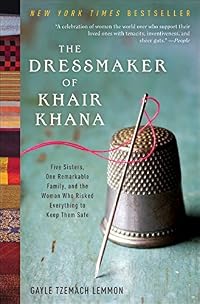
The Dressmaker of Khair Khana
by Gayle Tzemach Lemmon
On This Page
Description
The incredible true account of Kamila Sidiqi who, when her father and brother were forced to flee Kabul, became the sole breadwinner for her five siblings. Armed only with grit and determination, she picked up a needle and thread and created a thriving business of her own and held her family together.Tags
Recommendations















Member Reviews
When the father and older brother must leave Kabul to avoid punishment/conscription by the Taliban, the oldest sister living at home must figure out how to make money to feed her siblings. She starts a business that ultimately employs quite a few women, who desperately need jobs to survive, right under the noses of Taliban soldiers. What is life like for women in Afghanistan under the Taliban? This book, while amazingly inspiring, tears your heart out learning what their lives were like. Doubly so knowing that the Taliban is cracking down as hard now as it did then, after so much hope. I believe this is an important read to show how brutally women are treated by the Taliban, but also how women can be so brilliant and such creative show more thinkers to save their communities. Also, if you need pointers on how to start a business, this is entrepreneurship 101! An excellent book. show less
I have an education. I have a career. I have a varied wardrobe. I drive my own car. I live in my own home. I leave my home when I wish and return when I wish. My daughter enjoys the same freedom and my sons support and encourage their partners to do so as well. Why? We have the good fortune to live in Canada where these freedoms are taken for granted!
In 'The Dressmaker of Khair Khana' we meet a young woman and her family who did not have freedom in Afghanistan during the occupation of the Taliban. Kamila Sidiqui uses her intellect, her education and her chutzpah to start a dressmaking business under severely restrictive conditions that provided not just for her own family, but for many women in the city of Kabul.
It is powerful to read show more of women who did not just 'accept their fate' but worked against all odds to determine their own future. show less
In 'The Dressmaker of Khair Khana' we meet a young woman and her family who did not have freedom in Afghanistan during the occupation of the Taliban. Kamila Sidiqui uses her intellect, her education and her chutzpah to start a dressmaking business under severely restrictive conditions that provided not just for her own family, but for many women in the city of Kabul.
It is powerful to read show more of women who did not just 'accept their fate' but worked against all odds to determine their own future. show less
Kamila Sediqi grew up in a happy family of 11 children in Kabul, Afghanistan. She and her 8 sisters were fortunate in that their father believed in education for all of his children, something not always accepted for girls, and Kamila was enjoying her studies. In 1996 all of that would change as the Taliban took control of Kabul and Kamila's life would never be the same again. The Sediqi parents fled to the north country to avoid questionable loyalties to the Taliban; the elder Sediqi son emigrated to Pakistan. The Sediqi sisters, and one younger brother, were left behind to survive as best they could under an oppresive and frightening government. Knowing that they would need to find a way to earn money in secret since women were not show more allowed to work, Kamila decided that she and her sisters would become tailors and supply local businesses with hand sewn garments. Only the older sister knew how to sew but all of the girls learned quickly and soon they had so many orders that they invited other women into their home to help with the sewing and earn money for their own families. Ever the entrepreneur, Kamila decided that she could open a school for local women to teach them how to sew and bead. Despite many a harrowing close call with the Taliban forces, Kamila and her sisters thrived with their home business. In 2001 when the Taliban was overthrown and the war began, the Sediqi family was reunited and Kamila began to work with outreach programs to help other women open their own small businesses.
Kamila Sediqi is quite an inspiring woman and I cannot imagine the depth of her courage during such an oppresive time. She knew that she would have to keep her family together and provide food and shelter for all of them. How frightening it must have been to venture out on the streets of Kabul, always with her brother as women were not allowed outside without a chaperone, knowing she could be stopped at any time and questioned. When I read stories such as Kamila's I can't help but be extremely thankful that I live in a free country. show less
Kamila Sediqi is quite an inspiring woman and I cannot imagine the depth of her courage during such an oppresive time. She knew that she would have to keep her family together and provide food and shelter for all of them. How frightening it must have been to venture out on the streets of Kabul, always with her brother as women were not allowed outside without a chaperone, knowing she could be stopped at any time and questioned. When I read stories such as Kamila's I can't help but be extremely thankful that I live in a free country. show less
A vacuous book about a very important topic- even more so today with Afghanistan back in Taliban hands - how Afghan women can survive in the face of theocratic misogyny. This book is flat, odd chronologically, and so banal about the Taliban and the reasons for its pariah status. I wanted to like it but even the central “success” in the book is that time the women made dresses for imperious, demanding customers who turned out to be Taliban. How exciting to break your back and pull an all nighter to make good cold cash from your oppressors and their wedding ! This doesn’t strike me as neat or uplifting - rather, as a nightmare fusion of capitalism, theocracy, and bootlicking. And I’m not even getting into the usual Abrahamic show more religious platitudes. I’d skip this one. Library had the ebook and Scribd had the audio as of this date. Two stars. show less
This review first appeared on my blog: http://www.knittingandsundries.com/2012/03/dressmaker-of-khair-khana-by-gayle.ht...
When you think of Afghanistan under Taliban rule, what do you think of? Reading this book may well change your thinking, especially about the women there, who, literally overnight, were forced to live under extremely oppressive conditions.
Kamila Sidiq is the second-oldest daughter of a family of 11 siblings. Her mother and, most especially, her father, strongly believe in education for ALL of their children. As the Taliban move closer to the city of Kabul, Kamila completes her teacher training, but ends up using it in a fashion that she never envisioned - teaching other young neighborhood women in her suburb of Khair show more Khana to sew in order to make enough money to feed their families.
In these pages, we are taken through the five years of Taliban rule in Afghanistan, where the takeover was so sudden that women and girls in a modern culture where women went to work and school in Western wear, were, in one day, thrust into a world where they could not go outside without a chadri, or burqa, a head-to-toe covering with only a small mesh opening for the eyes.
Women and girls were no longer allowed to go to school or work. Medical doctors were no longer allowed to work with male patients or even talk to their male counterparts. Hospitals became segregated, and women and girls were not allowed to talk to any male outside of their own family members.
As Kamila's father, followed by her mother, leave for the northern provinces for safety (Kamila's father had worked for Massoud, the leader ousted by the Taliban), and her brother Najeeb also leaves to try to find work, Kamila, a teenager herself, becomes the head of a household where funds are running dry.
Rather than giving up and giving in, which would certainly have meant even more deprivation for her family in a city where electricity itself is spotty at best, Kamila finds a way to earn a living selling the clothing made by the light of hurricane lamps. In doing so, she opens the way for her sisters and for other women and girls in the neighborhood to help their families as well.
This inspiring story of a woman's will to DO something, when even a trip out of the house without a male relative could mean questioning, beating, detainment, or even death, is one that will fan a flame of hope inside everyone who reads it.
Written by Gayle Lemmon, a reporter who visited Afghanistan over a period of years beginning in 2005, this true story is uplifting and illuminating. As the reader lives and works beside Kamila through these pages, there are moments when you will hold your breath at the dangers faced by her and her family in their attempt to simply make a living. As Kabul and its outskirts are bombed after the events of 9/11, the dangers are different, but still very real.
In short, this is a remarkable story; one that will have the reader thinking of it long after the pages are closed.
QUOTES
Kabulis watched helplessly as the Taliban began reshaping the cosmopolitan capital according to their utopian vision of seventh-century Islam. Almost immediately they instituted a brutal - and effective - system of law and order. Accused thieves had one hand and one foot cut off, and their severed limbs were hung from posts on street corners as a warning to others. Overnight, crime in the monumentally lawless city dropped to almost zero. Then they banned everything they regarded as a distraction from the duty of worship: music, long a part of Afghan culture, and movies, television, card playing, the game of chess, and even kite flying, the popular Friday afternoon pastime. And they didn't stop at actions alone: Creating a representation of the human figure was soon forbidden, as was wearing European clothing or haircuts.
Brave young women complete heroic acts every day,with no one bearing witness. This was a chance to even the ledger, to share one small story that made the difference between starvation and survival for the families whose lives it changed. I wanted to pull the curtain back for readers on a place foreigners know more for its rocket attacks and roadside bombs than its countless quiet feats of courage. And to introduce them to the young women like Kamila Sidiqi who will go on. No matter what.
BOOK RATING: 4.5 out of 5 stars show less
When you think of Afghanistan under Taliban rule, what do you think of? Reading this book may well change your thinking, especially about the women there, who, literally overnight, were forced to live under extremely oppressive conditions.
Kamila Sidiq is the second-oldest daughter of a family of 11 siblings. Her mother and, most especially, her father, strongly believe in education for ALL of their children. As the Taliban move closer to the city of Kabul, Kamila completes her teacher training, but ends up using it in a fashion that she never envisioned - teaching other young neighborhood women in her suburb of Khair show more Khana to sew in order to make enough money to feed their families.
In these pages, we are taken through the five years of Taliban rule in Afghanistan, where the takeover was so sudden that women and girls in a modern culture where women went to work and school in Western wear, were, in one day, thrust into a world where they could not go outside without a chadri, or burqa, a head-to-toe covering with only a small mesh opening for the eyes.
Women and girls were no longer allowed to go to school or work. Medical doctors were no longer allowed to work with male patients or even talk to their male counterparts. Hospitals became segregated, and women and girls were not allowed to talk to any male outside of their own family members.
As Kamila's father, followed by her mother, leave for the northern provinces for safety (Kamila's father had worked for Massoud, the leader ousted by the Taliban), and her brother Najeeb also leaves to try to find work, Kamila, a teenager herself, becomes the head of a household where funds are running dry.
Rather than giving up and giving in, which would certainly have meant even more deprivation for her family in a city where electricity itself is spotty at best, Kamila finds a way to earn a living selling the clothing made by the light of hurricane lamps. In doing so, she opens the way for her sisters and for other women and girls in the neighborhood to help their families as well.
This inspiring story of a woman's will to DO something, when even a trip out of the house without a male relative could mean questioning, beating, detainment, or even death, is one that will fan a flame of hope inside everyone who reads it.
Written by Gayle Lemmon, a reporter who visited Afghanistan over a period of years beginning in 2005, this true story is uplifting and illuminating. As the reader lives and works beside Kamila through these pages, there are moments when you will hold your breath at the dangers faced by her and her family in their attempt to simply make a living. As Kabul and its outskirts are bombed after the events of 9/11, the dangers are different, but still very real.
In short, this is a remarkable story; one that will have the reader thinking of it long after the pages are closed.
QUOTES
Kabulis watched helplessly as the Taliban began reshaping the cosmopolitan capital according to their utopian vision of seventh-century Islam. Almost immediately they instituted a brutal - and effective - system of law and order. Accused thieves had one hand and one foot cut off, and their severed limbs were hung from posts on street corners as a warning to others. Overnight, crime in the monumentally lawless city dropped to almost zero. Then they banned everything they regarded as a distraction from the duty of worship: music, long a part of Afghan culture, and movies, television, card playing, the game of chess, and even kite flying, the popular Friday afternoon pastime. And they didn't stop at actions alone: Creating a representation of the human figure was soon forbidden, as was wearing European clothing or haircuts.
Brave young women complete heroic acts every day,with no one bearing witness. This was a chance to even the ledger, to share one small story that made the difference between starvation and survival for the families whose lives it changed. I wanted to pull the curtain back for readers on a place foreigners know more for its rocket attacks and roadside bombs than its countless quiet feats of courage. And to introduce them to the young women like Kamila Sidiqi who will go on. No matter what.
BOOK RATING: 4.5 out of 5 stars show less
For all of you who, like me, tend to avoid non-fiction thinking it dry and sleep inducing, I say: READ 'The Dressmaker of Khair Khana'!! You will have to remind yourself that what you are reading really happened; these amazing women really exist; there is an Afghanistan that we don't see on the news. The front cover reads: 'Five sisters, one remarkable family and the woman who risked everything to keep them safe'. I do take issue with that statement. Kamila wasn't the only one to risk everything, she just led the way. And she didn't just keep her family safe - she kept them safe and fed and did the same for so many other women and their families as well. My eyes have been opened. In every war-torn, poverty-ridden, calamity-hit country show more in this world, there are women working behind the scenes, without recognition, to pull their families and friends through.
As an equal opportunity blog, I have to also touch upon the men in the lives of these women. They deserve their space as well. The thing that amazed me most about this story was not the tenacity of the women in saving their families, women do that every day, although usually under more favorable circumstances. What really struck me was the support these women received from the men around them - even, eventually, from the Taliban itself.
The only 'culture shock' I suffered was in considering the actions of Kamila's parents. I felt myself wanting to judge their actions during this unreal time. It took some work to convince me that, as much as I can read and understand the words, I have no real understanding of life in Afghanistan during Taliban rule. These people understood the system and what they needed to do to survive. The parents survived, the brothers survived, the sisters, against all odds, not only survived, they thrived. And the story of how they did it makes for one of the most inspirational, feel good books I have read in a long time. show less
As an equal opportunity blog, I have to also touch upon the men in the lives of these women. They deserve their space as well. The thing that amazed me most about this story was not the tenacity of the women in saving their families, women do that every day, although usually under more favorable circumstances. What really struck me was the support these women received from the men around them - even, eventually, from the Taliban itself.
The only 'culture shock' I suffered was in considering the actions of Kamila's parents. I felt myself wanting to judge their actions during this unreal time. It took some work to convince me that, as much as I can read and understand the words, I have no real understanding of life in Afghanistan during Taliban rule. These people understood the system and what they needed to do to survive. The parents survived, the brothers survived, the sisters, against all odds, not only survived, they thrived. And the story of how they did it makes for one of the most inspirational, feel good books I have read in a long time. show less
This is a great nonfiction book about a family in Afghanistan trying to survive the Taliban rules. Women are given no privileges at all, forced to stay home, not educated or allowed to do business. Kamila risked everything by sewing dresses and eventually runs a sewing school out of her home for other repressed women. Her family survives and her community thrives because of her diligence and bright, hardworking mind and attitude.
Members
- Recently Added By
Author Information

8+ Works 1,640 Members
Gayle Tzemach Lemmon is a journalist and the author of The Dressmaker of Khair Khana, a New York Times bestseller published in March 2011. She is also a Senior Fellow at the Council on Foreign Relations and a contributor to the Atlantic's Defense One site covering foreign policy and national security matters. Lemmon graduated with a BA in show more Journalism summa cum laude from the University of Missouri. From 1997 to 2004, she worked in the ABC News Political Unit, where she served as producer in the first year of "This Week with George Stephanopoulos." She graduated with an MBA from Harvard Business School (HBS), where she received the 2006 Dean¿s Award for her work on women¿s entrepreneurship. (Bowker Author Biography) show less
All Editions
Some Editions
Awards and Honors
Distinctions
Notable Lists
Common Knowledge
- Canonical title
- The Dressmaker of Khair Khana
- Alternate titles
- The Dressmaker of Khair Khana: Five Sisters, One Remarkable Family, and the Woman Who Risked Everything to Keep Them Safe
- Original publication date
- 2011
- People/Characters
- Kamila Sidiqi
- Important places
- Kabul, Afghanistan; Afghanistan
- Dedication
- To all those women whose stories will never be told, and to Rhoda Tzemach and Frances Spielman
- First words
- I touched down in Afghanistan for the first time on a raw winter morning in 2005 after two days of travel that took me from Boston to Dubai via London. (Introduction)
Kamila Jan, I'm honored to present you with your certificate.
On November 13, 2001, the Taliban abandoned Kabul. (Epilogue) - Last words
- (Click to show. Warning: May contain spoilers.)For now, she thought, it would have to be enough.
- Blurbers
- Jolie, Angelina; Brown, Tina; El-Erian, Mohamed A.; Mortenson, Greg
Classifications
- Genres
- Nonfiction, Biography & Memoir, General Nonfiction, History
- DDC/MDS
- 958.1 — History & geography History of Asia Central Asia: Afghanistan, Pakistan, Uzebekistan Afghanistan
- LCC
- DS375 .K2 .T94 — History of Europe, Asia, Africa and Oceania Asia History of Asia Afghanistan Local history and description
- BISAC
Statistics
- Members
- 1,128
- Popularity
- 22,314
- Reviews
- 71
- Rating
- (3.66)
- Languages
- 8 — Chinese, English, German, Italian, Norwegian (Bokmål), Norwegian, Portuguese, Spanish
- Media
- Paper, Audiobook, Ebook
- ISBNs
- 30
- ASINs
- 9