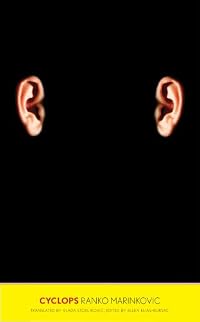
Cyclops
by Ranko Marinković
On This Page
Description
In his semiautobiographical novel, Cyclops, Croatian writer Ranko Marinkovic recounts the adventures of young theater critic Melkior Tresic, an archetypal antihero who decides to starve himself to avoid fighting in the front lines of World War II. As he wanders the streets of Zagreb in a near-hallucinatory state of paranoia and malnourishment, Melkior encounters a colorful circus of characters-fortune-tellers, shamans, actors, prostitutes, bohemians, and café intellectuals-all living in a show more fragile dream of a society about to be changed forever. A seminal work of postwar Eastern European literature, Cyclops reveals a little-known perspective on World War II from within the former Yugoslavia, one that has never before been available to an English-speaking audience. Vlada Stojiljkovic's able translation, improved by Ellen Elias-Bursac's insightful editing, preserves the striking brilliance of this riotously funny and densely allusive text. Along Melkior's journey Cyclops satirizes both the delusions of the righteous military officials who feed the national bloodlust as well as the wayward intellectuals who believe themselves to be above the unpleasant realities of international conflict. Through Stojiljkovic's clear-eyed translation, Melkior's peregrinations reveal how history happens and how the individual consciousness is swept up in the tide of political events, and this is accomplished in a mode that will resonate with readers of Charles Simic, Aleksandr Hemon, and Kundera. show lessTags
Recommendations















Member Reviews
The historical tomorrow: and when men discovered the divine power of matter, it came to reign over them, confusing their minds, blighting their lives and then swallowing itself and turning into a Force which destroyed all laws and there is now not a single consciousness left that could proclaim it stupid in the name of Hegel.
Ranko Marinkovic's Cyclops is likely my favorite novel of the year. It is a Ulysses of Zagreb in 1940 with the howl of War in the air. A theatre critic fears for the future and pines for a certain beauty, he ignores her particulars and ascribes her a mythic persona. The critic worries about conscription and notes how his weight plummets. His paranoid caprice continues apace on a story about castaways imprisoned by show more cannibals.
The Joycean delight takes a number of dark turns. The narrative rests in purgatory, a Catch-22 for the Damned. It returns to Zagreb as the Wehrmacht are poised to invade Yugoslavia. What unfolds is a bizarre variation on the Ithaca episode.
The novel would've benefited from footnotes, especially towards the Serbo-Croat literary references. Despite my minor qualm, Cyclops is a staggering work show less
Ranko Marinkovic's Cyclops is likely my favorite novel of the year. It is a Ulysses of Zagreb in 1940 with the howl of War in the air. A theatre critic fears for the future and pines for a certain beauty, he ignores her particulars and ascribes her a mythic persona. The critic worries about conscription and notes how his weight plummets. His paranoid caprice continues apace on a story about castaways imprisoned by show more cannibals.
The Joycean delight takes a number of dark turns. The narrative rests in purgatory, a Catch-22 for the Damned. It returns to Zagreb as the Wehrmacht are poised to invade Yugoslavia. What unfolds is a bizarre variation on the Ithaca episode.
The novel would've benefited from footnotes, especially towards the Serbo-Croat literary references. Despite my minor qualm, Cyclops is a staggering work show less
Ratings
Members
- Recently Added By
Published Reviews
ThingScore 100
'Cyclops is a semi-autobiographical, modernist tour de force . . . . '
added by bluepiano
Lists

Global Reads: Books Set in Eastern Europe
45 works; 10 members

Hidden Classics
73 works; 15 members

Reading Globally
136 works; 16 members
Author Information

18+ Works 142 Members
Awards and Honors
Series
Belongs to Publisher Series
Common Knowledge
- Canonical title
- Cyclops
- Original title
- Kiklop
- Original publication date
- 1965
- Important places
- Zagreb, Croatia
Classifications
- Genres
- Fiction and Literature, General Fiction
- DDC/MDS
- 891.8 — Literature & rhetoric Literatures of other languages East Indo-European and Celtic literatures West and South Slavic languages (Bulgarian, Slovene, Polish, Czech, Slovak, Serbo-Croatian, and Macedonian)
- LCC
- PG1618 .M28 .K513 — Language and Literature Slavic languages and literatures. Baltic languages. Albanian language Slavic. Baltic. Albanian Serbo-Croatian
- BISAC
Statistics
- Members
- 97
- Popularity
- 334,012
- Reviews
- 1
- Rating
- (4.25)
- Languages
- 9 — Czech, English, Hungarian, Macedonian, Polish, Russian, Serbian, Croatian, Slovenian
- Media
- Paper, Ebook
- ISBNs
- 9
- ASINs
- 1