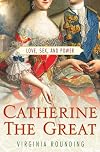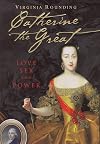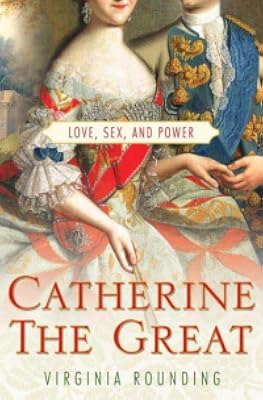
Catherine the Great: Love, Sex, and Power
by Virginia Rounding 
On This Page
Description
Dutiful daughter, frustrated wife, passionate lover, domineering mother, doting grandmother, devoted friend, tireless legislator, generous patron of artists and philosophers-the Empress Catherine II, the Great, was all these things, and more. Her reign, the longest in Russian Imperial history, lasted from 1762 until her death in 1796; during those years she built on the work begun by her most famous predecessor, Peter the Great, to establish Russia as a major European power and to transform show more its new capital, St Petersburg, into a city to rival Paris and London in the beauty of its architecture, the glittering splendor of its Court and the magnificence of its art collections. Yet the great Catherine was not even Russian by birth and had no legitimate claim to the Russian throne; she seized it and held on to it, through wars, rebellions and plagues, by the force of her personality, by her charm and determination, and by an unshakable belief in her own destiny. This is the story of Catherine the woman, whom power alone could never satisfy, for she also wanted love, affection, friendship and humor. She found these in letter-writing, in grandchildren, in gardens, architecture and greyhounds-as well as in a succession of lovers which gave rise to salacious rumors throughout Europe. The real Catherine, however, was more interesting than any rumor. Using many of Catherine's own words from her voluminous correspondence and other documents, as well as contemporary accounts by courtiers, ambassadors and foreign visitors, Virginia Rounding penetrates the character of this most powerful, fascinating and surprisingly sympathetic of eighteenth-century women. show lessTags
Recommendations


Member Recommendations
Member Reviews
Admittedly this book took me a long time to finish (this is in large part due to the fact that I'm not the speediest reader and I tend to have more than one book going at a time), but as far as nonfiction goes, this is officially a favorite. In fact, it is one of the better books I've ever read; fiction, nonfiction, or otherwise. In "Love, Sex, Power", Rounding brings to life a fantastic minx of woman that put Russia on the map as a legitimate world player. The reader is thoroughly entertained and educated. So often with biographies, the storytelling becomes dry and muddled with incoherent facts. However, with this book, Rounding cleverly weaves history, people and legend into one enthralling story. From the infamous “horse rumors” show more to “Potemkin Villages”, the life of Catherine is depicted whole-heartedly. In many ways, this biography read like a novel, and a thrilling one at that.
Rating: 5 out of 5 stars.
Suggested With: Many many midday hours during which one can get wrapped up with a bowl of soup or cup of tea. show less
Rating: 5 out of 5 stars.
Suggested With: Many many midday hours during which one can get wrapped up with a bowl of soup or cup of tea. show less
An enjoyable biography, and filled with the sort of details that made Catherine the Great, her many lovers, and many of her courtiers came alive. We are fortunate that Catherine maintained such a voluminous correspondence and did a great deal of personal writing, both of which the book liberally quoted. In addition, a large number of letters from foreign diplomats (especially the series of British ambassadors to her court) describing the details of life at court were preserved, and were also quoted from many times. The combination provided an excellent insight into how Catherine thought, the broader circumstances surrounding her activities, and how she approached what she considered her duties as Empress. For example, her letters show more describe how she decided to have herself and her children inoculated against smallpox at a time when the technique was uncommon and not without risks because she believed in taking selfless actions to improve the public health and to set a good example.
In addition, "the horse story" is a complete myth, and an autopsy showed that she actually died of a cerebral stroke
I appreciated how Rounding enhanced the readability of the book by using modern spellings, and using the name Catherine only for Catherine the Great (there were many other "Catherines" but the Russian spelling was used for clarity), and mostly omitted the patronymics (except for the royal family). Both of these made everything much easier to follow. In addition, she was careful to specify when she was using the old calendar to date events and when she was using the new calendar (Russia was still using the old calendar at that point, although most of the rest of Europe was using the new), so it was also easier to keep track of what happened when. show less
In addition, "the horse story" is
I appreciated how Rounding enhanced the readability of the book by using modern spellings, and using the name Catherine only for Catherine the Great (there were many other "Catherines" but the Russian spelling was used for clarity), and mostly omitted the patronymics (except for the royal family). Both of these made everything much easier to follow. In addition, she was careful to specify when she was using the old calendar to date events and when she was using the new calendar (Russia was still using the old calendar at that point, although most of the rest of Europe was using the new), so it was also easier to keep track of what happened when. show less
An enjoyable biography, and filled with the sort of details that made Catherine the Great, her many lovers, and many of her courtiers came alive. We are fortunate that Catherine maintained such a voluminous correspondence and did a great deal of personal writing, both of which the book liberally quoted. In addition, a large number of letters from foreign diplomats (especially the series of British ambassadors to her court) describing the details of life at court were preserved, and were also quoted from many times. The combination provided an excellent insight into how Catherine thought, the broader circumstances surrounding her activities, and how she approached what she considered her duties as Empress. For example, her letters show more describe how she decided to have herself and her children inoculated against smallpox at a time when the technique was uncommon and not without risks because she believed in taking selfless actions to improve the public health and to set a good example.
In addition, "the horse story" is a complete myth, and an autopsy showed that she actually died of a cerebral stroke
I appreciated how Rounding enhanced the readability of the book by using modern spellings, and using the name Catherine only for Catherine the Great (there were many other "Catherines" but the Russian spelling was used for clarity), and mostly omitted the patronymics (except for the royal family). Both of these made everything much easier to follow. In addition, she was careful to specify when she was using the old calendar to date events and when she was using the new calendar (Russia was still using the old calendar at that point, although most of the rest of Europe was using the new), so it was also easier to keep track of what happened when. show less
In addition, "the horse story" is
I appreciated how Rounding enhanced the readability of the book by using modern spellings, and using the name Catherine only for Catherine the Great (there were many other "Catherines" but the Russian spelling was used for clarity), and mostly omitted the patronymics (except for the royal family). Both of these made everything much easier to follow. In addition, she was careful to specify when she was using the old calendar to date events and when she was using the new calendar (Russia was still using the old calendar at that point, although most of the rest of Europe was using the new), so it was also easier to keep track of what happened when. show less
A -very- indepth look at Catherine the Great's life. It's exceedingly detailed, and yet I didn't really get tired of reading. Admittedly, it took me quite a while to get through it all, but I did. I never even thought about leaving it unfinished.
All the detail of the biography makes me inclined to believe the author about almost everything, but Virginia Rounding paints her in such a positive light that I can't help but wonder. Nevertheless, I'm pretty convinced that Catherine the Great really was great. She just...had some crazy tendencies and some crazy descendants.
All the detail of the biography makes me inclined to believe the author about almost everything, but Virginia Rounding paints her in such a positive light that I can't help but wonder. Nevertheless, I'm pretty convinced that Catherine the Great really was great. She just...had some crazy tendencies and some crazy descendants.
Catherine is a particular favorite of mine. I have great respect and admiration for her. She dragged Russia forward and forced elightenment, education, relgious reform, modern medicine and sanitation upon her subjects. Certainly it is true that she was not democratic. But that is to judge her by a standard that would have been unrecognized by anyone in her part of the world at that time. Though she was not without faults, the good she did far outweighed those shortcomings. Moreover, if Catherine had not been on the throne, what are we to suppose would have been the fate of Russia under the rule of whoever else happened to seize power? It is not as if she were the only thing standing between Russia and freedom. Quite the contrary, she show more was standing between Russia and even worse oppression.
While I am enjoying reading this book, I confess that I am also irritated by it. It is far too popular and unscholarly. There are no references and very few notes. What few notes there are, are not tied to the text so the reader is left to figure out as best he can what goes where. Far better biographies of Catherine exist. show less
While I am enjoying reading this book, I confess that I am also irritated by it. It is far too popular and unscholarly. There are no references and very few notes. What few notes there are, are not tied to the text so the reader is left to figure out as best he can what goes where. Far better biographies of Catherine exist. show less
The book is interesting - Catherine the Great was a very intriguing woman - but occasionally lapses into slow cataloging of facts. I'd only recommend it if you really want to know a lot about her, or the start of the Hermitage Museum.
So, let’s say you’re a man who is consistently suffocating under the thumb of your mother. You’re forced to live in her house, ask her permission to do anything, and at times you even have to wait on her. No one sympathizes with you because they only care about dear ol’ Mom.
You’ve long suspected that she offed Dad and she’s recently taken to sleeping with men much, much younger than you. She commandeers your children for herself and your wife must also be at her beck and call.
Then — finally — she dies. Now, everyone waits on you. You suddenly have limitless power. What do you do?
You say your mother died while doing the nasty with a horse, of course.
For rest of review: show more target="_top">http://deathbynovel.blogspot.com/2008/06/cat-great-original-cougar-originally.ht... show less
You’ve long suspected that she offed Dad and she’s recently taken to sleeping with men much, much younger than you. She commandeers your children for herself and your wife must also be at her beck and call.
Then — finally — she dies. Now, everyone waits on you. You suddenly have limitless power. What do you do?
You say your mother died while doing the nasty with a horse, of course.
For rest of review: show more target="_top">http://deathbynovel.blogspot.com/2008/06/cat-great-original-cougar-originally.ht... show less
Members
- Recently Added By
Author Information

6 Works 646 Members
Virginia Rounding lives in London where, in addition to being an author, book critic, and clerk to a City of London guild, she recently held a three-year Royal Literary Fund Fellowship at the Courtauld Institute of Art. She is the author of the critically acclaimed Catherine the Great and Grandes Horizontales.
Virginia Rounding is a LibraryThing Author, an author who lists their personal library on LibraryThing.
Common Knowledge
- Canonical title
- Catherine the Great: Love, Sex, and Power
- Original publication date
- 2006
- People/Characters
- Catherine the Great; Empress Elizabeth of Russia; Ekaterina Dashkova; Grigory Potemkin; Alexander I, Emperor of Russia; Bestuzhev, Alexi (show all 12); Khrapovitsky, Alexander; Orlov, Grigory; Panin, Nikita; Paul I, Emperor of Russia; Peter III, Emperor of Russia; Zubov, Platon
- Important places
- Tsarkoye Selo
- Epigraph
- What is certain is that I have never undertaken anything without having been intimately persuaded that what I was doing conformed to the good of my Empire. This Empire has done everything for me: - I believed that all of my ... (show all)individual faculties, constantly employed for the good of this Empire, for its prosperity for its superior interest, could hardly suffice to acquit myself towards it.
Catherine II, 16 June 1791 - Dedication
- In gratitude: MR and PER who first encouraged me to study Russian
- First words
- The woman who became Catherine II, the Great, Empress of All the Russias, was born Sophie Frederica Auguste of Anhalt-Zerbst on 21 April Old Style, 2 May New Style, 1729, in the Baltic port of Stettin in Pomerania (now Szczec... (show all)in in north-west Poland).
- Last words
- (Click to show. Warning: May contain spoilers.)Ultimately the scales come down in Catherine's favour, and posterity, while taking into account her weaknesses and failures, her prejudices and her pride, justly calls her Great.
- Original language
- English
Classifications
- Genres
- History, Nonfiction, Biography & Memoir, General Nonfiction
- DDC/MDS
- 947.063092 — History & geography History of Europe Eastern European Counties and Russia Russian & Slavic History by Period Catharine I - Catharine II 1725-96 Catherine II (the Great), 1762-1796
- LCC
- DK170 .R68 — History of Europe, Asia, Africa and Oceania Russia. Soviet Union. Former Soviet Republics – Poland History of Russia. Soviet Union. Former Soviet Republics History House of Romanov, 1613-1917
- BISAC
Statistics
- Members
- 290
- Popularity
- 110,628
- Reviews
- 7
- Rating
- (3.58)
- Languages
- English
- Media
- Paper, Ebook
- ISBNs
- 5
- ASINs
- 4