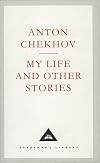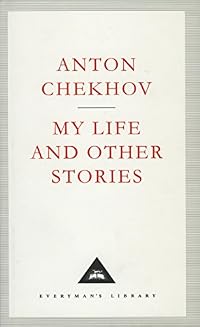
My Life and Other Stories
by Anton Chekhov
On This Page
Description
Among the great nineteenth-century Russian writers, Chekhov was the one least interested in the political issues of his time, but it is fair to claim, nonetheless, that of them all he was, in his own extraordinary way, the most radical. His miraculous stories not only changed the face of the short story form, but have provided for the innumerable readers who have cherished his work an access to the quiet dramas of the soul, and a degree of human fellow-feeling never before offered by literature.Tags
Recommendations








Member Reviews
A little weaker than "volume 1", with no stories that truly stand out, and some which go on a bit too long. On the other hand, there are thoughts and themes which Chekhov expresses which are truly striking in both how profound and modern they are.
Quotes:
On meaninglessness, from "Ward No. 6":
“Life is a vexatious trap; when a thinking man reaches maturity and attains to full consciousness he cannot help feeling that he is in a trap from which there is no escape. Indeed, he is summoned without his choice by fortuitous circumstances from non-existence into life…what for? He tries to find out the meaning and object of his existence; he is told nothing, or he is told absurdities; he knocks and it is not opened to him; death comes to him show more – also without his choice. And so, just as in prison men held together by common misfortune feel more at ease when they are together, so one does not notice the trap in life when people with a bent for analysis and generalization meet together and pass their time in the interchange of proud and free ideas. In that sense the intellect is the source of an enjoyment nothing can replace.”
Also:
"Oh, why is not man immortal? he thought. What is the good of the brain centers and convolutions, what is the good of sight, speech, self-consciousness, genius, if it is all destined to depart into the soil, and in the end to grow cold together with the earth’s crusts, and then for millions of years to fly with the earth round the sun with no meaning and no object? To do that there was no need at all to draw man with his lofty, almost godlike intellect, out of non-existence, and then, as though in mockery, to turn him into clay."
And:
"To stifle petty thoughts he made haste to reflect that he himself, and Hobotov, and Mihail Averyanitch would all sooner or later perish without leaving any trace on the world. If one imagined some spirit flying by the earthly globe in space in a million years he would see nothing but clay and bare rocks. Everything – culture and the moral law – would pass away and not even a burdock would grow out of them. Of what consequence was shame in the presence of a shopkeeper, of what consequence was the insignificant Hobotov or the wearisome friendship of Mihail Averyanitch? It was all trivial and nonsensical."
On memories, from "An Artist's Story"
"I am beginning to forget the old house, and only sometimes when I am painting or reading I suddenly, apropos of nothing, remember the green light in the window, the sound of my footsteps as I walked home through the fields in the night, with my heart full of love, rubbing my hands in the cold. And still more rarely, at moments when I am sad and depressed by loneliness, I have dim memories, and little by little I begin to feel that she is thinking of me, too – that she is waiting for me, and that we shall meet…
Misuce, where are you?"
On natural selection in man, from "The Duel":
“Human culture weakens and strives to nullify the struggle for existence and natural selection; hence the rapid achievement of the weak and their predominance over the strong. Imagine that you succeeded in instilling into bees humanitarian ideas in their crude and elementary form. What would come of it? The drones who ought to be killed would remain alive, would devour the honey, would corrupt and stifle the bees, resulting in a predominance of the weak over the strong and the degeneration of the latter. The same process is taking place now with humanity; the weak are oppressing the strong.”
On old age, from "A Dreary Story":
"I gaze at my wife and wonder like a child. I ask myself in perplexity, is it possible that this old, very stout, ungainly woman, with her dull expression of petty anxiety and alarm about daily bread, with eyes dimmed by continual brooding over debts and money difficulties, who can talk of nothing but expenses and who smiles at nothing but things getting cheaper – is it possible that this woman is no other than the slender Varya whom I fell in love with so passionately for her fine, clear intelligence, for her pure soul, her beauty, and, as Othello his Desdemona, for her ‘sympathy’ for my studies? Could that woman be no other than the Varya who had once borne me a son?"
On religion, from "The Duel":
"…Of all humane learning the most durable and living is, of course, the teaching of Christ; but look how differently even that is interpreted! Some teach that we must love all our neighbors but make an exception of soldiers, criminals, and lunatics. They allow the first to be killed in war, the second to be isolated or executed, and the third they forbid to marry. Other interpreters teach that we must love all our neighbors without exceptions…For that reason you should never put a question on a philosophical or so-called Christian basis; by so doing you only remove the question further from the solution."
On socialism, from "An Artist's Story":
“Take upon yourself a share of their labor. If all of us, townspeople and country people, all without exception, would agree to divide between us the labor which mankind spends on the satisfaction of their physical needs, each of us would perhaps need to work for only two or three hours a day. Imagine that we all, rich and poor, work only for three hours a day, and the rest of our time is free."
And this, from "My Life":
"We talked, and when we got upon manual labor I expressed this idea: that what is wanted is that the strong should not enslave the weak, that the minority should not be a parasite on the majority, nor a vampire forever sucking its vital sap; that is, all, without exception, strong and weak, rich and poor, should take part equally in the struggle for existence, each one on his own account, and that there was no better means for equalizing things in that way than manual labor, in the form of universal service, compulsory for all."
On suicide, from "Ward No. 6":
"…why hinder people dying if death is the normal and legitimate end of everyone? What is gained if some shopkeeper or clerk lives an extra five or ten years? If the aim of medicine is by drugs to alleviate suffering, the question forces itself on one: why alleviate it?"
On the younger generation, from "A Dreary Story":
"‘Yes; they have degenerated horribly,’ Katya agrees. ‘Tell me, have you had one man of distinction among them for the last five or ten years?’ …
It offends me that these charges are wholesale, and rest on such worn-out commonplaces, on such worldly vapourings as degeneration and absence of ideals, or on references to the splendours of the past. … I am an old man, I have been lecturing for thirty years, but I notice neither degeneration nor lack of ideals, and I don’t find that the present is worse than the past."
Also this, from "The Duel":
"The cause for his extreme dissoluteness and unseemliness lies, do you see, not in himself, but somewhere outside in space. And so – an ingenious idea – it is not only he who is dissolute, false, and disgusting, but we…”we men of the eighties”, “we the spiritless, nervous offspring of the serf-owning class”; “civilization has crippled us”…" show less
Quotes:
On meaninglessness, from "Ward No. 6":
“Life is a vexatious trap; when a thinking man reaches maturity and attains to full consciousness he cannot help feeling that he is in a trap from which there is no escape. Indeed, he is summoned without his choice by fortuitous circumstances from non-existence into life…what for? He tries to find out the meaning and object of his existence; he is told nothing, or he is told absurdities; he knocks and it is not opened to him; death comes to him show more – also without his choice. And so, just as in prison men held together by common misfortune feel more at ease when they are together, so one does not notice the trap in life when people with a bent for analysis and generalization meet together and pass their time in the interchange of proud and free ideas. In that sense the intellect is the source of an enjoyment nothing can replace.”
Also:
"Oh, why is not man immortal? he thought. What is the good of the brain centers and convolutions, what is the good of sight, speech, self-consciousness, genius, if it is all destined to depart into the soil, and in the end to grow cold together with the earth’s crusts, and then for millions of years to fly with the earth round the sun with no meaning and no object? To do that there was no need at all to draw man with his lofty, almost godlike intellect, out of non-existence, and then, as though in mockery, to turn him into clay."
And:
"To stifle petty thoughts he made haste to reflect that he himself, and Hobotov, and Mihail Averyanitch would all sooner or later perish without leaving any trace on the world. If one imagined some spirit flying by the earthly globe in space in a million years he would see nothing but clay and bare rocks. Everything – culture and the moral law – would pass away and not even a burdock would grow out of them. Of what consequence was shame in the presence of a shopkeeper, of what consequence was the insignificant Hobotov or the wearisome friendship of Mihail Averyanitch? It was all trivial and nonsensical."
On memories, from "An Artist's Story"
"I am beginning to forget the old house, and only sometimes when I am painting or reading I suddenly, apropos of nothing, remember the green light in the window, the sound of my footsteps as I walked home through the fields in the night, with my heart full of love, rubbing my hands in the cold. And still more rarely, at moments when I am sad and depressed by loneliness, I have dim memories, and little by little I begin to feel that she is thinking of me, too – that she is waiting for me, and that we shall meet…
Misuce, where are you?"
On natural selection in man, from "The Duel":
“Human culture weakens and strives to nullify the struggle for existence and natural selection; hence the rapid achievement of the weak and their predominance over the strong. Imagine that you succeeded in instilling into bees humanitarian ideas in their crude and elementary form. What would come of it? The drones who ought to be killed would remain alive, would devour the honey, would corrupt and stifle the bees, resulting in a predominance of the weak over the strong and the degeneration of the latter. The same process is taking place now with humanity; the weak are oppressing the strong.”
On old age, from "A Dreary Story":
"I gaze at my wife and wonder like a child. I ask myself in perplexity, is it possible that this old, very stout, ungainly woman, with her dull expression of petty anxiety and alarm about daily bread, with eyes dimmed by continual brooding over debts and money difficulties, who can talk of nothing but expenses and who smiles at nothing but things getting cheaper – is it possible that this woman is no other than the slender Varya whom I fell in love with so passionately for her fine, clear intelligence, for her pure soul, her beauty, and, as Othello his Desdemona, for her ‘sympathy’ for my studies? Could that woman be no other than the Varya who had once borne me a son?"
On religion, from "The Duel":
"…Of all humane learning the most durable and living is, of course, the teaching of Christ; but look how differently even that is interpreted! Some teach that we must love all our neighbors but make an exception of soldiers, criminals, and lunatics. They allow the first to be killed in war, the second to be isolated or executed, and the third they forbid to marry. Other interpreters teach that we must love all our neighbors without exceptions…For that reason you should never put a question on a philosophical or so-called Christian basis; by so doing you only remove the question further from the solution."
On socialism, from "An Artist's Story":
“Take upon yourself a share of their labor. If all of us, townspeople and country people, all without exception, would agree to divide between us the labor which mankind spends on the satisfaction of their physical needs, each of us would perhaps need to work for only two or three hours a day. Imagine that we all, rich and poor, work only for three hours a day, and the rest of our time is free."
And this, from "My Life":
"We talked, and when we got upon manual labor I expressed this idea: that what is wanted is that the strong should not enslave the weak, that the minority should not be a parasite on the majority, nor a vampire forever sucking its vital sap; that is, all, without exception, strong and weak, rich and poor, should take part equally in the struggle for existence, each one on his own account, and that there was no better means for equalizing things in that way than manual labor, in the form of universal service, compulsory for all."
On suicide, from "Ward No. 6":
"…why hinder people dying if death is the normal and legitimate end of everyone? What is gained if some shopkeeper or clerk lives an extra five or ten years? If the aim of medicine is by drugs to alleviate suffering, the question forces itself on one: why alleviate it?"
On the younger generation, from "A Dreary Story":
"‘Yes; they have degenerated horribly,’ Katya agrees. ‘Tell me, have you had one man of distinction among them for the last five or ten years?’ …
It offends me that these charges are wholesale, and rest on such worn-out commonplaces, on such worldly vapourings as degeneration and absence of ideals, or on references to the splendours of the past. … I am an old man, I have been lecturing for thirty years, but I notice neither degeneration nor lack of ideals, and I don’t find that the present is worse than the past."
Also this, from "The Duel":
"The cause for his extreme dissoluteness and unseemliness lies, do you see, not in himself, but somewhere outside in space. And so – an ingenious idea – it is not only he who is dissolute, false, and disgusting, but we…”we men of the eighties”, “we the spiritless, nervous offspring of the serf-owning class”; “civilization has crippled us”…" show less
Ratings
Members
- Recently Added By
Author Information

2,638+ Works 44,748 Members
Anton Pavlovich Chekhov was born in the provincial town of Taganrog, Ukraine, in 1860. In the mid-1880s, Chekhov became a physician, and shortly thereafter he began to write short stories. Chekhov started writing plays a few years later, mainly short comic sketches he called vaudvilles. The first collection of his humorous writings, Motley show more Stories, appeared in 1886, and his first play, Ivanov, was produced in Moscow the next year. In 1896, the Alexandrinsky Theater in St. Petersburg performed his first full- length drama, The Seagull. Some of Chekhov's most successful plays include The Cherry Orchard, Uncle Vanya, and Three Sisters. Chekhov brought believable but complex personalizations to his characters, while exploring the conflict between the landed gentry and the oppressed peasant classes. Chekhov voiced a need for serious, even revolutionary, action, and the social stresses he described prefigured the Communist Revolution in Russia by twenty years. He is considered one of Russia's greatest playwrights. Chekhov contracted tuberculosis in 1884, and was certain he would die an early death. In 1901, he married Olga Knipper, an actress who had played leading roles in several of his plays. Chekhov died in 1904, spending his final years in Yalta. (Bowker Author Biography) show less
Series
Belongs to Publisher Series
Common Knowledge
- Canonical title
- My Life and Other Stories
Classifications
- Genres
- Fiction and Literature, General Fiction
- DDC/MDS
- 891.733 — Literature & rhetoric Asian Literature East Indo-European and Celtic literatures Russian and East Slavic languages Russian fiction 1800–1917
- LCC
- PG3456 .A15 .G37 — Language and Literature Slavic languages and literatures. Baltic languages. Albanian language Slavic. Baltic. Albanian Russian literature Individual authors and works 1870-1917 Chekhov
- BISAC
Statistics
- Members
- 108
- Popularity
- 299,385
- Reviews
- 1
- Rating
- (4.29)
- Languages
- English, Italian, Russian
- Media
- Paper
- ISBNs
- 6
- ASINs
- 1