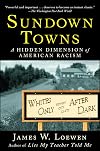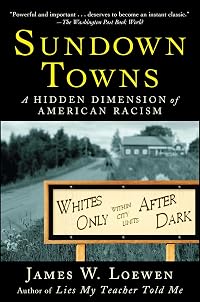
Sundown Towns: A Hidden Dimension of American Racism
by James W. Loewen
On This Page
Description
The award-winning look at an ugly aspect of American racism by the bestselling author of Lies My Teacher Told Me, reissued with a new preface by the author In this groundbreaking work, sociologist James W. Loewen, author of the classic bestseller Lies My Teacher Told Me, brings to light decades of hidden racial exclusion in America. In a provocative, sweeping analysis of American residential patterns, Loewen uncovers the thousands of "sundown towns"-almost exclusively white towns where it show more was an unspoken rule that blacks weren't welcome-that cropped up throughout the twentieth century, most of them located outside of the South. Written with Loewen's trademark honesty and thoroughness, Sundown Towns won the Gustavus Myers Outstanding Book Award, received starred reviews in Publishers Weekly and Booklist, and launched a nationwide online effort to track down and catalog sundown towns across America. In a new preface, Loewen puts this history in the context of current controversies around white supremacy and the Black Lives Matter movement. He revisits sundown towns and finds the number way down, but with notable exceptions in exclusive all-white suburbs such as Kenilworth, Illinois, which as of 2010 had not a single black household. And, although many former sundown towns are now integrated, they often face "second-generation sundown town issues," such as in Ferguson, Missouri, a former sundown town that is now majority black, but with a majority-white police force. show lessTags
Recommendations












Member Reviews
Scholarly works can be difficult to write in a way that appeals to non-academic readers. This one does a good job of engaging and enraging those who are unaware that locales that banned Black people ("Don't let the sun go down on you in this town") were mostly Midwestern rather than Southern. The good professor starts by going back to the brief progressive period (1865 - 1889), when the Confederacy was reviled and Black people served in legislatures, and the beginning of "The Nadir" and "The Great Retreat" (1890 - 1940), when Black people were forced from integrated small towns into large cities and into non-citizenship. It's a fraught and dangerous period, filled with white riots, murders, lynchings, and burning of homes. It's also show more when the worship of the Confederacy, "the glorious cause", revived and remains a major dividing line, through Nixon's "Southern Strategy" and Trump's blatant support of white supremacy.
Quotes: "After 1890, most whites no longer viewed slavery and racism as the problem. Now Black people themselves were seen as the problem, by white northerners as well as southerners."
"Black people increasingly lived in separate neighborhoods, and whites no longer had the benefit of knowing them individually, so whites fell back into stereotypical racist thinking.
"From its inception, the Federal Housing Administration (FHA) set itself up as the protector of all-white neighborhoods and as the most important single cause of residential segregation. And every town or community planned by a single developer or owner between 1890 - 1960 kept out Black people from its beginnings. "
"White racism therefore became first and foremost a rationale for African slavery. Even after it ended, slavery was responsible for the continuing stigmatization of Black Americans."
"Living in an all-white community leads many residents to defend living in an all-white community. Residents of elite sundown suburbs are free to infer that Black people are inferior, which explains their absence. Stereotypes imply that as soon as Black people "really apply themselves", our racial problems will be fixed."
"White misbehavior, not alleged Black inferiority, is the source of America's racial problem." show less
Quotes: "After 1890, most whites no longer viewed slavery and racism as the problem. Now Black people themselves were seen as the problem, by white northerners as well as southerners."
"Black people increasingly lived in separate neighborhoods, and whites no longer had the benefit of knowing them individually, so whites fell back into stereotypical racist thinking.
"From its inception, the Federal Housing Administration (FHA) set itself up as the protector of all-white neighborhoods and as the most important single cause of residential segregation. And every town or community planned by a single developer or owner between 1890 - 1960 kept out Black people from its beginnings. "
"White racism therefore became first and foremost a rationale for African slavery. Even after it ended, slavery was responsible for the continuing stigmatization of Black Americans."
"Living in an all-white community leads many residents to defend living in an all-white community. Residents of elite sundown suburbs are free to infer that Black people are inferior, which explains their absence. Stereotypes imply that as soon as Black people "really apply themselves", our racial problems will be fixed."
"White misbehavior, not alleged Black inferiority, is the source of America's racial problem." show less
This revelatory, well-documented book should be read by every White American. I always considered myself aware of racial issues, but this book made me realize that many things I'd taken for granted as "just the way things are" were the result of racism and eliminationism. I wish I could require everyone protesting the teaching of "Critical Race Theory" to read it.
It's sometimes a little dense and academic, but if you push through those sections, the narrative is vivid and horrifying. I warn you that many of the photos are very difficult to look at.
We will never begin to reconcile the racial issues in the United States until we are willing to confront the past honestly and fully.
It's sometimes a little dense and academic, but if you push through those sections, the narrative is vivid and horrifying. I warn you that many of the photos are very difficult to look at.
We will never begin to reconcile the racial issues in the United States until we are willing to confront the past honestly and fully.
James Loewen is the well-known author of Lies My Teacher Told Me which is an excellent primer on the portions of history that aren’t really covered in school. Sundown Towns is his treatment of the practice of counties, towns, and suburbs that intentionally excluded blacks and other non-whites from living within their boundaries. Such towns popularly had signs at the city limits that stated things like “No n***ers after sundown!”, hence the term.
I listened to the audio version of the book. I’ve found that in audio form, repetition in a book is really drilled into my brain. In a work of fiction, repeated story tics become extremely apparent and are distracting. In a book like Sundown Towns the sheer number of examples of sundown show more practices is a flood in my brain. I didn’t think about much else for the duration.
And Loewen’s examples in the book alone become a litany. The conception I, a suburban-educated middle-aged white guy, had was that they were ugly but not particularly common. The best examples Loewen has litter Illinois and Indiana to the point that non-exclusionary towns were in the minority in those states. In addition, descriptions of the practices themselves make me think that the North’s sundown towns were far more racist than the South’s Jim Crow laws. That’s an outside assessment by a white dude after reading this book, so I don’t think it holds a lot of weight. But I think it’s clear that us northerners can’t be smug about the South being the racist part of the country, which I often have been. show less
I listened to the audio version of the book. I’ve found that in audio form, repetition in a book is really drilled into my brain. In a work of fiction, repeated story tics become extremely apparent and are distracting. In a book like Sundown Towns the sheer number of examples of sundown show more practices is a flood in my brain. I didn’t think about much else for the duration.
And Loewen’s examples in the book alone become a litany. The conception I, a suburban-educated middle-aged white guy, had was that they were ugly but not particularly common. The best examples Loewen has litter Illinois and Indiana to the point that non-exclusionary towns were in the minority in those states. In addition, descriptions of the practices themselves make me think that the North’s sundown towns were far more racist than the South’s Jim Crow laws. That’s an outside assessment by a white dude after reading this book, so I don’t think it holds a lot of weight. But I think it’s clear that us northerners can’t be smug about the South being the racist part of the country, which I often have been. show less
This was a difficult read. I remember asking my mom when I was kid why there was this neighborhood outside of town that was only black families and she couldn't give me an answer. It was just "there." As were other neighborhoods that were a majority Latino.
Sundown Towns gives us the real history of why we still live in mostly segregated communities. If a city or neighborhood is mostly white today, it is not by accident. There is most likely a history of systematic exclusion of people of color. There were also federal
policies that prohibited blacks from benefitting from FHA loans that went to mostly white people. Even after fair housing laws went into effect local communities still rebelled and the national government refused to enforce show more their laws.
After the civil war, free blacks settled in communities all across the country. But by the 1890s a change occurs and population records show a sudden decline of African Americans in the North. What happened? Where did they go? Loewen traces this tragic pattern that repeats in our history to the present day.
Every white person needs to read this book. We need to understand the reality of systematic oppression our country has placed on African American citizens. We need to come to grips with the fact that we largely remain ignorant and that our ancestors for the most part just let it happen. The evidence is overwhelming. And now we see the repercussions but are reluctant to take responsibility first in our own hearts. That's where it is going to need to start.
After finishing this book I did a little research on my home town and surrounding cities. It was shocking to read that my little town in California did indeed have policies in place before the 1960s to excluded African Americans from buying property. As late as the 1990s the city tried to use eminent domain to raze another traditionally black neighborhood to expand a shopping mall. Palm
Springs, our more famous neighboring city actually used eminent domain to raze a whole section of town that was home to African Americans and forced them to move to another part of town many people lost the personal possessions and were never compensated. This happened in the early 1960s to make way for the Palm Springs convention center. Indian Wells, also near my home town of Indio, is one of the wealthiest communities in the country that also excluded blacks and to this day is still predominantly white. Knowing this is it a surprise that Serena Williams faced racist jeers at the Indian Wells tennis tournament In 2001?
At the end of the book Loewen gives some suggestions for moving forward. I'm thankful for his research and bringing this painful subject into the light so we can be more understanding and move in the direction of real change. show less
Sundown Towns gives us the real history of why we still live in mostly segregated communities. If a city or neighborhood is mostly white today, it is not by accident. There is most likely a history of systematic exclusion of people of color. There were also federal
policies that prohibited blacks from benefitting from FHA loans that went to mostly white people. Even after fair housing laws went into effect local communities still rebelled and the national government refused to enforce show more their laws.
After the civil war, free blacks settled in communities all across the country. But by the 1890s a change occurs and population records show a sudden decline of African Americans in the North. What happened? Where did they go? Loewen traces this tragic pattern that repeats in our history to the present day.
Every white person needs to read this book. We need to understand the reality of systematic oppression our country has placed on African American citizens. We need to come to grips with the fact that we largely remain ignorant and that our ancestors for the most part just let it happen. The evidence is overwhelming. And now we see the repercussions but are reluctant to take responsibility first in our own hearts. That's where it is going to need to start.
After finishing this book I did a little research on my home town and surrounding cities. It was shocking to read that my little town in California did indeed have policies in place before the 1960s to excluded African Americans from buying property. As late as the 1990s the city tried to use eminent domain to raze another traditionally black neighborhood to expand a shopping mall. Palm
Springs, our more famous neighboring city actually used eminent domain to raze a whole section of town that was home to African Americans and forced them to move to another part of town many people lost the personal possessions and were never compensated. This happened in the early 1960s to make way for the Palm Springs convention center. Indian Wells, also near my home town of Indio, is one of the wealthiest communities in the country that also excluded blacks and to this day is still predominantly white. Knowing this is it a surprise that Serena Williams faced racist jeers at the Indian Wells tennis tournament In 2001?
At the end of the book Loewen gives some suggestions for moving forward. I'm thankful for his research and bringing this painful subject into the light so we can be more understanding and move in the direction of real change. show less
Loewen defines a sundown town as "any organized jurisdiction that for decades kept African Americans or other groups from living in it and thus 'all-white' on purpose." Since the Civil War, blacks have been herded into cities, while many surrounding suburbs posted the sign "N*, don't let the sun set on you here." Using census data, local archives, and interviews, the author found thousands of such towns, but no literature on the phenomenon. Yet, he charges, "outside the traditional South...probably a majority of all incorporated places kept out African Americans." He details many reported instances in which violence was used to enforce the residential (and indeed, just physical) segregration. Loewen maintains that residential show more segregation is an important reason for the continuation of racism. He claims that all-white communities not only facilitate the conception of nonwhites as "the other" but also allow stereotypes to be unchallenged by experience. Moreover, the effect is cyclical as life chances in all-white neighborhoods tend to be more favorable than those in all-black neighborhoods. This is not just historic behavior; Loewen's horrifying progression of violence continues throughout the years up until as recently as the date of his manuscript in 2004. The book's detailed census data makes for slow-going at times, and the book is depressing at all times - yet contains information important for everyone to know, especially those who think vicious racism is confined to the south. (JAF) show less
This book is a fairly large and educational work on the widespread nature of "sundown towns" as recently as 1970 with many still in existence today. Basically a sundown town (or neighborhood, suburb, county, state) is a place that excludes black people from being able to live there usually by posting signs that say "Nigger Don't Let the Sun Go Down on You in ___." Blacks may be allowed to shop there or drive through during the day, but if they were found within city limits after dark, the results have often been fatal. This book also serves to eliminate the myth that the South is the main antagonist towards blacks, because the vast majority of sundown towns were actually in the North and West. This book was written primarily because show more it's a part of history that most Americans know nothing about...it's something that towns have tried to keep secret and are perhaps ashamed of today. However, it's an important topic to research because the persistence of many of these sundown areas help to explain why many blacks still do not live in certain parts of the country while pretty much every other minority group is fairly evenly spread out. Since blacks were often kept out of suburbs, this added an even bigger element of racism because they were then denied access to better schools.
I liked this book because I'm already interested in this subject. It reads like an interesting textbook, but parts can be fairly statistics-heavy or just show example after example of instances...which I think is important to emphasize what a big problem this has been in our country, but doesn't always make for the smoothest read. show less
I liked this book because I'm already interested in this subject. It reads like an interesting textbook, but parts can be fairly statistics-heavy or just show example after example of instances...which I think is important to emphasize what a big problem this has been in our country, but doesn't always make for the smoothest read. show less
Context - I'm white, and I grew up in a small town in the North.
Well, I for one am not surprised to learn how many sundown towns there were, and that many still exist. I do believe it gets easier, every year, for activists to get government policies updated, racist cops reprimanded, etc. - but I also believe we've got a ways to go.
I live in a poor neighborhood in a small city. We are integrated to the overall level that northern Nevada is, I'm pretty sure. Many of our cops and teachers are non-white. Of course, our principle minority is Hispanic, mostly of first or second generation - does that make a difference? Otoh, it is interesting to note that the 'best' elementary school district is more white - how much of that is de facto, how show more much de jure, and how hard is it for non-white families to move in & feel comfortable there?
And then there's the big cities. I admit I have never lived in or very near one. My ex-husband lived in an integrated neighborhood in Minneapolis, but it was not one of the 'nicest' neighborhoods. Did African-Americans try to move out of it, and if they did, could they succeed? When I visited Atlanta (two decades ago), why was I the only white person on the subway? I was never made to feel the least bit uncomfortable - did I make the regular users feel uncomfortable? When I visited Washington D.C. a few years after that, the subways seemed integrated - blacks & whites in suits, blacks & whites in sloppy casual. Is that a good sign?
This book seems like it would be a very good reference for anyone who is still noticing government sanctioned, remediable issues. I admit that I only scanned it. As I said in my first comments, I do not need the whole book to tell me that a problem does exist. so I skipped to the last chapter, the one that discusses remediation. I don't feel I read enough to rate it.
I would be delighted to ship this book, free, to any interested US reader. show less
Well, I for one am not surprised to learn how many sundown towns there were, and that many still exist. I do believe it gets easier, every year, for activists to get government policies updated, racist cops reprimanded, etc. - but I also believe we've got a ways to go.
I live in a poor neighborhood in a small city. We are integrated to the overall level that northern Nevada is, I'm pretty sure. Many of our cops and teachers are non-white. Of course, our principle minority is Hispanic, mostly of first or second generation - does that make a difference? Otoh, it is interesting to note that the 'best' elementary school district is more white - how much of that is de facto, how show more much de jure, and how hard is it for non-white families to move in & feel comfortable there?
And then there's the big cities. I admit I have never lived in or very near one. My ex-husband lived in an integrated neighborhood in Minneapolis, but it was not one of the 'nicest' neighborhoods. Did African-Americans try to move out of it, and if they did, could they succeed? When I visited Atlanta (two decades ago), why was I the only white person on the subway? I was never made to feel the least bit uncomfortable - did I make the regular users feel uncomfortable? When I visited Washington D.C. a few years after that, the subways seemed integrated - blacks & whites in suits, blacks & whites in sloppy casual. Is that a good sign?
This book seems like it would be a very good reference for anyone who is still noticing government sanctioned, remediable issues. I admit that I only scanned it. As I said in my first comments, I do not need the whole book to tell me that a problem does exist. so I skipped to the last chapter, the one that discusses remediation. I don't feel I read enough to rate it.
I would be delighted to ship this book, free, to any interested US reader. show less
Members
- Recently Added By
Lists

Charleston Syllabus (waitingtoderail)
143 works; 2 members

Works Cited in The History of White People by Nell Irvin Painter
321 works; 2 members
Author Information

18+ Works 11,293 Members
Social scientist and professor James Loewen is an outspoken critic of "feel-good" history. In his book "Lies My Teacher Told Me: Everything Your American Textbook Got Wrong" (1996) he debunks the myths and exposes the omissions he feels are taught in the nation's high schools. Disturbed by his college students' lack of knowledge of history and show more concerned about minority misconceptions, Loewen spent two years at the Smithsonian analyzing 12 leading history texts and 11 years writing this best-selling indictment of history teaching. Loewen believes that controversy has been removed from classrooms in favor of blind patriotism. "Any history book that celebrates, rather than examines, our heritage has the by-product, intended or not, of alienating all those in the 'out group', those who have not become affluent, and denies them a tool for understanding their own group's lack of success." Loewen's other books include ""Mississippi: Conflict and Change" (1974, rev. 1980), a revisionist history of the state written with a coalition of students and faculty at Tougaloo College, Mississippi; "Mississippi Chinese: Between Black and White" (1971), a study of this minority's role in society; "Social Science in the Courtroom" (1983), based on the author's experiences as an expert witness in civil rights cases and "The Truth About Columbus: A Subversively True Poster Book For A Dubiously Celebratory Occasion" (1992). In addition, the author is a frequent contributor to professional publications, sometimes under the pseudonym James Lyons. James W. Loewen was born February 6, 1942 in Decatur, Illinois and was educated at Carleton College (B.A., 1964) and Harvard University (M.A, 1967; Ph.D., 1968). He was a sociologist and teacher specializing in race relations at Tougaloo College, Mississippi from 1968 to 1974. (Bowker Author Biography) show less
Awards and Honors
Distinctions
Work Relationships
Inspired
Common Knowledge
- Canonical title
- Sundown Towns: A Hidden Dimension of American Racism
- Original publication date
- 2005; 2018 (revised edition) (revised edition)
- Important places
- USA; Gardnerville, Nevada, USA; Oblong, Illinois, USA; Wyandotte, Michigan, USA; Ste. Genevieve, Missouri, USA; Joplin, Missouri, USA (show all 8); Cicero, Illinois, USA; Pekin, Illinois, USA
- Important events
- Great Migration
- Quotations
- After 1890, most whites no longer viewed slavery and racism as the problem. Now Black people themselves were seen as the problem, by white northerners as well as southerners.
Black people increasingly lived in separate neighborhoods, and whites no longer had the benefit of knowing them individually, so whites fell back into stereotypical racist thinking.
From its inception, the Federal Housing Administration (FHA) set itself up as the protector of all-white neighborhoods and as the most important single cause of residential segregation. And every town or community planned by ... (show all)a single developer or owner between 1890–1960 kept out Black people from its beginnings.
White racism therefore became first and foremost a rationale for African slavery. Even after it ended, slavery was responsible for the continuing stigmatization of Black Americans.
Living in an all-white community leads many residents to defend living in an all-white community. Residents of elite sundown suburbs are free to infer that Black people are inferior, which explains their absence. Stereotypes ... (show all)imply that as soon as Black people "really apply themselves", our racial problems will be fixed.
White misbehavior, not alleged Black inferiority, is the source of America's racial problem. - Blurbers
- Wise, Tom
Classifications
Statistics
- Members
- 628
- Popularity
- 46,409
- Reviews
- 8
- Rating
- (4.20)
- Languages
- English
- Media
- Paper, Audiobook, Ebook
- ISBNs
- 10
- ASINs
- 7