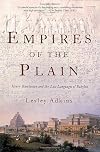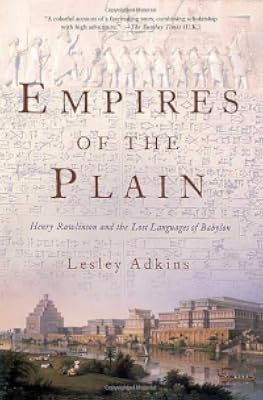
Empires of the Plain: Henry Rawlinson and the Lost Languages of Babylon
by Lesley Adkins
On This Page
Description
This is the true adventure story of Henry Rawlinson, a fearless soldier, sportsman and explorer. From 1827 he spent 25 years in India, Iran, Iraq and Afghanistan. A brilliant linguist, fascinated by history, he became obsessed with cuneiform, the world's earliest writing. An immense inscription on a sheer rock face at Bisitun in Iran was the key to understanding the many cuneiform scripts and languages, and only Rawlinson had the skills to achieve the perilous ascent and copy the monument. show more the lost languages of Persia and Babylonia, overcoming his bitter rival, Edward Hincks. While Rawlinson was based at Baghdad, incredible palaces with whole libraries of cuneiform clay tablets were unearthed in the ancient mounds of Mesopotamia, from Nineveh to Babylon- the great flood plain of the Tigris and the Euphrates rivers that had been fought over by so many powerful empires. His decipherment of the inscriptions resurrected these lost civilisations, revealing fascinating details of everyday life and forgotten historical events. By proving to the astonished Victorian public that people and places in the Old Testament really existed, Rawlinson assured his own place in history. show lessTags
Recommendations






Member Reviews
A difficult book to read in its entirety. The opening chapter with Rawlinson precariously balanced on a ladder spanning a narrow path hundreds of feet up the cliff face was magnificent atmosphere. The following chapters were detailed reports of all the minutiae of young Henry's life and his unpleasant sea voyage to India. I abandoned the story at that point and cannot in all fairness assess the rest of the book, since I skimmed and read only the parts that captured the same sense of audacious adventure as the beginning. Such an intrepid historian and explorer deserved a better biography, though readers with a strong interest in cuneiform discoveries and translation will be pleased.
The story of Henry Rawlinson who pioneered the translation of cuneiform, a man of many talents, all crucial: physical endurance, agility, great intelligence and ability to focus. Posted to India at first and finding himself with time on his hands he learned Persian and then was sent to what is now Iraq as a result. There he became fascinated by cuneiform even to clambering around on cliffsides to copy the figures. Twenty years with no return to England he was outstanding as an administrator, admired by all he encountered, and achieved amazing progress in his goals. While there were others on the same path none of them had his combined talents and he must get special credit for putting his outstanding qualities to good use.
Overall as a show more story, Adkins had no choice but to put in much detail about the pickier aspects of translating, but she does an admirable job at not going in too deep and staying focused on the main elements of Rawlinson's character and story. I spent a good deal of time reading about some of the places mentioned, looking for images and so on, always a good sign with me that I am engaged. Be aware though that this is not an 'exciting' read unless you are obsessed with cuneiform! ***1/2 show less
Overall as a show more story, Adkins had no choice but to put in much detail about the pickier aspects of translating, but she does an admirable job at not going in too deep and staying focused on the main elements of Rawlinson's character and story. I spent a good deal of time reading about some of the places mentioned, looking for images and so on, always a good sign with me that I am engaged. Be aware though that this is not an 'exciting' read unless you are obsessed with cuneiform! ***1/2 show less
Ratings
Members
- Recently Added By
Author Information

20+ Works 3,089 Members
Lesley Adkins holds a degree in archaeology, ancient history, and Latin and an M.Phil for research in ancient settlement patterns Roy A. Adkins holds a degree in archaeology
Common Knowledge
- Original publication date
- 2003
- People/Characters
- Henry Creswicke Rawlinson; Ahuramazda - God; Akbar Khan; Prince Albert Victor, Duke of Clarence; Alexander the Great; Ashur, son of Nimrod (show all 41); Ashurbanipal, King of Assyria, son of Esarhaddon "Osnappar"; Ashurnasirpal II; Assyrian King List; George Eden, 1st Earl of Auckland; Benjamin Austen; Bahram Mirza; Bakir Khan; Thomas Bell; Samuel Birch; Paul Emile Botta; E. A. Wallis Budge; Sir Alexander Burnes; Cambyses II, King of Persia; Eugène Burnouf; Cambyses II; Stratford Canning, 1st Viscount Stratford de Redcliffe; Jean-François Champollion; William Desborough Cooley; Frederick Charles Cooper; Pascal Coste; Sir Willoughby Cotton; Cyrus the Great; Darius the Great; Dost Mohammad Khan, Emir of Afghanistan; Abraham-Hyacinthe Anquetil Duperron; Edward Law, Lord Ellenborough; William George Keith Elphinstone; General Richard England; Fath Ali Shah; Fatima al-Ma’suma; Eugène Flandin; Fulgence Fresnel; King Gilgamesh; William Ewart Gladstone; Georg Friedrich Grotefend
- Important places
- Ahmedabad, Gujarat, India; Akkad, Mesopotamia; Accad, Iraq; Agade, Iraq; Iraq; Mesopotamia (show all 60); Aleppo, Syria; Mount Ararat, Turkey; Arbela, Iraq; Arbil, Iraq; Ashur, Iraq; Qalah Shergat, Iraq; Assyria; Babylon, Iraq; Babel, Iraq; Babylonia; Baghdad, Iraq; Basra, Iraq; Bussorah, Iraq; Bavian, Iraq; Berlin, Germany; Birs Nimrud, Iraq; Borsippa, Iraq; Bishapur, Iran; Iran; Bisitun, Mesopotamia; Bisitun, Iran; Bolan Pass, Balochistan, Pakistan; Mumbai, India (as Bombay); India; Bristol, England, UK; British Museum, London, England, UK; Brookwood Cemetery, Surrey, England, UK; Bushire, Iran (a.k.a. Bushehr); Bushehr, Iran (a.k.a. Bushire); Canford, Dorset, England, UK; Ceylon (Sri Lanka); Chadlington, Oxfordshire, England, UK; Constantinople (Istanbul, Turkey); Copenhagen, Denmark; Ctesiphon, Persia (in present day Iraq); Dublin, Ireland; Dublin University, Dublin, Ireland; East India House, London, England, UK; Ecbatana, Persia (present day Iran); Hamadan, Iran; Edinburgh, Scotland, UK; Egypt; Elam; Mount Edwand; Ferozepore, Punjab, India (Firozpur); Frome, Somerset, England, UK; Ghazni, Afghanistan; Ghuznee, Afghanistan; Afghanistan; Göttingen, Lower Saxony, Germany; Great Ealing School, Ealing, London, England, UK (closed in 1908); Kolkata, India (as Calcutta); Sri Lanka; Firozpur, Punjab, India
- Important events
- Deciphering Of cuneiform; First Anglo-Afghan War
Classifications
- Genres
- Anthropology, Nonfiction, History, Biography & Memoir, General Nonfiction
- DDC/MDS
- 492.1092 — Language Other languages Afro-Asiatic languages East Semitic languages Aramaic philology
- LCC
- PJ3164 .R33 .A674 — Language and Literature Oriental languages and literatures Oriental philology and literature Assyriology. Akkadian
- BISAC
Statistics
- Members
- 191
- Popularity
- 171,345
- Reviews
- 3
- Rating
- (3.46)
- Languages
- English, Polish
- Media
- Paper, Ebook
- ISBNs
- 6
- ASINs
- 1