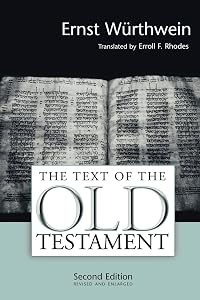
The Text of the Old Testament: An Introduction to the Biblia Hebraica
by Ernst Würthwein
On This Page
Description
Kristin De Troyer -University of St.Andrews "This finely revised and nicely updated version of one of the classics in our field can truly be called a grand introduction to the history of the biblical text." Leonard Greenspoon -Creighton University "Readers familiar with Wu?rthwein's earlier work will discover all of the strengths of his approach to Biblical Hebrew. Old and new readers will enjoy the thoroughly up-to-date discussion of the aims and methods of textual criticism as well as the show more unbiased analysis of ancient versions and their modern scholarly editions. Beautifully reproduced plates are easy to read, and the updated bibliography is satisfyingly full.... This successful project can be easily digested by newcomers and savored by specialists." Robert L. Hubbard -North Park Theological Seminary "A very welcome, thorough revision of the long-honored standard introduction to the Masoretic text. Its integration of recent scholarship is first-rate, and the rewritten text retains the clear, accessible style that won its predecessors decades of popularity as a textbook. Yet another generation of students will find in this book a friendly, reliable guide through the complex terrain of ancient Hebrew texts and their relationships. Highly commended." The Bible Today "Every scholar and serious Bible student should have a passing knowledge of the work of the text critic. This book will provide such knowledge." Books at a Glance "An important, up-to-date resource that will benefit everyone interested in Old Testament Textual criticism. The excellent bibliography, diagrams, and plates are unique contributions among introductory works in the field. Highly recommended." show lessTags
Recommendations



Member Reviews
It's a good thing Ernst Würthwein doesn't listen too closely to his own advice.
Textual criticism is the attempt to reconstruct a lost original document based on later corrupt copies. This inherently has two parts: Cataloging and assessing the surviving materials, and then reconstructing the text. Würthwein does a good job of the former, describing the Masoretic Text (the type of text to which all recent Hebrew copies belong), the Samaritan Pentateuch, the Greek Septuagint translation, and many other translations made later, either from Hebrew or from the Septuagint.
So far, so good. Then Würthwein sits down to analyze them so that he can reconstruct the text. And what he says boils down to, "The Masoretic Hebrew is the best." This is show more a widely-held position, supported by many Christians and effectively all Jewish scholars (after all, it is the Jews who, with meticulous care, copied the Masoretic text) -- but there are overwhelming reasons to think it isn't always true. In the Book of Samuel, for instance, the Masoretic text has many clear defects that can be corrected based on the Septuagint.
So it's often better to learn from Würthwein's examples than his words. The latter, while they may still defer a little too much to the Masoretic Text, show a much broader array of the tools available to the Old Testament critic. Combine this with a few other books on the field and you'll be off to a solid start in Old Testament Textual Criticism.
The book is a translation, but Erroll F. Rhodes is a good translator; the fact that the original is in German is rarely evident and should not pose any major problems. show less
Textual criticism is the attempt to reconstruct a lost original document based on later corrupt copies. This inherently has two parts: Cataloging and assessing the surviving materials, and then reconstructing the text. Würthwein does a good job of the former, describing the Masoretic Text (the type of text to which all recent Hebrew copies belong), the Samaritan Pentateuch, the Greek Septuagint translation, and many other translations made later, either from Hebrew or from the Septuagint.
So far, so good. Then Würthwein sits down to analyze them so that he can reconstruct the text. And what he says boils down to, "The Masoretic Hebrew is the best." This is show more a widely-held position, supported by many Christians and effectively all Jewish scholars (after all, it is the Jews who, with meticulous care, copied the Masoretic text) -- but there are overwhelming reasons to think it isn't always true. In the Book of Samuel, for instance, the Masoretic text has many clear defects that can be corrected based on the Septuagint.
So it's often better to learn from Würthwein's examples than his words. The latter, while they may still defer a little too much to the Masoretic Text, show a much broader array of the tools available to the Old Testament critic. Combine this with a few other books on the field and you'll be off to a solid start in Old Testament Textual Criticism.
The book is a translation, but Erroll F. Rhodes is a good translator; the fact that the original is in German is rarely evident and should not pose any major problems. show less
This book provides a good summary of information on the extant manuscripts of the Old Testament, including information about textual criticism.
Ratings
Members
- Recently Added By
Author Information
8+ Works 577 Members
Some Editions
Common Knowledge
- Original title
- Der Text des Alten Testaments
- Original publication date
- 1973; 1988 (fifth German edition) (fifth German edition); 1995 (English edition) (English edition)
- People/Characters
- Dominique Barthélemy; Moshe H. Goshen-Gottstein; Robert Hanhart; Paul Kahle; Paul Lagarde; Alfred Rahlfs (show all 8); Emanuel Tov; Joseph Ziegler
- Important places
- Qumran, West Bank
- First words
- Preface to the Fifth German Edition
This fifth edition, like earlier editions, has been thoroughly revised in the light of new critical editions of texts, as well as recent contributions and findings in the various areas o... (show all)f the history of the text (especially of the Masoretic text, the Septuagint, and the Peshitta) and of textual criticism.
Introduction
When we read a modern book, printed from a manuscript which has been prepared by the author himself and produced under his own supervision, we can study it with confidence that its text represents the author's... (show all) intention of its wording and even in the details of its punctuation. - Quotations
- V. The Septuagint (G)
I. Introduction
In accordance with the purpose of this book G is considered here as a witness to the text of the Old Testament, but its great significance for the history of Western t... (show all)hought deserves at least a brief mention. - Last words
- (Click to show. Warning: May contain spoilers.)Because this is so, the concern for the letter of the text which this book seeks to promote has genuine theological significance.
- Canonical LCC
- BS1136 .W813 1995
Classifications
Statistics
- Members
- 554
- Popularity
- 53,644
- Reviews
- 2
- Rating
- (3.90)
- Languages
- English, German
- Media
- Paper, Ebook
- ISBNs
- 9
- UPCs
- 1
- ASINs
- 8