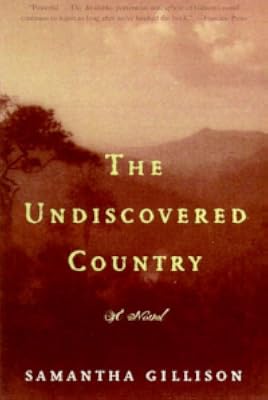
The Undiscovered Country
by Samantha Gillison
On This Page
Description
Set in the lush rain forests of Papua New Guinea, this deeply evocative first novel is both a haunting family saga and a remarkable rendering of a clash of cultures. With The Undiscovered Country, Samantha Gillison asserts herself as an exciting, emotionally fearless new voice in contemporary literature.Despite their misgivings about bringing their young daughter, Taylor, to such a remote and wild place, Peter and June Campbell feel certain that, during a year of medical research for Peter's show more doctoral thesis on Papua New Guinea, they will find new meanings for themselves and their marriage. But once settled in the village of Abini, June and Peter realize that what seemed important to them in New England -- the success of Peter's Harvard career -- seems meaningless in the jungle. Meanwhile, Taylor runs freely among the villagers and begins to speak, sing, and think in the Abini language. As time passes, Peter and June slowly discover that their daughter is becoming an utter stranger to them.Under the pressures of existence in an alien culture, the ties that bind the Campbells together begin to come undone, and the dark undercurren show lessTags
Recommendations
















Member Reviews
This was a rather odd, in many ways disappointing book. I was curious to read it to get to know about Papua New Guinea, and the parts dealing with the people and the place were interesting, but otherwise, I couldn't help but feel the book could have used a decent editing before going to print.
It wasn't spelling or formatting that was the problem, more the nature of the book that was a bit odd. It started off so impersonal, talking about "the man", "the woman" and "the girl" for several pages, it felt like a vignette of an unrelated matter to the main story rather than an introduction to the three people who really make the book. Likewise, the sudden change of tense in the last part of the book was really awkward and jarring, and didn't show more serve the novel well.
Then there was the constant brand-name-dropping. I understand the author probably wanted to nail the details well, but as an Australian, it was kind of irksome to hear the characters order "sandwiches and Schweppes" for lunch (you don't order "Schweppes"; you just order lemonade and that's pretty much what you're going to get), and no one drank coffee, or even instant coffee, it was always Nescafé. Also, the characters were perpetually eating a "Cadbury's", which is just plain weird - nobody calls a block of Cadbury's chocolate or even a bar of chocolate "Cadbury's". All this might sound like a really minor thing to complain about, but it was so rife it felt almost like product-placement.
But the story itself had its moments, and I actually rather liked the way events came to a head. Perhaps it's just a matter of preference, but there were many times I felt the story dragged and became bogged down in the characters' wallowing introspection, especially their attitudes towards one-another and such a tight focus on the family unit often felt claustrophobic or even annoying.
If it had a bit of a tidy-up stylistically and moved the plot along a bit quicker, I think there could have been a really good book here, as the author obviously has some talent and a good eye for place and detail; sadly, it felt as if it had been published too soon. show less
It wasn't spelling or formatting that was the problem, more the nature of the book that was a bit odd. It started off so impersonal, talking about "the man", "the woman" and "the girl" for several pages, it felt like a vignette of an unrelated matter to the main story rather than an introduction to the three people who really make the book. Likewise, the sudden change of tense in the last part of the book was really awkward and jarring, and didn't show more serve the novel well.
Then there was the constant brand-name-dropping. I understand the author probably wanted to nail the details well, but as an Australian, it was kind of irksome to hear the characters order "sandwiches and Schweppes" for lunch (you don't order "Schweppes"; you just order lemonade and that's pretty much what you're going to get), and no one drank coffee, or even instant coffee, it was always Nescafé. Also, the characters were perpetually eating a "Cadbury's", which is just plain weird - nobody calls a block of Cadbury's chocolate or even a bar of chocolate "Cadbury's". All this might sound like a really minor thing to complain about, but it was so rife it felt almost like product-placement.
But the story itself had its moments, and I actually rather liked the way events came to a head. Perhaps it's just a matter of preference, but there were many times I felt the story dragged and became bogged down in the characters' wallowing introspection, especially their attitudes towards one-another and such a tight focus on the family unit often felt claustrophobic or even annoying.
If it had a bit of a tidy-up stylistically and moved the plot along a bit quicker, I think there could have been a really good book here, as the author obviously has some talent and a good eye for place and detail; sadly, it felt as if it had been published too soon. show less
June and Peter Campbell have taken their young daughter Taylor and left the cultured city of Boston for the highlands of Papua New Guinea. Peter expects to spend six months to a year conducting medical research among the Abini villagers for his PhD dissertation. June finances the expedition, hoping the trip will help repair their failing marriage. Once among the villagers, they are faced with the dangers of germs and diseases. Taylor runs free, joining the villager children and quickly picks up their language. June and Peter become more estranged and eventually alienate the villagers.
Although the premise of the story is interesting, the characters are not very realistic. Their emotions tend to be flat and they are hard to relate to. The show more Abini setting is intriguing and I would have loved to have read more about their way of life. Instead they are presented in a stereotypical manner. Overall I rate this book 3 out of 5. show less
Although the premise of the story is interesting, the characters are not very realistic. Their emotions tend to be flat and they are hard to relate to. The show more Abini setting is intriguing and I would have loved to have read more about their way of life. Instead they are presented in a stereotypical manner. Overall I rate this book 3 out of 5. show less
Ratings
Members
- Recently Added By
Author Information
2 Works 110 Members
Some Editions
Awards and Honors
Series
Belongs to Publisher Series
Goldmann (44430)
Common Knowledge
- Original title
- The Undiscovered Country
- Original publication date
- 1998
- Important places*
- Papoea-Nieuw-Guinea
*Some information comes from Common Knowledge in other languages. Click "Edit" for more information.
Classifications
Statistics
- Members
- 70
- Popularity
- 449,033
- Reviews
- 2
- Rating
- (3.38)
- Languages
- English, German
- Media
- Paper
- ISBNs
- 4
- ASINs
- 1