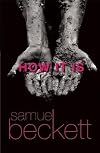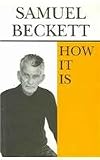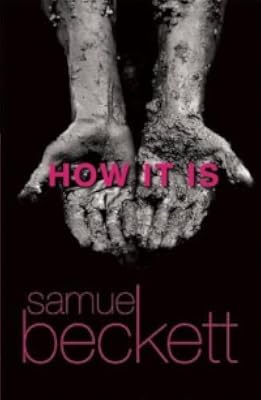
How It Is
by Samuel Beckett
On This Page
Description
This book contains the English and French texts and a complete record of the genesis of each. Besides Comment C'est How It Is, O'Reilly has included L'Image and an excerpt from Comment C'est that was published later in another volume.Tags
Recommendations














Member Reviews
*How It Is* is the book you get after someone puts down his or her copy of *The Unnameable*, glances at Beckett who is of course looming like some Irish vulture over the back of the chair and says "well, it can't get any bleaker than THAT."
To which Beckett says "hold my porter."
To which Beckett says "hold my porter."
Reading Beckett I - How It Is
"how it was I quote before Pim with Pim after Pim how it is three parts I say it as I hear it."
Having now spent three months getting through "How It Is" at the rate of only a few pages a day, on and off, a few words about my reactions to it seem justified. I selected it to read from among Beckett's works because of a growing curiosity about his writings that began with reading "Waiting for Godot" after hearing so much about that very well known play. That enticed me further to "Stories and Texts for Nothing", which led to the anecdotal remark somewhere along the way that "How It Is" was his most difficult work. Being in the mood, back around Christmas, for a challenging novel, which moreover is regarded as show more one of the outstanding works of modern English literature, I opened its covers one day at the bookstore and was immediately captured.
At first glance, it is almost impenetrable. The opening line, given above, says it all.
The style is nearly overwhelming, completely lacking in punctuation of any sort.
The plot is nearly underwhelming, coming late in Beckett's development toward minimal expression.
Characterization is almost non-existent, as a monotone narrator carries the entire story ploddingly along, almost entirely in monologue.
And setting? It takes place completely engulfed in mud. That's right, mud. Above and below and all around. In the hair and mouth and ears. As if the entire action is among voiceless remains of bodies slowly oozing around underground for eons after having died and been buried in wet holes on a rainy day in a very muddy cemetery. Bleak is the word.
But back to the opening line. The wondering reader might by now have mentally parsed that line to say
"How it was. I quote: "Before Pim, with Pim, after Pim. How it is. Three parts. I say it as I hear it."
A glance ahead reveals that the book is indeed in three parts so, emboldened by that correspondence with what one has just tentatively parsed, one is on one's way. Into a solid 147 pages of prose to be parsed and absorbed without hint, with paragraph breaks every now and then, until at the end one is rewarded with
"good good end at last of part three and last that's how it was end of quotation after Pim how it is."
So, next, what is "it"?
An extended metaphor for mankind's completely bleak endlessly meaningless existence? Perhaps, to wit:
"alone in the mud yes the dark yes sure yes panting yes someone hears me no no one hears me no no murmuring sometimes yes when the panting stops yes not at other times no in the mud yes to the mud yes my voice yes mine yes not another's no mine alone yes sure yes when the panting stops yes on and off yes a few words yes a few scraps yes that no one hears no but less and less no answer LESS AND LESS yes"
An existence described extensively earlier on as endless lonely journeys seeking, then encountering another, coupling, tormenting, being tormented, abandoning, then again seeking and repeating, through endless eons. It is all carefully constructed, "mathematically" as the narrator says, as a circle with four points marked around it, A, B, C and D for the four stages, seeking, coupling, abandoning, tormenting/tormented.
And at that moment it occurred to me that perhaps Beckett was here constructing a diabolically inverted cosmology, or at least a detailed underworld in the mud -- perhaps a black satire on the efforts of those mostly medieval theologians who created Heavens and Hells for population by the virtuous and sinners among us, and also a mocking satire of modern-day people who still find meaning in mankind's existence. That would not be entirely out of keeping, either, with the opening act in "Waiting for Godot", which to this pair of eyes, and others, clearly seems to be a metaphor of waiting for the Second Coming of a Messiah whom it will be difficult to recognize -- and might even be missed when He appears.
If any of that sounds interesting, or even intriguing, then "How It Is" might be a book for you. If it doesn't, then there are many more enjoyable books to read.
How do you feel about solving puzzles? show less
"how it was I quote before Pim with Pim after Pim how it is three parts I say it as I hear it."
Having now spent three months getting through "How It Is" at the rate of only a few pages a day, on and off, a few words about my reactions to it seem justified. I selected it to read from among Beckett's works because of a growing curiosity about his writings that began with reading "Waiting for Godot" after hearing so much about that very well known play. That enticed me further to "Stories and Texts for Nothing", which led to the anecdotal remark somewhere along the way that "How It Is" was his most difficult work. Being in the mood, back around Christmas, for a challenging novel, which moreover is regarded as show more one of the outstanding works of modern English literature, I opened its covers one day at the bookstore and was immediately captured.
At first glance, it is almost impenetrable. The opening line, given above, says it all.
The style is nearly overwhelming, completely lacking in punctuation of any sort.
The plot is nearly underwhelming, coming late in Beckett's development toward minimal expression.
Characterization is almost non-existent, as a monotone narrator carries the entire story ploddingly along, almost entirely in monologue.
And setting? It takes place completely engulfed in mud. That's right, mud. Above and below and all around. In the hair and mouth and ears. As if the entire action is among voiceless remains of bodies slowly oozing around underground for eons after having died and been buried in wet holes on a rainy day in a very muddy cemetery. Bleak is the word.
But back to the opening line. The wondering reader might by now have mentally parsed that line to say
"How it was. I quote: "Before Pim, with Pim, after Pim. How it is. Three parts. I say it as I hear it."
A glance ahead reveals that the book is indeed in three parts so, emboldened by that correspondence with what one has just tentatively parsed, one is on one's way. Into a solid 147 pages of prose to be parsed and absorbed without hint, with paragraph breaks every now and then, until at the end one is rewarded with
"good good end at last of part three and last that's how it was end of quotation after Pim how it is."
So, next, what is "it"?
An extended metaphor for mankind's completely bleak endlessly meaningless existence? Perhaps, to wit:
"alone in the mud yes the dark yes sure yes panting yes someone hears me no no one hears me no no murmuring sometimes yes when the panting stops yes not at other times no in the mud yes to the mud yes my voice yes mine yes not another's no mine alone yes sure yes when the panting stops yes on and off yes a few words yes a few scraps yes that no one hears no but less and less no answer LESS AND LESS yes"
An existence described extensively earlier on as endless lonely journeys seeking, then encountering another, coupling, tormenting, being tormented, abandoning, then again seeking and repeating, through endless eons. It is all carefully constructed, "mathematically" as the narrator says, as a circle with four points marked around it, A, B, C and D for the four stages, seeking, coupling, abandoning, tormenting/tormented.
And at that moment it occurred to me that perhaps Beckett was here constructing a diabolically inverted cosmology, or at least a detailed underworld in the mud -- perhaps a black satire on the efforts of those mostly medieval theologians who created Heavens and Hells for population by the virtuous and sinners among us, and also a mocking satire of modern-day people who still find meaning in mankind's existence. That would not be entirely out of keeping, either, with the opening act in "Waiting for Godot", which to this pair of eyes, and others, clearly seems to be a metaphor of waiting for the Second Coming of a Messiah whom it will be difficult to recognize -- and might even be missed when He appears.
If any of that sounds interesting, or even intriguing, then "How It Is" might be a book for you. If it doesn't, then there are many more enjoyable books to read.
How do you feel about solving puzzles? show less
Whither the well-wrought novel?: Beckett mastered standing on both sides of the borderline between convention and experiment. How It Is, both immediate in poignancy and resistant to a straight-forward reading, is wonderful testimony to this incredible ability. What is most wonderful about How It Is, and Beckett's late prose works in general, is how the form of the works speak just as loudly as the meanings of the words, if not louder. If anyone is heralding the death of the well-wrought novel, Beckett has demonstrated a controversal but brilliant way forward. We might baulk at its strangeness, but Beckett's is a very generous strangeness, one that requires work on the reader's part but will give the reader a unique experience of what a show more literary work can do. show less
This was a more abstract work by Beckett, at the end bordering to the extreme. There is, relatively, no plot in this novel- it is more an exercise of impending thoughts, patterns, and observations all strung together in an attempt to make a coherent whole. The effects are surprising and this is one of the reasons why Beckett was able to maintain his literary stature. It borders on the absurd, but there are still things to be gleamed here.
3 stars- worth it.
3 stars- worth it.
How It Is 2 stars for the effort to write a book that makes no sense, has no punctuation and getting people to pay for it.
Well, what can I say? This is a work of Samuel Beckett and I believe his last work before he started writing plays. I can see the results of Waiting for Godet. It is more a work of poetry, not hte rhyming kind but words, phrases, numbers all with out any punctuation. I am not sure I even saw the one apostrophe. Must have fallen asleep in the mud. There is structure; part one "before Pim", part two "with Pim" and part three, without Pim. You do try to make sense of the work, Does the mud stand for life? As with all Beckett's work, this explores the isolation of man. Man starts out alone, may find someone but that show more union might be best described as sadistic with nails in armpits and various things in the arse and thumps on the head. And there are quaqua all the way, before with and after. A quaqua according to wikipedia is a stem succulent. What I don't get is all the ravings on how wonderful this is when I looked it up on Goodreads. I just am not a lover of all thing Beckett and I think it is perfectly okay to die before you read this. show less
Well, what can I say? This is a work of Samuel Beckett and I believe his last work before he started writing plays. I can see the results of Waiting for Godet. It is more a work of poetry, not hte rhyming kind but words, phrases, numbers all with out any punctuation. I am not sure I even saw the one apostrophe. Must have fallen asleep in the mud. There is structure; part one "before Pim", part two "with Pim" and part three, without Pim. You do try to make sense of the work, Does the mud stand for life? As with all Beckett's work, this explores the isolation of man. Man starts out alone, may find someone but that show more union might be best described as sadistic with nails in armpits and various things in the arse and thumps on the head. And there are quaqua all the way, before with and after. A quaqua according to wikipedia is a stem succulent. What I don't get is all the ravings on how wonderful this is when I looked it up on Goodreads. I just am not a lover of all thing Beckett and I think it is perfectly okay to die before you read this. show less
3.6 stars
This book is unlike anything I have ever read before!
There is absolutely no punctuation. For me, this had the curious effect that the book itself seemed to be panting, or throwing words at me in short bursts. Like a desperate effort to communicate.
Surprisingly this really short book took a long while for me to get through. I think because I would read it before bed, and I was unable to concentrate. Not a book for speed reading.
This book is unlike anything I have ever read before!
There is absolutely no punctuation. For me, this had the curious effect that the book itself seemed to be panting, or throwing words at me in short bursts. Like a desperate effort to communicate.
Surprisingly this really short book took a long while for me to get through. I think because I would read it before bed, and I was unable to concentrate. Not a book for speed reading.
This book was hard to put down. Makes me think of something John Hollander said in an interview: "A poem that doesn’t get out of hand isn’t a poem." According to that statement, this book was a fine example of true poetry.
Members
- Recently Added By
Lists

1001 Books You Must Read Before You Die
1,448 works; 1,134 members

recalling favorites...
105 works; 2 members

Cooper
79 works; 1 member

Harold Bloom - The Western Canon: D. The Chaotic Age
833 works; 24 members

Books Read in 2024
4,623 works; 126 members
Talk Discussions
Past Discussions
Group Read, May 2025: How It Is in 1001 Books to read before you die (June 2025)
Author Information

529+ Works 43,110 Members
Nobel Prize winner (1969) Samuel Beckett was born on April 13, 1906 near Dublin, Ireland into a middle-class Protestant family. As a boy, he studied French and enjoyed cricket, tennis, and boxing. At Trinity College he continued his studies in French and Italian and became interested in theater and film, including American film. After graduation, show more Beckett taught English in Paris and traveled through France and Germany. While in Paris Beckett met Suzanne Deschevaus-Dusmesnil. During World War II when Paris was invaded, they joined the Resistance. They were later forced to flee Paris after being betrayed to the Gestapo, but returned in 1945. Beckett and Deschevaus-Dusmesnil married in 1961. Samuel Beckett's first novel was Dream of Fair to Middling Women. Among his many works are Murphy; Malone Dies; and The Unnameable. His plays include Endgame, Happy Days, Not I, That Time, and Krapp's Last Tape. In 1953, the production of Waiting For Godot in Paris by director and actor Roger Blin earned Beckett international fame. Beckett was awarded the Nobel Prize in Literature in 1969. His style was postmodern minimalist and some of his major themes were imprisonment in one's self, the failure of language, and moral conduct in a godless world. Despite his fame, Samuel Beckett led a secluded life. In his later years he suffered from cataracts and emphysema. His wife Suzanne died on July 17, 1989 and Beckett died on December 22nd of the same year. (Bowker Author Biography) show less
Some Editions
Awards and Honors
Series
Belongs to Publisher Series
Literair paspoort (130)
Nuovi Coralli [Einaudi] (258)
Work Relationships
Common Knowledge
- Canonical title
- How It Is
- Original title
- Comment c'est
- Alternate titles
- How it is
- Original publication date
- 1964 (English translation) (English translation); 1961
- Original language
- French
Classifications
Statistics
- Members
- 714
- Popularity
- 39,803
- Reviews
- 9
- Rating
- (3.91)
- Languages
- 12 — Danish, Dutch, English, Finnish, French, German, Greek, Italian, Norwegian (Bokmål), Portuguese, Spanish, Swedish
- Media
- Paper, Audiobook, Ebook
- ISBNs
- 24
- ASINs
- 18