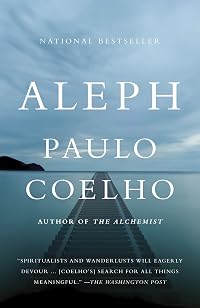
Aleph
by Paulo Coelho
On This Page
Description
Transform your life. Rewrite your destiny.In his most personal novel to date, internationally best-selling author Paulo Coelho returns with a remarkable journey of self-discovery. Like the main character in his much-beloved The Alchemist, Paulo is facing a grave crisis of faith. As he seeks a path of spiritual renewal and growth, he decides to begin again: to travel, to experiment, to reconnect with people and the landscapes around him.
Setting off to Africa, and then to Europe and Asia show more via the Trans-Siberian Railway, he initiates a journey to revitalize his energy and passion. Even so, he never expects to meet Hilal. A gifted young violinist, she is the woman Paulo loved five hundred years before—and the woman he betrayed in an act of cowardice so far-reaching that it prevents him from finding real happiness in this life. Together they will initiate a mystical voyage through time and space, traveling a path that teaches love, forgiveness, and the... show less
Tags
Recommendations




























Member Reviews
This book was listed as non-fiction but it was a better written fiction than the author's acclaimed The Alchemist. Although Coelho is a brilliant spinner of yarns, he obviously has no clue about reality or how the world works. Strangely, that works to the reader's benefit because we get to enjoy the fruits of the author's over-active imagination and flights of fancy. It might even work out better that he pretended this was a real account from his life because it adds the air of legitimacy that makes the lunacy within more enduring.
So, the back of the book says fiction. The blurb says it is Coelho's most "personal novel to date." Given that it is written like a travel memoir (of sorts), we are left wondering just how "personal" it is. The main character *is* Paulo, the author, and after receiving his "call to adventure" (monomyth), he embarks on a journey that is not nearly as mystical as it is annoying and disturbing. The character of Hilal, a violinist, injects herself into Paulo's travel coterie, and is so inconsistently written that we don't feel as sorry for her as we should. She is exploited by Paulo, with whom she shares a past mystical connection. The relationship is textbook dysfunctional -- there is some sort of weird paternalistic vibe, she's show more starstruck, but then she's throwing things at him and he's getting naked. I'm well aware that there's a whole "let's get naked and spiritual together" crowd, so maybe this book is for them.
There are the typical Coelho takeaways (occasionally): "Although sometimes...we need to be strangers to ourselves. Then the hidden light in our souls will illuminate what we need to see." (40) See also insights such as: "I know a lot of people who feel they have an identity only when they're talking about their problems. That way, they exist, because their problems are linked to what they judge to be "their history." (116). While I agree, there is just a dust of pretension covering most of the book. The hero is perhaps redeemed, perhaps not--by the end of the book I just wanted it to end. As someone who has enjoyed many of Coelho's books, this one left me uncomfortable and not interested in any other volumes like this. show less
There are the typical Coelho takeaways (occasionally): "Although sometimes...we need to be strangers to ourselves. Then the hidden light in our souls will illuminate what we need to see." (40) See also insights such as: "I know a lot of people who feel they have an identity only when they're talking about their problems. That way, they exist, because their problems are linked to what they judge to be "their history." (116). While I agree, there is just a dust of pretension covering most of the book. The hero is perhaps redeemed, perhaps not--by the end of the book I just wanted it to end. As someone who has enjoyed many of Coelho's books, this one left me uncomfortable and not interested in any other volumes like this. show less
Years ago I went to a live taping of the Dr. Phil show. I never watched his show again. His behavior in front of a live audience was a massive turnoff. Reading Aleph was a similar experience for me. After reading a couple other Paulo Coelho books and countless quotes, it seemed reasonable to assume he was all about love and the humility that comes with authentic spirituality. The several mildly to moderately derogatory and/or egotistical statements that were peppered throughout Aleph reminded me of my Dr. Phil experience. While I very much connected and enjoyed The Alchemist, PC's other books have failed to live up to it. I never say never, but I think I'm done with PC. There are just too many other books in the sea.
Simply amazing! This book made me want to read everything that Paulo Coelho has ever written. It is the story of the author's own spiritual quest. During his publicity tour through Russia on the Trans-Siberian Railway he has the opportunity to confront a key experience in one of his past lives through the help of a young violinist named Hilal. Beautiful, magical, and uplifting.
I thoroughly enjoyed reading this book! Paulo Coelho's enchanting lyricism combined with his esoteric spiritual beliefs made this autobiographical work quite extraordinary. Having read some of his other books, I would say that this one is a perfect summary of the themes that pervade all of his work. In "Aleph", he takes us on his journey through Russia but more importantly, the reader gets to see everything that occurs through the wisdom of Coelho's perspective. We get to experience Coelho's raw emotions and reactions to the things that go on in his life, and as he reveals more and more the story becomes too delicious to set down. This book touches upon the slightly taboo but very important themes of reincarnation, past life show more connections, and the rise of the divine feminine. show less
"You are an egotistical man who thinks the world owes him something" says the character Hilal to the "character" Paulo. Truer words never spoken. I almost bailed on this book, but didn't have anything else to listen to. I liked the Alchemist, but this was a sore disappointment. The narrator (author?) cannot sustain happiness in his life and is seeking for some understanding of this predicament. He embarks on various trips with his wife, but only when he leaves her behind, rides the Trans-Siberian railroad for 9000 kilometers and travels back into a past life with Hilal, (the Turkish violinist who randomly shows up at his first appearance in Russia and insists on joining him), is he able to get a grip. This is a completely self-absorbed, show more selfish, self-important undertaking and the way he uses Hilal is so irritating. He had wronged her egregiously in a past life (which did not ring historically true -- Spanish Inquisition) and only with her help can he enter the Aleph, a type of portal which allows him to see and re-live part of that life to understand that he must ask forgiveness. It felt like a bunch of spiritual mumbo jumbo from start to finish. Only interesting parts were the idea of Aleph (first letter in the Hebrew, Aramaic, and Arabic alphabets) representing the oneness of God and the concept of time like a train -- all connected and sequential but each train car represents a different era or life that we can fluidly move between. We don't change, but the surroundings do. That was 5 minutes. The other 5+ hours were wasted. show less
Indescribably amazing book. But probably not everyone's cup of tea. Paul Coelho has really changed the publishing industry. He puts his books online for free in many places and then asks only that if people like the book, they then buy a copy. He also interacts with his readers on social media and that is very exciting. He actually discusses his books with his readers as he writes them.
This is a book for people who spend their time questioning the meaning of their lives, who undertake the work of a spiritual warrior in their quest to find out and who are interested in esoterica and spirituality. If you are a skeptic of magic/alchemy/spiritual tradition then this book is probably not for you. It has been a very long time (a significant show more number of years) since I have spent time underlining passages in a book. Within the first few pages I was looking for a pen and getting busy.
SPOILERS NOW
The story starts with the author in a spiritual malaise. He goes to visit his "guru" for want of a better word and in the typical mystic tradition, provides few answers and more questions to encourage the spiritual quest. "When a sense of dissatisfaction persists, that means it was placed their by God for one reason only: you need to change everything and move forward." To this end the author undertakes a grueling book tour but the focus is primarily on a trip on the Trans-Siberian Railway from Moscow to Vladivostock.
The author, his translator, his publisher and a small entourage are ready to set off when a young violin prodigy, Hilal, approaches the author revealing that she has been called to follow him and that she is in love with him, despite the fact that he is happily married. Because of a complex issue that he is trying to resolve, he asks her to travel with the group.
As it turns out, the author, Hilal and the translator Yao are all on personal spiritual journeys. At some point, I boarded the Trans-Siberian railway and joined them. A conversation about becoming a writer between the author and Yao resonated with me: "Don't be intimidated by other people's opinions. Only mediocrity is sure of itself, so take risks and do what you really want to do. Seek out people who aren't afraid of making mistakes and who, therefore, do make mistakes. They are precisely the kind of people who change the world, and after many mistakes, do something that will transform their own community completely."
Which brings me to the Aleph. This is the first letter in the Jewish alphabet but for those familiar with the bible, it is the beginning and the end - a timelessness in which all things are always occurring at every given moment. A small aleph occurs when you find yourself at a place and time stands still so to speak. You enter the perfect moment. A large aleph occurs when two people with a strong affinity for one another meet in a small aleph and their energies merge into one. Most people think of this as "meeting one's soul mate" but that is only one example. Two people can be together for a long time or meet only once and part, but the message is one from the divine bringing two people together to manifest love - many times people miss the opportunity for a whole variety of reasons - timing, place whatever - and so must continue meeting over "time" until they achieve their mission. In his description, the author says "Love is the only thing that can save us" and that "Dreamers will never be tamed.
The mission of the author and Hilal is to resolve a past life conflict. To this end there is some meditative and esoteric practices that unfold the back story of their past lives. There is also the unfolding story of Hilal's unrequited love for the author. It is a complicated and delicate matter well handled in the end by both.
But there is a parallel mission between the author and his interpreter Yao. Yao is attempting to recover from the loss of his wife and to this end, has made repeated trips to a place in Siberia known for its shamans. He is seeking meaning in his wife's death and meaning for himself to keep going. In a serendiptious turn of events, all three go to see the shamans. Hilal experiencing an event with the female shamans and Yao and the author with a male shaman. It is a very well described and explained experience and for anyone who has spent time with a mystic, it will immediately resonate.
Again there was a passage for my spiritual journey that helped me progress. It explains leaders and shamans and how originally shaman's were women. Leadership changed and became corrupted and when men had secured and corrupted the leadership role, they then usurped the role of the shaman. "Force won out over harmony. The natural qualities of women were ignored; what mattered was their power....whenever they (women) put themselves forward however they were treated as heretics and prostitutes. If the system felt threatened by them it did not hesitate to punish them with burnings, stonings and in milder cases, exile."
Bottom line - much is learned, some things are resolved, some are not. Time is reinterpreted. A trip is taken and completed. The mystical tradition is experienced and explained. A book is written and read. show less
This is a book for people who spend their time questioning the meaning of their lives, who undertake the work of a spiritual warrior in their quest to find out and who are interested in esoterica and spirituality. If you are a skeptic of magic/alchemy/spiritual tradition then this book is probably not for you. It has been a very long time (a significant show more number of years) since I have spent time underlining passages in a book. Within the first few pages I was looking for a pen and getting busy.
SPOILERS NOW
The story starts with the author in a spiritual malaise. He goes to visit his "guru" for want of a better word and in the typical mystic tradition, provides few answers and more questions to encourage the spiritual quest. "When a sense of dissatisfaction persists, that means it was placed their by God for one reason only: you need to change everything and move forward." To this end the author undertakes a grueling book tour but the focus is primarily on a trip on the Trans-Siberian Railway from Moscow to Vladivostock.
The author, his translator, his publisher and a small entourage are ready to set off when a young violin prodigy, Hilal, approaches the author revealing that she has been called to follow him and that she is in love with him, despite the fact that he is happily married. Because of a complex issue that he is trying to resolve, he asks her to travel with the group.
As it turns out, the author, Hilal and the translator Yao are all on personal spiritual journeys. At some point, I boarded the Trans-Siberian railway and joined them. A conversation about becoming a writer between the author and Yao resonated with me: "Don't be intimidated by other people's opinions. Only mediocrity is sure of itself, so take risks and do what you really want to do. Seek out people who aren't afraid of making mistakes and who, therefore, do make mistakes. They are precisely the kind of people who change the world, and after many mistakes, do something that will transform their own community completely."
Which brings me to the Aleph. This is the first letter in the Jewish alphabet but for those familiar with the bible, it is the beginning and the end - a timelessness in which all things are always occurring at every given moment. A small aleph occurs when you find yourself at a place and time stands still so to speak. You enter the perfect moment. A large aleph occurs when two people with a strong affinity for one another meet in a small aleph and their energies merge into one. Most people think of this as "meeting one's soul mate" but that is only one example. Two people can be together for a long time or meet only once and part, but the message is one from the divine bringing two people together to manifest love - many times people miss the opportunity for a whole variety of reasons - timing, place whatever - and so must continue meeting over "time" until they achieve their mission. In his description, the author says "Love is the only thing that can save us" and that "Dreamers will never be tamed.
The mission of the author and Hilal is to resolve a past life conflict. To this end there is some meditative and esoteric practices that unfold the back story of their past lives. There is also the unfolding story of Hilal's unrequited love for the author. It is a complicated and delicate matter well handled in the end by both.
But there is a parallel mission between the author and his interpreter Yao. Yao is attempting to recover from the loss of his wife and to this end, has made repeated trips to a place in Siberia known for its shamans. He is seeking meaning in his wife's death and meaning for himself to keep going. In a serendiptious turn of events, all three go to see the shamans. Hilal experiencing an event with the female shamans and Yao and the author with a male shaman. It is a very well described and explained experience and for anyone who has spent time with a mystic, it will immediately resonate.
Again there was a passage for my spiritual journey that helped me progress. It explains leaders and shamans and how originally shaman's were women. Leadership changed and became corrupted and when men had secured and corrupted the leadership role, they then usurped the role of the shaman. "Force won out over harmony. The natural qualities of women were ignored; what mattered was their power....whenever they (women) put themselves forward however they were treated as heretics and prostitutes. If the system felt threatened by them it did not hesitate to punish them with burnings, stonings and in milder cases, exile."
Bottom line - much is learned, some things are resolved, some are not. Time is reinterpreted. A trip is taken and completed. The mystical tradition is experienced and explained. A book is written and read. show less
Members
- Recently Added By
Author Information

231+ Works 100,969 Members
Paulo Coelho was born in Rio de Janeiro, Brazil on August 24, 1947. As a teenager, he wanted to become a writer, but his parents wanted him to pursue a more substantial and secure career. At the age of 17, his introversion and opposition to his parents led them to commit him to a mental institution. He escaped three times before being released at show more the age of 20. Once released, he abandoned his ideas of becoming a writer and enrolled in law school to please his parents. He stayed in law school for one year. In 1986, Coelho walked the 500-plus mile Road of Santiago de Compostela in northwestern Spain, a turning point in his life. On the path, he had a spiritual awakening, which he described in his book The Pilgrimage. Before becoming a full-time author, he worked as theatre director and actor, lyricist, and journalist. He wrote song lyrics for many famous performers in Brazilian music including Elis Regina, Rita Lee, and Raul Seixas. His first book, Hell Archives, was published in 1982. He has written over 25 books since then including The Alchemist, Brida, The Fifth Mountain, The Devil and Miss Prym, Eleven Minutes, The Zahir, The Witch of Portobello, Like a Flowing River, and Adultery. He received numerous awards including Las Pergolas Prize, The Budapest Prize, Nielsen Gold Book Award, and the Grand Prix Litteraire Elle. In 1996, he founded the Paulo Coelho Institute, which provides aid to children and elderly people with financial problems. In 2007, Coelho was named a Messenger of Peace to the United Nations. (Bowker Author Biography) show less
Some Editions
Series
Belongs to Publisher Series
detebe (24242)
Common Knowledge
- Canonical title*
- Aleph
- Original title
- O Aleph
- Original publication date
- 2010
- People/Characters
- Hilal
- Important places
- Trans-Siberian Railway
- Epigraph
- O Mary, conceived without sin, pray for those who turn to you. Amen.
A certain nobleman went into a far country, to receive for himself a kingdom, and to return.
- Luke 19:12
The Aleph was about two to three centimeters in diameter, but all of cosmic space was there, with no diminution in size. Each thing was infinite, because I could clearly see it from every point on the universe.
-Jorge L... (show all)uis Borges, The Aleph
Thou knowest all--I cannot see.
I trust I shall not live in vain,
I know that we shall meet again,
in some divine eternity.
- Oscar Wilde, "The True Knowledge" - Dedication
- For J, who keeps me walking,
S.J., who continues to protect me,
Hilal, for her words of forgiveness in the church in Novosibirsk. - First words
- Oh, No, Not another ritual!
- Last words
- (Click to show. Warning: May contain spoilers.)"They said it's the most romantic thing they've ever seen in this airport."
Saint George's Day, 2010 - Blurbers
- Samartin, Ceciia
- Original language
- Portuguese
*Some information comes from Common Knowledge in other languages. Click "Edit" for more information.
Classifications
- Genres
- Fiction and Literature, General Fiction
- DDC/MDS
- 869.3 — Literature & rhetoric Spanish Literature Literatures of Portuguese and Galician languages Portuguese fiction
- LCC
- PQ9698.13 .O3546 .A4413 — Language and Literature French, Italian, Spanish and Portuguese literatures Portuguese literature Provincial, local, colonial, etc. Brazil
- BISAC
Statistics
- Members
- 1,352
- Popularity
- 17,756
- Reviews
- 41
- Rating
- (3.18)
- Languages
- 30 — Albanian, Arabic, Bulgarian, Catalan, Czech, Danish, Dutch, English, Estonian, Finnish, French, German, Greek, Hebrew, Hungarian, Indonesian, Italian, Lithuanian, Malayalam, Norwegian (Bokmål), Polish, Portuguese, Romanian, Russian, Croatian, Slovenian, Spanish, Swedish, Turkish, Vietnamese
- Media
- Paper, Audiobook, Ebook
- ISBNs
- 98
- ASINs
- 14