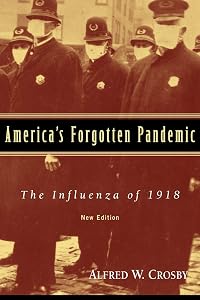
America's Forgotten Pandemic: The Influenza of 1918
by Alfred W. Crosby
On This Page
Description
Between August 1918 and March 1919 the Spanish influenza spread worldwide, claiming over 25 million lives - more people than perished in the fighting of the First World War. It proved fatal to at least a half-million Americans. Yet, the Spanish flu pandemic is largely forgotten today. In this vivid narrative, Alfred W. Crosby recounts the course of the pandemic during the panic-stricken months of 1918 and 1919, measures its impact on American society, and probes the curious loss of national show more memory of this cataclysmic event. This 2003 edition includes a preface discussing the then recent outbreaks of diseases, including the Asian flu and the SARS epidemic. show lessTags
Recommendations











Member Reviews
Six Degrees of Contagion: A Morphology of the 1918 Mortality Crisis
Crosby’s account of the 1918 influenza pandemic is widely considered a classic. Originally published in 1976, this book will be of interest to a broad audience. While dated, “America’s Forgotten Pandemic” remains an exemplary study of one of the most compelling events in medical history.
When the American Expeditionary Force rolled into Bordeaux, France in April 1918, they brought with them not only hope of defeating the Central Powers, but also a highly virulent virus of the orthomyxoviridae family. As the AEF troops were deployed throughout the Western Front, the infection spread prolifically to the other forces involved in the Great War. By May 1918, “la show more grippe” was sweeping through the French troops, British soldiers apparently carried the flu with them when they debarked in Russia in June 1918, while German soldiers were laid low by “blitzkatarrh” to such an extent that von Ludendorff reported that his July 1918 offensive was blunted in part by influenza.
Despite its virulence, the virus was still evolving. Its new incarnation, which probably emerged around August 1918, rendered the virus more powerful in terms of communicability and lethality, possibly due to transmission to human hosts which did not possess antibodies from earlier flu outbreaks. August 1918 saw the revitalized Spanish flu breaking out simultaneously in Sierra Leone, Brest, and Boston. In Sierra Leone, the virus wiped out 3% of the indigenous population before the end of September 1918; in Brest, a major port and transshipment point in France for US troops, 1,350 individuals were hospitalized between August 22 and September 15, of which more than 25% died; in Chelsea Naval Hospital in Boston, a gathering point for troops bound for Europe, the mortality rate for those who acquired pneumonia together with flu was estimated to be between 60-70%.
From these three points of initial contact with local populations, the reinvigorated virus extended its reach, circling the globe within a matter of months. The pandemic is estimated to have infected half of the world’s population at the time; global mortality was estimated to be 40-50 million. In the United States, the number of excess deaths, that is, deaths that would not had appeared in the data had the virus not metamorphosed into something significantly more virulent, totaled 550,000. Crosby warns that this is a conservative number, as it excludes those who perished from secondary infections. Under statistical scrutiny, the mortality data covering various age groups revealed a starkly atypical W-curve, instead of the usual U-shaped curve; this meant that individuals between the ages of 15 and 35 were more likely to succumb to the new influenza strain, possibly due to their immune system’s hyperactive response to the infection. In view of the speed of transmission, the hyper-virulence of the viral adversary, the resulting immense excess mortality, and the impact on individuals in the prime of their lives, the pandemic was by far the largest sudden infectious burden in modern times.
Nearly as remarkable as the virus’s trek around the world was the intensive search for the causative agent of the pandemic. Because the virus is submicroscopic, researchers at the time placed the blame on a number of opportunistic organisms, such as Pfeiffer’s bacillus, staphylococcus, and streptococcus, which thrive in the respiratory tract. The search for the flu-causing organism evidently led, serendipitously, to the discovery of penicillin. Alexander Fleming’s research on staphylococcus allowed him to venture in a direction that facilitated the discovery of the antimicrobial capabilities of the penicillium mold. In 1921, Theobold Smith, a researcher from the Rockefeller Institute, proposed that the solution to the flu conundrum might possibly lie in finding the ultimate cause of dog distemper. This germ of an idea led to the isolation in 1926 of the virus that causes canine distemper. Researchers also undertook the development of an anti-distemper vaccine. With the groundwork done, it was only a matter of time before the 1918 flu virus was isolated. Finally, in 1931, Richard Shope, another Rockefeller Institute researcher, managed to isolate the influenza virus from swine. In 1933, Wilson Smith, C. H. Andrewes and P.P. Laidlaw managed to isolate the causative agent of the pandemic. The virus came from Smith himself, who came down with influenza while working with flu-stricken ferrets. (Today, the said virus strain, still being used in research, bears the notation A/WS/1933.) Smith’s virus, however, came from a 1933 outbreak of influenza in England, and its structure arguably was already far removed from the 1918 organism. It would actually take another six decades before the face of the 1918 influenza virus was finally revealed. In a 1997 article in the journal Science, Jeffrey Taubenberger and his colleagues at the US Armed Forces Institute of Pathology disclosed that they managed to sequence parts of the 1918 influenza virus’s genome, using tissue samples preserved at the Institute’s vaults.
With the causative agent, denounced as “a mob of protean creatures effectively defended against vaccine by their diversity and mutability”, identified and isolated in 1933, Crosby turns his attention to analyzing why the virus and the pandemic in its wake left no lasting scar in the collective consciousness. He posits that the struggle against the flu was subsumed within the battles of World War 1—the flu became part and parcel of the great reckoning, and, in people’s minds, was just another front to fight in. Furthermore, according to Crosby, the illness moved too fast for comprehension; often, people had no time to dwell on the danger the spread of the virus posed to society. In addition, the 1918 influenza virus, similar to the plague unleashed on Egypt as described in the Old Testament, tended to be lethal to young adults, but spared, by and large, those elders who were in a position of great authority, further mitigating collective trauma. Thus, at the institutional level, termed by Crosby as “the level of collectivities”, the flu “did not spur great changes in the structure and procedures of governments, armies, corporations, or universities”, but exerted “a permanent influence not on the collectivities but on the atoms of human society – individuals.”
The foremost advantage of writing the history of the 1918 pandemic with a focus on the American experience is that the resultant work highlights the complete and utter vulnerability of an industrial economy as vibrant as the United States’ in the face of a crippling onslaught of a rapidly evolving pathogen. While focusing on the pandemic’s impact in North America, this book nonetheless does not lose sight of the fact that the disease was a genuinely global phenomenon: Crosby’s superlative research includes the collision between members of the orthomyxoviridae family and Homo sapiens in places such as West Africa and Samoa, as well as covers efforts in the United Kingdom, as described above, to study the origins of the global contagion. Crosby even goes to the extent of positing that in dealing with an influenza pandemic, “democracy can be a very dangerous form of government; the need is for a strong central authority with a grasp of the basic principles of epidemiology.” Aimed at a general readership, this book serves as a commendable point of departure for a further exploration of the growing literature on “la grippe”. show less
Crosby’s account of the 1918 influenza pandemic is widely considered a classic. Originally published in 1976, this book will be of interest to a broad audience. While dated, “America’s Forgotten Pandemic” remains an exemplary study of one of the most compelling events in medical history.
When the American Expeditionary Force rolled into Bordeaux, France in April 1918, they brought with them not only hope of defeating the Central Powers, but also a highly virulent virus of the orthomyxoviridae family. As the AEF troops were deployed throughout the Western Front, the infection spread prolifically to the other forces involved in the Great War. By May 1918, “la show more grippe” was sweeping through the French troops, British soldiers apparently carried the flu with them when they debarked in Russia in June 1918, while German soldiers were laid low by “blitzkatarrh” to such an extent that von Ludendorff reported that his July 1918 offensive was blunted in part by influenza.
Despite its virulence, the virus was still evolving. Its new incarnation, which probably emerged around August 1918, rendered the virus more powerful in terms of communicability and lethality, possibly due to transmission to human hosts which did not possess antibodies from earlier flu outbreaks. August 1918 saw the revitalized Spanish flu breaking out simultaneously in Sierra Leone, Brest, and Boston. In Sierra Leone, the virus wiped out 3% of the indigenous population before the end of September 1918; in Brest, a major port and transshipment point in France for US troops, 1,350 individuals were hospitalized between August 22 and September 15, of which more than 25% died; in Chelsea Naval Hospital in Boston, a gathering point for troops bound for Europe, the mortality rate for those who acquired pneumonia together with flu was estimated to be between 60-70%.
From these three points of initial contact with local populations, the reinvigorated virus extended its reach, circling the globe within a matter of months. The pandemic is estimated to have infected half of the world’s population at the time; global mortality was estimated to be 40-50 million. In the United States, the number of excess deaths, that is, deaths that would not had appeared in the data had the virus not metamorphosed into something significantly more virulent, totaled 550,000. Crosby warns that this is a conservative number, as it excludes those who perished from secondary infections. Under statistical scrutiny, the mortality data covering various age groups revealed a starkly atypical W-curve, instead of the usual U-shaped curve; this meant that individuals between the ages of 15 and 35 were more likely to succumb to the new influenza strain, possibly due to their immune system’s hyperactive response to the infection. In view of the speed of transmission, the hyper-virulence of the viral adversary, the resulting immense excess mortality, and the impact on individuals in the prime of their lives, the pandemic was by far the largest sudden infectious burden in modern times.
Nearly as remarkable as the virus’s trek around the world was the intensive search for the causative agent of the pandemic. Because the virus is submicroscopic, researchers at the time placed the blame on a number of opportunistic organisms, such as Pfeiffer’s bacillus, staphylococcus, and streptococcus, which thrive in the respiratory tract. The search for the flu-causing organism evidently led, serendipitously, to the discovery of penicillin. Alexander Fleming’s research on staphylococcus allowed him to venture in a direction that facilitated the discovery of the antimicrobial capabilities of the penicillium mold. In 1921, Theobold Smith, a researcher from the Rockefeller Institute, proposed that the solution to the flu conundrum might possibly lie in finding the ultimate cause of dog distemper. This germ of an idea led to the isolation in 1926 of the virus that causes canine distemper. Researchers also undertook the development of an anti-distemper vaccine. With the groundwork done, it was only a matter of time before the 1918 flu virus was isolated. Finally, in 1931, Richard Shope, another Rockefeller Institute researcher, managed to isolate the influenza virus from swine. In 1933, Wilson Smith, C. H. Andrewes and P.P. Laidlaw managed to isolate the causative agent of the pandemic. The virus came from Smith himself, who came down with influenza while working with flu-stricken ferrets. (Today, the said virus strain, still being used in research, bears the notation A/WS/1933.) Smith’s virus, however, came from a 1933 outbreak of influenza in England, and its structure arguably was already far removed from the 1918 organism. It would actually take another six decades before the face of the 1918 influenza virus was finally revealed. In a 1997 article in the journal Science, Jeffrey Taubenberger and his colleagues at the US Armed Forces Institute of Pathology disclosed that they managed to sequence parts of the 1918 influenza virus’s genome, using tissue samples preserved at the Institute’s vaults.
With the causative agent, denounced as “a mob of protean creatures effectively defended against vaccine by their diversity and mutability”, identified and isolated in 1933, Crosby turns his attention to analyzing why the virus and the pandemic in its wake left no lasting scar in the collective consciousness. He posits that the struggle against the flu was subsumed within the battles of World War 1—the flu became part and parcel of the great reckoning, and, in people’s minds, was just another front to fight in. Furthermore, according to Crosby, the illness moved too fast for comprehension; often, people had no time to dwell on the danger the spread of the virus posed to society. In addition, the 1918 influenza virus, similar to the plague unleashed on Egypt as described in the Old Testament, tended to be lethal to young adults, but spared, by and large, those elders who were in a position of great authority, further mitigating collective trauma. Thus, at the institutional level, termed by Crosby as “the level of collectivities”, the flu “did not spur great changes in the structure and procedures of governments, armies, corporations, or universities”, but exerted “a permanent influence not on the collectivities but on the atoms of human society – individuals.”
The foremost advantage of writing the history of the 1918 pandemic with a focus on the American experience is that the resultant work highlights the complete and utter vulnerability of an industrial economy as vibrant as the United States’ in the face of a crippling onslaught of a rapidly evolving pathogen. While focusing on the pandemic’s impact in North America, this book nonetheless does not lose sight of the fact that the disease was a genuinely global phenomenon: Crosby’s superlative research includes the collision between members of the orthomyxoviridae family and Homo sapiens in places such as West Africa and Samoa, as well as covers efforts in the United Kingdom, as described above, to study the origins of the global contagion. Crosby even goes to the extent of positing that in dealing with an influenza pandemic, “democracy can be a very dangerous form of government; the need is for a strong central authority with a grasp of the basic principles of epidemiology.” Aimed at a general readership, this book serves as a commendable point of departure for a further exploration of the growing literature on “la grippe”. show less
This is a medium-technical work (no details about how viruses work, but lots of charts, tables and footnotes) yet still manages to be an engaging read. Author Alfred Crosby notes that there were actually three waves of “flu” that year: a relatively mild outbreak in the spring followed by two massive disease waves in the fall and winter. It’s not clear whether the particular strain of flu was nastier than usual; the world had the bad luck to have a whole lot of young men in cramped quarters in military camps and naval vessels (not to mention the bad luck of being at war, of course).
As far as epidemics go, we’re not talking the Black Death here; it seems like about 25% of the population of the US caught the flu, and about 8% of show more those infected died (and there were probably many cases that were mild enough not to be diagnosed, so the real death rate was even smaller). Nevertheless, it was bad enough. The flu’s propensity for turning a victim’s immune system against him or her made for an unusual fatality distribution; while most diseases take the young and the old, fully 45% of flu fatalities were aged 25-45. The US Army’s influenza deaths during the war were 80% of its combat deaths.
Crosby speculates the flu may have had a great affect on the outcome of the war and the outcome of the peace. Luddendorf later claimed that the Kaiserschlact of 1918 would have been successful if so many of his troops hadn’t been sick; at the Versailles conference, Woodrow Wilson and his chief of staff, Edward House, both had the flu during the talks. (I think I can forgive Wilson a little knowing that; Crosby even suggests that Wilson may have suffered a “ministroke” while ill, as witnesses said his post-flu personality seemed to be different from the pre-flu one).
The causative organism wasn’t pinned down until the 1930s. For a long time it was thought that the bacterium Haemophilus influenzae was responsible, since it was found in a great many of the victims – but it couldn’t be made to satisfy Koch’s Postulates. The viral agent was finally tracked down by one of those common medical coincidences – a veterinary team in England looking for the cause of canine distemper discovered that ferrets could get the flu. Ferrets, of course, are not the world’s best experimental animal, but they are certainly better than (say) giraffes, and the veterinary team could demonstrate Kock’s Postulates with ferret nasal mucus through 100-or so generations of animals. This didn’t answer the question of why the 1918 strain was so nasty, but at least it eventually made vaccines possible.
Crosby closes with an interesting question – why is the 1918 flu “forgotten”, and makes some interesting suggestions. For one thing, simply because the flu took so many young people, nobody really famous died of it – although, tragically, a number of children of famous people did. And, since there was a war on, the deaths of so many young people were “diluted”; then after the war everybody was ready to forget about the whole thing. Not quite everybody; my great uncle once told me about going to several funerals a week at his church in 1918.
Well worth a read. I notice there are a number of flu books out; I’ll have to compare and contrast. I just happened to pick this one up first. show less
As far as epidemics go, we’re not talking the Black Death here; it seems like about 25% of the population of the US caught the flu, and about 8% of show more those infected died (and there were probably many cases that were mild enough not to be diagnosed, so the real death rate was even smaller). Nevertheless, it was bad enough. The flu’s propensity for turning a victim’s immune system against him or her made for an unusual fatality distribution; while most diseases take the young and the old, fully 45% of flu fatalities were aged 25-45. The US Army’s influenza deaths during the war were 80% of its combat deaths.
Crosby speculates the flu may have had a great affect on the outcome of the war and the outcome of the peace. Luddendorf later claimed that the Kaiserschlact of 1918 would have been successful if so many of his troops hadn’t been sick; at the Versailles conference, Woodrow Wilson and his chief of staff, Edward House, both had the flu during the talks. (I think I can forgive Wilson a little knowing that; Crosby even suggests that Wilson may have suffered a “ministroke” while ill, as witnesses said his post-flu personality seemed to be different from the pre-flu one).
The causative organism wasn’t pinned down until the 1930s. For a long time it was thought that the bacterium Haemophilus influenzae was responsible, since it was found in a great many of the victims – but it couldn’t be made to satisfy Koch’s Postulates. The viral agent was finally tracked down by one of those common medical coincidences – a veterinary team in England looking for the cause of canine distemper discovered that ferrets could get the flu. Ferrets, of course, are not the world’s best experimental animal, but they are certainly better than (say) giraffes, and the veterinary team could demonstrate Kock’s Postulates with ferret nasal mucus through 100-or so generations of animals. This didn’t answer the question of why the 1918 strain was so nasty, but at least it eventually made vaccines possible.
Crosby closes with an interesting question – why is the 1918 flu “forgotten”, and makes some interesting suggestions. For one thing, simply because the flu took so many young people, nobody really famous died of it – although, tragically, a number of children of famous people did. And, since there was a war on, the deaths of so many young people were “diluted”; then after the war everybody was ready to forget about the whole thing. Not quite everybody; my great uncle once told me about going to several funerals a week at his church in 1918.
Well worth a read. I notice there are a number of flu books out; I’ll have to compare and contrast. I just happened to pick this one up first. show less
I read this book specifically because of my PhD, as I'm looking at contexts in San Francisco around this time. There is a whole chapter on the situation in San Francisco which is great. I was also excited about the focus on the pandemic as "forgotten" which ties in to some of what I'm writing about. However, Crosby never really puts forward an argument as to why the pandemic was forgotten. There is a lot of evidence and some speculation that adds up to nothing much but evidence and speculation, and which is also seemingly tacked onto the end instead of weaved throughout the book. From the title and the opening I was hoping for more focus on the element of forgotten trauma on the American public body. Still, this is the revised edition show more of one of the first histories of a forgotten topic, and often an interesting read. show less
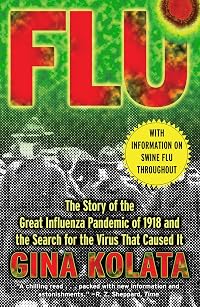
A reviewer of this book years ago started his review with this: "I think this book is complimentary to Gina Kolata's work on the same topic." And it's interesting because I was going to say basically the same thing, which would have looked stupid, so I'm glad I read through some reviews. That said, I do think Kolata's book is the better one, possibly more interesting to me personally, although I agree with the reviewer in thinking they compliment each other well. As I write this, it's March 2020 and the world is experiencing its first major pandemic since that one, and to this point, the similarities are eery. However, I think it would help people have some context as well as a glimpse of the probable future, no matter how grim, so I show more definitely recommend anyone looking at this at the time of my writing this invest in researching and reading this book, Gina's "Flu" or others like them, because I think it's important to educate ourselves in light of the present situation. Hence, recommended. show less
Well researched account of the 1918 influenza pandemic. This is the best book that I've read on this topic so far.
Absolutely vital reading for the current COVID-19 pandemic. The number of parallels are very disturbing.
Fascinating!
Members
- Recently Added By
Lists

Best Books About Plagues and Epidemics
99 works; 17 members
Author Information

15+ Works 2,494 Members
Alfred Worcester Crosby Jr. was born in Boston, Massachusetts on January 15, 1931. He received a bachelor's degree in history from Harvard University in 1952. He served as a sergeant in the Army in the Panama Canal Zone. After his service, he received a doctorate in history from Boston University. He taught at Washington State University for 11 show more years and at the University of Texas in Austin for 22 years. He retired in 1999 as professor emeritus of geography, history, and American studies. He was considered the father of environmental history. He incorporated studies of biology, ecology, geography, and other sciences in his efforts to chronicle and understand human events. He wrote numerous books including The Columbian Exchange: Biological and Cultural Consequences of 1492; Ecological Imperialism: The Biological Expansion of Europe, 900-1900; Germs, Seeds and Animals: Studies in Ecological History; The Measure of Reality: Quantification and Western Society, 1250-1600; and Children of the Sun: A History of Humanity's Unappeasable Appetite for Energy. He died from complications of Parkinson's disease on March 14, 2018 at the age of 87. (Bowker Author Biography) show less
Common Knowledge
- Canonical title
- America's Forgotten Pandemic: The Influenza of 1918
- Original publication date
- 1989
- Important places
- USA
- Important events
- Influenza pandemic (1918)
- Dedication
- For Katherine Anne Porter, who survived
- Last words
- (Click to show. Warning: May contain spoilers.)"And I knew then that life was not a perpetual present, and that even tomorrow would be part of the past, and that for all my days and years to come I too must one day die."
- Original language
- English
- Canonical DDC/MDS
- 614.5180973; 614.51809730904
- Canonical LCC
- RC150.1
Classifications
- Genres
- History, Nonfiction, General Nonfiction, Science & Nature
- DDC/MDS
- 614.5180973 — Applied science & technology Medicine & health Epidemics, Poisons, Alternative Medicine Incidence of and public measures to prevent specific diseases and kinds of diseases Salmonella infections, bacillary diseases, clostridium infections, diphtheria, cholera, dysenteries, influenza Influenza
- LCC
- RC150.1 — Medicine Internal medicine Internal medicine Infectious and parasitic diseases
- BISAC
Statistics
- Members
- 257
- Popularity
- 126,410
- Reviews
- 7
- Rating
- (3.88)
- Languages
- English, Japanese
- Media
- Paper, Audiobook, Ebook
- ISBNs
- 7
- ASINs
- 1