On This Page
Description
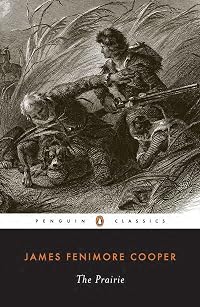
Pining for a tale of frontier life on the vast prairie? Settle in with this novel from James Fenimore Cooper, the fifth and final installment in his Leatherstocking Tales series, which follows the exploits of one Natty Bumppo, a trapper living out his twilight years in the wide open spaces of the Midwest..
Tags
Recommendations






















Member Reviews
It is a curious fact on his death-bed Franzy Schubert was asking for the latest Cooper novel (in German, of-course): such was the power of Cooper's art, at-least in those days. But It is hard now to imagine the era in which Cooper was the common property and a shared focus among millions of readers around the Northern Hemisphere. Of-course, his perspective on American life was beginning to reveal its inadequacies decades ago, and satires like Mark Twain's shredded his style and psychology almost as long ago. Even so, he will always be regarded as an American classic. That being conceded, to read his work today is to enter a very unfamiliar world, and ultimately one in which is is still harder to find permanent values and interest than show more it is to find distressing and incomprehensible incidents, motivation, and behavior. With the benefit of time, we can see that no matter how much he tried to be a great American writer, his goal was closer to being a great epic writer who happened to use the themes he knew best, namely American ones. I rather suspect it is this epic style and sweep, rather than the lure of American exotica which may have drawn Schubert. Anyway, peace to all of them, and of-course to old Natty Bumpo. For the record, sundry latter-day commentators nothwithstanding, the Ishmaelites of this book have very little to do with the astonishing Nineteenth-century migratory folk-group of the same name.. show less
Set in the immense landscape of the Great Plains, The Prairie (1827) addresses many questions raised by the penetration of the American west: the displacement of the Indians, the destruction of nature, and the creation of a just society both ordered and free. Natty Bumppo, a man now in the autumn of his days, is the spokesman for the conservation of the natural environment. But as his physical prowess wanes he is ultimately unable to thwart the despoilers. In this, the last in the series of five Leatherstocking Tales, Cooper resolves the issues of The Pioneers and The Last of the
Mohicans, but at the same time eloquently suggests that humility, self-control, reverence for God, and respect for nature are tragically lost on the prairie.
Mohicans, but at the same time eloquently suggests that humility, self-control, reverence for God, and respect for nature are tragically lost on the prairie.
4619. The Prairie, by James Fenimore Cooper (read 16 Sep 2009) The concluding volume of the pentalogy The Leatherstocking Tales is a much better book than The Pioneers. I found it moved along very well, and was consistently attention-holding. While the story is somewhat fantastic, it does have exciting events which come one right after another--in contrast to The Pioneers, which was pretty dull for long stretches. The trapper--Natty Bumppo--is sententious in his old age, but still a handy man to have as a friend on the western prairie. I am glad I have read, finally, these Cooper works.
The last of the Leatherstocking Tales shows Natty Bumpus as an old man wandering the Prairie. Written in 1827 it was the last of the series but the second written. It shows that even at this early time there were those that saw that a way of life was ending. The spread of settlements west were bringing an end to woodsmen type of American, a lifestyle, and a philosophy that would not be seen again.
Probably the most readable of the Leatherstocking Tales. Provides a retrospective to the series. Natty is an Old Man now. The reader is given a sense of completion.
Good conclusion to the series.
To be honest, I find the main protagonist annoying, not lovable, as some do. But to each his own.
To be honest, I find the main protagonist annoying, not lovable, as some do. But to each his own.
Very interesting! Love story, kidnapping, & Indians combined! Although this wasn't published last, it ends with Leatherstocking's death.
Members
- Recently Added By
Lists

Fiction (Mostly) in Selective Bibliography of American Literature 1775-1900
431 works; 3 members
Author Information

James Fenimore Cooper, acclaimed as one of the first American novelists, was born in Burlington, N.J., on September 15, 1789. When he was one year old, his family moved to Cooperstown, N.Y., which was founded by his father. Cooper attended various grammar schools in Burlington, Cooperstown, and Albany, and entered Yale University in 1803 at the show more age of 13. In 1806, Cooper was expelled from Yale for pushing a rag with gunpowder under a classmate's door, causing it to explode. He then spent some time as a merchant seaman and served as a midshipman in the U.S. Navy from 1808-1811. In 1811, Cooper married Susan De Lancey, and lived the life of a country gentleman until one day in 1820. Cooper and his wife were reading a book together. When Cooper told Susan that he could write a better book than the one they were reading, she challenged him to do so. Thus began his career as an author, with Precaution (first published anonymously). Cooper is known for writing more than 50 works under his own name, Jane Morgan, and Anonymous. His works included fiction, nonfiction, history, and travel sketches. He gained insight for his travel works while the Cooper family lived in Europe from 1826 to 1833. Cooper is best known for the novel The Last of The Mohicans, which has been made into several motion picture adaptations, the most recent starring Daniel Day-Lewis as Hawkeye. The Last of the Mohicans is part of The Leatherstocking Tales, which includes the other novels, The Pioneers, The Deerslayer, and The Pathfinder. Hawkeye, whose given name is Nathaniel Bumpo, is a recurring character in the series which accurately chronicles early American pioneering life and events during the French and Indian War. In 1851, Cooper developed a liver condition, dying on September 14th of that year, just one day before his 62nd birthday. (Bowker Author Biography) show less
Some Editions
Awards and Honors
Notable Lists
Series

Belongs to Publisher Series
Doubleday Dolphin (C14)
Penguin American Library (PAL26)
Limited Editions Club (S:12.01)
Airmont Classics (41)
Everyman's Library (172)
insel taschenbuch (0183)
Work Relationships
Is contained in
Has the adaptation
Is abridged in
Common Knowledge
- Canonical title
- The Prairie
- Original title
- The Prairie
- Original publication date
- 1827
- People/Characters
- Natty Bumppo; Ishmael Bush; Esther Bush; Asa Bush; Ellen Wade; Paul Hover (show all 17); Abiram White; Inez de Certavallos-Middleton; Duncan Uncas Middleton; Obed Bat; Asinus; Hector; Mahtoree; Hard Heart; Tachechana; Le Balafré; Weucha
- Related movies
- The Prairie (1947 | IMDb)
- Epigraph
- I pray the, shepherd, if that love, or gold
Can in this desert place buy entertainment,
Bring us where we may rest ourselves and feed.
- As You Like It - First words
- The geological formation of that portion of the American Union, which
lies between the Alleghanies and the Rocky Mountains, has given rise
to many ingenious theories. [Introduction]
Much was said and written at the time concerning the policy of adding the vast regions of Louisiana to the already immense and but half-tenanted territories of the Unites States. [Chapter 1] - Last words
- (Click to show. Warning: May contain spoilers.)The grave was made beneath the shade of some noble oaks. It has been
carefully watched to the present hour by the Pawnees of the Loop, and
is often shown to the traveller and the trader as a spot where a just
Whiteman sleeps. In due time the stone was placed at its head, with
the simple inscription, which the trapper had himself requested. The
only liberty, taken by Middleton, was to add--"May no wanton hand ever
disturb his remains!" - Original language
- English
- Canonical DDC/MDS
- 813.2
Classifications
- Genres
- Fiction and Literature, General Fiction, Historical Fiction
- DDC/MDS
- 813.2 — Literature & rhetoric American literature in English American fiction in English Post-Revolutionary 1776-1830
- LCC
- PS1416 .A1 — Language and Literature American literature American literature Individual authors 19th century
- BISAC
Statistics
- Members
- 1,225
- Popularity
- 20,218
- Reviews
- 14
- Rating
- (3.45)
- Languages
- 15 — Czech, Danish, English, Estonian, Finnish, French, German, Hungarian, Italian, Lithuanian, Norwegian (Bokmål), Norwegian, Polish, Spanish, Swedish
- Media
- Paper, Audiobook, Ebook
- ISBNs
- 142
- ASINs
- 92