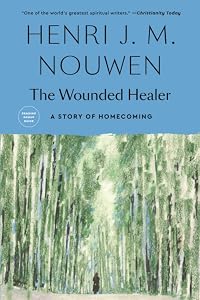
The Wounded Healer: Ministry in Contemporary Society
by Henri J. M. Nouwen
On This Page
Description
"Nouwen at his best." -Best Sellers "A lucid and profoundly simple book." -America "One's overall response to this book has to be 'Yes.' Yes, this describes a style of ministry desperately needed by all of us." -The Christian Century What does it mean to be a minister in our modern world? In this hope-filled book, Nouwen offers a fresh interpretation of modern ministry. Here he offers inspiration to men and women who want to be of service in their Church or community but who have found the show more traditional ways of ministry alienating and ineffective. According to Nouwen, "the minister is called to recognize the sufferings of his time in his own heart and make that recognition the starting point of his service.". show lessTags
Recommendations







Member Reviews
At the very beginning I completely disagreed with the ideas that Nouwen presented in this book. It seemed that everything that he said was distorted. Looking back on it now, I think that he did a very good job of describing the human condition, but I think that the theories he presents as to how humanity got there are a little off. But, after I got past his theories concerning the “nuclear man” and about the ways in which man searches for immortality I started to actually agree with what he was saying. I believe that he was right on in describing the characteristics of “the coming generation” as being inwardness, fatherlessness, and convulsiveness. Even though he was writing this concerning the previous generation I see these show more things as being very common in people my own age and I think that he has some very practical ways of dealing with these things.
I completely agree with him when he says, “The Christian leader must be in the future what he has always had to be in the past: a man of prayer, a man who has to pray, and who has to pray always.” At some times I felt that he was presenting ideas that were completely alienated from God. It seemed that he was more concerned with looking into man and like he thought that all the answers could be found in our own souls, but somehow in the end he always brought the focus around to God or Christ. I think that this makes his ideas very practical. They aren't unrealistic seminary answers, they are answers that he has come up with through trial and error, and also prayer and reading of the Bible.
Then in the last chapter he talks about how in order to properly minister to others one has to first recognize his own faults, weaknesses, and wounds. I think that this is very important. It is impossible to minister to others when you have undealt with problems in your own life. But it isn't that you have to get rid of your problems and then you help others, you must recognize your problems, and then as you help others you yourself will be healed. show less
I completely agree with him when he says, “The Christian leader must be in the future what he has always had to be in the past: a man of prayer, a man who has to pray, and who has to pray always.” At some times I felt that he was presenting ideas that were completely alienated from God. It seemed that he was more concerned with looking into man and like he thought that all the answers could be found in our own souls, but somehow in the end he always brought the focus around to God or Christ. I think that this makes his ideas very practical. They aren't unrealistic seminary answers, they are answers that he has come up with through trial and error, and also prayer and reading of the Bible.
Then in the last chapter he talks about how in order to properly minister to others one has to first recognize his own faults, weaknesses, and wounds. I think that this is very important. It is impossible to minister to others when you have undealt with problems in your own life. But it isn't that you have to get rid of your problems and then you help others, you must recognize your problems, and then as you help others you yourself will be healed. show less
This powerfully written, yet simple book changed my life! In "The Wounded Healer," Nouwen addresses one of the main challenges of the human condition- our weaknesses. These wounds, as Nouwen refers to them, are so often viewed as sources of shame and guilt for us. He reminds us all, however, that these wounds, can be transformed into strengths, if we will allow them to be.
By accepting that we are human and addressing our human weaknesses, we can then turn them into helpful resources to extend the gift of emotional healing to others. Because, in order to reach people, we need a point of connection. We can all relate to experiences of emotional woundedness, and within appropriate relational boundaries, they can become instruments of show more healing.
Nouwen shares several stories, and conversations that he had with persons going through various experiences of emotional woundedness. One of the most poignant of these was a visit he made to a man who was about to go in for surgery to have a leg amputated. By offering himself as a compassionate listener, he was able to help the man find peace in the midst of a devastating loss.
A point of clarification that Nouwen makes well is that becoming a wounded healer does not mean that we dump all of our problems on people, or seek to wear them like badges. Instead, by being aware of our woundedness, and facing it, we can become more sensitized to the needs of the people around us- after all we are all subject to human imperfection.
If you are ready to find hope and a renewed perspective on helping others- read this book! I would highly recommend "The Wounded Healer" to all persons in caring professions, as well as anyone who just want to find peace in the midst of human challenges. show less
By accepting that we are human and addressing our human weaknesses, we can then turn them into helpful resources to extend the gift of emotional healing to others. Because, in order to reach people, we need a point of connection. We can all relate to experiences of emotional woundedness, and within appropriate relational boundaries, they can become instruments of show more healing.
Nouwen shares several stories, and conversations that he had with persons going through various experiences of emotional woundedness. One of the most poignant of these was a visit he made to a man who was about to go in for surgery to have a leg amputated. By offering himself as a compassionate listener, he was able to help the man find peace in the midst of a devastating loss.
A point of clarification that Nouwen makes well is that becoming a wounded healer does not mean that we dump all of our problems on people, or seek to wear them like badges. Instead, by being aware of our woundedness, and facing it, we can become more sensitized to the needs of the people around us- after all we are all subject to human imperfection.
If you are ready to find hope and a renewed perspective on helping others- read this book! I would highly recommend "The Wounded Healer" to all persons in caring professions, as well as anyone who just want to find peace in the midst of human challenges. show less
Henri's writing becomes more and more familiar and comforting as I read more of his work. His style of organization follows a pattern that makes his approach clear and simple.
The wounded healer, someone who stays present to his or her own experience while connecting with and supporting others, continues to ring wise and true.
Several aspects of the book felt dated and were frequent enough to be distracting to me as a reader, for example, the phrase post-nuclear man and the repeated use of the male pronoun to frame references to leadership and ministry. Nevertheless, a worthwhile addition to my morning reflection.
"When the imitation of Christ does not mean to live a life like Christ, but to live your life as authentically as Christ lived show more his, then there are many ways and forms in which a man can be a Christian." 99 show less
The wounded healer, someone who stays present to his or her own experience while connecting with and supporting others, continues to ring wise and true.
Several aspects of the book felt dated and were frequent enough to be distracting to me as a reader, for example, the phrase post-nuclear man and the repeated use of the male pronoun to frame references to leadership and ministry. Nevertheless, a worthwhile addition to my morning reflection.
"When the imitation of Christ does not mean to live a life like Christ, but to live your life as authentically as Christ lived show more his, then there are many ways and forms in which a man can be a Christian." 99 show less
The Wounded Healer is divided into 4 sections: ministry in a dislocated world, ministry for a rootless generation, ministry to a hopeless man, and ministry by a lonely minister. The purpose for the book is to answer the question of what does it mean to be a minister in a contemporary society where the familiar ways are crumbling. Nouwen wrote for an audience of people who want to be of service in their church and community but who have found the traditional ways threatening and ineffective. The 4 chapters are can be seen as the 4 doors through which Nouwen tried to enter into the problems of ministry in a modern world. He believed that in our own woundedness we can become a source of life for others.
Case studies of ministry to people show more from diverse cultures and religious traditions are analyzed and dissected in order to show what the minister did wrong and how he should have handled the event. According to the publisher's synopsis "Emphasizing that which is common to both minister and believer, this woundedness can serve as a source of strength and healing when counseling others. Nouwen proceeds to develop his approach to ministry with an analysis of sufferings -- a suffering world, a suffering generation, a suffering person, and a suffering minister. It is his contention that ministers are called to recognize the sufferings of their time in their own hearts and make that recognition the starting point of their service. For Nouwen, ministers must be willing to go beyond their professional role and leave themselves open as fellow human beings with the same wounds and suffering -- in the image of Christ."
I was struck by Nouwen's description of people he calls nuclear-those who grew up with the nuclear bomb and its prospect for destroying the world. These nuclear people are drawn to something different than what their parents can offer because there is no trust in the institutions of their parents' time. The nuclear person becomes a prisoner of the "now" time feeling no connection to the past or the future. This person has lost faith with technology due to its prospects for total destruction of mankind. The nuclear person has no sense of continuity and does not feel that he is a part of history and therefore, the here and now is what is important. This feeling of nonhistory results in apathy, boredom and a desire for material things because there is no feeling of being responsible for the future. This person drifts from one moment to the next "making life a long row of randomly chained incidents and accidents." Nouwen's description of a nuclear person is a description of me and I am shocked by this discovery. Nouwen further states that the only way to recover from this nuclear malady is through Jesus Christ.
Nouwen's life was difficult. He had alot of personal problems. By surviving all of these problems he found that he could minister to others who were going through similar paths in life. He coined the phrase "the wounded healer" to describe the ministry that can be done toward those suffering from physical and emotional ailments. I identify with his life. My life has consisted of one bad event after another beginning with my childhood with an alcoholic parent to living with a chronic illness that has kept me in physical pain 24/7 for the past 25 years.
I am going to need to re-read this book 1 or 2 more times in order to get its full impact on me as a person. If you were born after WWII, you should read this book. It reveals the problems our generation faces and ways to deal with it. show less
Case studies of ministry to people show more from diverse cultures and religious traditions are analyzed and dissected in order to show what the minister did wrong and how he should have handled the event. According to the publisher's synopsis "Emphasizing that which is common to both minister and believer, this woundedness can serve as a source of strength and healing when counseling others. Nouwen proceeds to develop his approach to ministry with an analysis of sufferings -- a suffering world, a suffering generation, a suffering person, and a suffering minister. It is his contention that ministers are called to recognize the sufferings of their time in their own hearts and make that recognition the starting point of their service. For Nouwen, ministers must be willing to go beyond their professional role and leave themselves open as fellow human beings with the same wounds and suffering -- in the image of Christ."
I was struck by Nouwen's description of people he calls nuclear-those who grew up with the nuclear bomb and its prospect for destroying the world. These nuclear people are drawn to something different than what their parents can offer because there is no trust in the institutions of their parents' time. The nuclear person becomes a prisoner of the "now" time feeling no connection to the past or the future. This person has lost faith with technology due to its prospects for total destruction of mankind. The nuclear person has no sense of continuity and does not feel that he is a part of history and therefore, the here and now is what is important. This feeling of nonhistory results in apathy, boredom and a desire for material things because there is no feeling of being responsible for the future. This person drifts from one moment to the next "making life a long row of randomly chained incidents and accidents." Nouwen's description of a nuclear person is a description of me and I am shocked by this discovery. Nouwen further states that the only way to recover from this nuclear malady is through Jesus Christ.
Nouwen's life was difficult. He had alot of personal problems. By surviving all of these problems he found that he could minister to others who were going through similar paths in life. He coined the phrase "the wounded healer" to describe the ministry that can be done toward those suffering from physical and emotional ailments. I identify with his life. My life has consisted of one bad event after another beginning with my childhood with an alcoholic parent to living with a chronic illness that has kept me in physical pain 24/7 for the past 25 years.
I am going to need to re-read this book 1 or 2 more times in order to get its full impact on me as a person. If you were born after WWII, you should read this book. It reveals the problems our generation faces and ways to deal with it. show less
I've read only two of Nouwen's books so far, and just from those I can say his books warrant a 2nd and maybe a 3rd reading. His insights are rich, dense, and provoke a lot of contemplation. This is most definitely not a book to peruse through, but something to meditate on. I love the title- it perfectly describes the subject of this marvelous short book. People in helping professions develop their compassion and ability to help heal others by being wounded themselves, just as Christ was wounded. Highly recommend this book for pastors, counselors and anyone who wants to help others.
A hope-filled and profoundly simple book that speaks directly to those men and women who want to be of service in their church or community, but have found the traditional ways often threatening and ineffective. Combines creative case studies of ministry with stories from diverse cultures and religious traditions in preparing a new model for ministry.
Nouwen has come up with a balanced and creative theology of service that begins with the realization of fundamental woundedness in human nature. Emphasizing that which is in humanity common to both minister and believer, this woundedness can serve as a source of strength and healing when counseling others. Nouwen proceeds to develop his approach to ministry with an analysis of sufferings -- a suffering world, a suffering generation, a suffering person, and a suffering minister. It is his contention that ministers are called to recognize the sufferings of their time in their own hearts and make that recognition the starting point of their service. For Nouwen, ministers must be willing to go beyond their professional role and leave show more themselves open as fellow human beings with the same wounds and suffering -- in the image of Christ. In other words, we heal from our own wounds. Filled with examples from everyday experience, The Wounded Healer is a thoughtful and insightful guide that will be welcomed by anyone engaged in the service of others. show less
Members
- Recently Added By
Lists

Spiritual Growth
8 works; 1 member

Henri Nouwen, All Inclusive
100 works; 1 member

Books We Want To Read Again For The First Time
384 works; 160 members

Men's healing resources
749 works; 1 member
Author Information

319+ Works 44,323 Members
He was born in the Netherlands in 1932. An ordained priest and gifted teacher, he taught at several universities including Notre Dame, Harvard and Yale. He was a missionary in Peru. He died of a heart attack in 1996. (Publisher Provided) Henri J. M. Nouwen was born in Nijkerk, The Netherlands on January 24, 1932. He was ordained a priest in 1957. show more He taught theology at Yale University Divinity School from 1971 to 1981 and at Harvard Divinity School from 1983 to 1985. He was the pastor at Daybreak, the L'Arche community for the mentally handicapped in Toronto, Canada from 1986 to 1996. He wrote over 30 books on spirituality, healing, and ministry including Reaching Out, The Genesee Diary, The Wounded Healer, The Road to Daybreak, The Return of the Prodigal Son, and Can You Drink the Cup? He died of a heart attack on September 21, 1996 at the age of 64. (Bowker Author Biography) show less
Awards and Honors
Notable Lists
Series
Belongs to Publisher Series
Work Relationships
Is contained in
Common Knowledge
- Original title
- The wounded healer : ministry in contemporary society
- Alternate titles
- 當代牧養事工的省思
- Original publication date
- 1979
- People/Characters
- Henri Nouwen
- Dedication
- To Colin and Phyllis Williams
- First words
- What does it mean to be a minister in our contemporary society?
- Last words
- (Click to show. Warning: May contain spoilers.)The minister is called to make this forward thrust credible to his many guests, so that they do not stay but have a growing desire to move on, in the conviction that the full liberation of man and his world is still to come.
Classifications
Statistics
- Members
- 3,349
- Popularity
- 5,071
- Reviews
- 20
- Rating
- (3.97)
- Languages
- 8 — Chinese, English, Finnish, French, Korean, Portuguese, Spanish, Swedish
- Media
- Paper, Audiobook, Ebook
- ISBNs
- 14
- ASINs
- 15