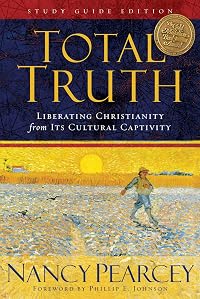
Total Truth: Liberating Christianity from its Cultural Captivity
by Nancy R. Pearcey
On This Page
Description
Is God a public figure? Does Christianity have a legitimate role to play in the public realm of politics, business, law, and education? Or are secularists right when they relegate religion to the strictly private realm of faith and feelings? In Total Truth, Nancy Pearcey offers a razor-sharp analysis of the split between public and private, fact and feelings. She reveals the strategies of secularist gatekeepers who use this division to banish biblical principles from the cultural mainstream, show more stripping Christianity of its power to challenge and redeem the whole of culture. How can this divide be overcome? How to unify fragmented lives and recover authentic spirituality? With compelling examples from the struggles of real people, Pearcey shows how to liberate Christianity from its cultural captivity. She walks listeners through practical, hands-on steps for developing a full-orbed Christian worldview. Finally, she makes a passionate case that Christianity is not just religious truth but truth about total reality. It is total truth. show lessTags
Recommendations







Member Reviews
Published 20 years ago, it was thought of as an instant classic then: I heartily agree with that assessment. Pearcey is a trenchant thinker and writer. Total Truth is filled with piercing analyses, exhibits wide reading and study, and is worth re-reading on a regular basis until the subject has enabled you to develop your own worldview. She is an evangelical but does not hesitate to refer to atheists, agnostics, Catholics and others from a wide variety of backgrounds. Whether she is commending or critiquing, her ideas have weight and substance.
As a Christian philosopher, she takes pains to integrate theology into her work...and it is a practical theology that should make a difference in how one leads one's life. She is unsparing in her show more denunciation of the fact-value split in modern thought and shows how Christians have contributed to this false kind of dichotomy that ultimately relegates our faith to a secondary, pious role in a second storey that is irrelevant to "the real world" when it is factually, provably, the ground of all truth.
Yes, I am convinced of her thesis and believe that this book will change the direction of your life, if you will apply it appropriately, carefully, thoughtfully. That is my personal intention.
Oh, I do not agree with every word she writes, but the overall direction is solid, sound and unimpeachable. show less
As a Christian philosopher, she takes pains to integrate theology into her work...and it is a practical theology that should make a difference in how one leads one's life. She is unsparing in her show more denunciation of the fact-value split in modern thought and shows how Christians have contributed to this false kind of dichotomy that ultimately relegates our faith to a secondary, pious role in a second storey that is irrelevant to "the real world" when it is factually, provably, the ground of all truth.
Yes, I am convinced of her thesis and believe that this book will change the direction of your life, if you will apply it appropriately, carefully, thoughtfully. That is my personal intention.
Oh, I do not agree with every word she writes, but the overall direction is solid, sound and unimpeachable. show less
After reading reviews on Nancy Pearcey’s Total Truth by Francis Beckwith, Tim Challies, and Al Mohler, writing my own seemed daunting. Al Mohler wrote, “In Total Truth, Nancy Pearcey offers a solid theological engagement with the critical intellectual issues of our times.” Such a bold statement is characteristic of thoughtful books reviews. In light of other reviews, my goal is to provide a concise analysis of Pearcey’s book, stating its main argument and identifying salient points.
It would be impossible to understand Total Truth apart from its connection to Francis Schaeffer. Schaeffer himself was instrumental in Pearcey’s conversion to Christianity. The skeptical author first encountered this 20th century intellectual show more giant at the L’Abri community in the Swiss Alps. Perched on the side of a mountain, he influenced Pearcey and many others who were disillusioned with religion in the 60’s. Schaeffer’s scathing critique of modernism and its inability to answer the deep questions of the human soul led to Pearcey’s conversion, which resulted in a lifetime of intellectual work on behalf of the Christian faith.
This is Pearcey’s book though, not Schaeffer’s. She breezes through centuries of philosophical systems—deconstructing them as she goes—in order to show that the Christian worldview is the only one that can truly account for all of reality. The Christian worldview is total truth.
Why is developing a Christian worldview important? Postmodern America is awash in a “sea of secularism.” There are many ideologies competing for attention in today’s marketplace of ideas. However, are any of them capable of providing a comprehensive account of all of reality? This is the question Pearcey poses… and answers.
Pearcey’s thesis is that the majority of Christians have been subject to cultural captivity and must be set free, hence the title of the book, Total Truth: Liberating Christianity from Its Cultural Captivity. We are in a state of intellectual bondage where a sharp divide has been drawn between the sacred and the secular. There has been a bifurcation between religion and reason, science and faith, that has inexorably driven Christians to retreat from the public sphere and succumb to the prevailing cultural norms and mores of their day.
Pearcey states her thesis in the introduction: “This book addresses that hunger [to have a Christian worldview] and offers new direction for advancing the worldview movement.” One of the reasons Christians have a truncated, lifeless worldview is because they’ve bought into the fact/value distortion which has permeated Western culture for centuries. The onslaught of the Enlightenment and the impact of revivalism within the sphere of the emerging Evangelical empire has created this distortion.
The fact-value distortion is described as a two-story way of looking at the world. In the “lower” story are facts, which are binding on everyone. The “lower” story of Science is built on empirical knowledge, rational thinking, and objective facts. In the “upper” story are values, which are based on individual preferences. A person’s religious beliefs would fit here. The “lower” story is what is universally accepted by the public and accepted as “objective” truth, whereas the “upper” story is both cursorily dismissed and not taken seriously by the public.
One of the strengths of this book is Pearcey’s ability to analyze and explain large strata of the intellectual, economic, and religious foundation of Western Culture. Schaeffer’s influence is certainly evident as she explains how the two-story divide has played out in the various strands of Western thought. For instance, postmodernism can be seen as the “upper” story in today’s prevailing worldview; it is subjective and relative to particular groups. The “lower” story, on the other hand, is modernism with its accompanying emphases on what is objective and universally valid.
This dichotomy, she explains, “is the single most potent weapon for delegitimizing the biblical perspective in the public square today.” Those who don’t believe in God have been able to subvert Christianity by relegating its tenets to that which belongs in the private sphere. Religion, particularly Christianity—which is what is professed by most Americans—is no longer taken seriously; not because it’s true, but because religion is seen as a matter of preference. Christianity opposed America and lost the fight.
There are four parts to this book. The first part explains how the secular/sacred split came into being. The second part “zeroes in on Creation, which is the foundational starting point for any world-view.” In this section she assesses Darwinism, which is the prevailing worldview today, and shows how this particular worldview fails to hold up when evaluated in light of recent scientific findings; it falls well short of providing a coherent, comprehensive worldview for all of life. The third part criticizes the author’s own tradition, Evangelicalism, and looks at how we arrived at where we’re at now. The fourth part shows how “submission of our whole selves to the Lordship of Christ” is the only way to develop a Christian worldview.
I even found Pearcey’s method for the development of a Christian worldview to be theologically supple. Her explication of suffering in context of a vibrant, lived-out faith is a much needed slice to the prideful, therapeutic, flabby Christianity that has developed over the years. She advances Martin Luther’s theology of the Cross as a means by which we die to ourselves and the idolatry of our hearts on a daily basis. She writes, “True knowledge of Christ comes only as we are willing to give up up our dreams of glory, praying to be identified with Him on the cross.” Ouch.
Furthermore, her incorporation of Schaeffer’s “Rejected, Slain, Raised” concept of sanctification shows that she’s not afraid to swim upstream against the currents of much of the Evangelical self-help chicanery. A slight criticism might be that Pearcey relies too heavily on Schaeffer here and the concept of “Rejected, Slain, Raised” doesn’t fully capture other means of grace, such as the importance of reading the Bible, prayer, and service, which serve to develop a full-orbed view of Christianity.
This book is a must-read for all young people heading off to college, pastors, lay leaders, and anyone interested in learning more about the Christian worldview. This is a primer on why a Christian worldview is important and how we should go about identifying competing worldviews while developing a solid, mature, biblically-informed one of our own. show less
It would be impossible to understand Total Truth apart from its connection to Francis Schaeffer. Schaeffer himself was instrumental in Pearcey’s conversion to Christianity. The skeptical author first encountered this 20th century intellectual show more giant at the L’Abri community in the Swiss Alps. Perched on the side of a mountain, he influenced Pearcey and many others who were disillusioned with religion in the 60’s. Schaeffer’s scathing critique of modernism and its inability to answer the deep questions of the human soul led to Pearcey’s conversion, which resulted in a lifetime of intellectual work on behalf of the Christian faith.
This is Pearcey’s book though, not Schaeffer’s. She breezes through centuries of philosophical systems—deconstructing them as she goes—in order to show that the Christian worldview is the only one that can truly account for all of reality. The Christian worldview is total truth.
Why is developing a Christian worldview important? Postmodern America is awash in a “sea of secularism.” There are many ideologies competing for attention in today’s marketplace of ideas. However, are any of them capable of providing a comprehensive account of all of reality? This is the question Pearcey poses… and answers.
Pearcey’s thesis is that the majority of Christians have been subject to cultural captivity and must be set free, hence the title of the book, Total Truth: Liberating Christianity from Its Cultural Captivity. We are in a state of intellectual bondage where a sharp divide has been drawn between the sacred and the secular. There has been a bifurcation between religion and reason, science and faith, that has inexorably driven Christians to retreat from the public sphere and succumb to the prevailing cultural norms and mores of their day.
Pearcey states her thesis in the introduction: “This book addresses that hunger [to have a Christian worldview] and offers new direction for advancing the worldview movement.” One of the reasons Christians have a truncated, lifeless worldview is because they’ve bought into the fact/value distortion which has permeated Western culture for centuries. The onslaught of the Enlightenment and the impact of revivalism within the sphere of the emerging Evangelical empire has created this distortion.
The fact-value distortion is described as a two-story way of looking at the world. In the “lower” story are facts, which are binding on everyone. The “lower” story of Science is built on empirical knowledge, rational thinking, and objective facts. In the “upper” story are values, which are based on individual preferences. A person’s religious beliefs would fit here. The “lower” story is what is universally accepted by the public and accepted as “objective” truth, whereas the “upper” story is both cursorily dismissed and not taken seriously by the public.
One of the strengths of this book is Pearcey’s ability to analyze and explain large strata of the intellectual, economic, and religious foundation of Western Culture. Schaeffer’s influence is certainly evident as she explains how the two-story divide has played out in the various strands of Western thought. For instance, postmodernism can be seen as the “upper” story in today’s prevailing worldview; it is subjective and relative to particular groups. The “lower” story, on the other hand, is modernism with its accompanying emphases on what is objective and universally valid.
This dichotomy, she explains, “is the single most potent weapon for delegitimizing the biblical perspective in the public square today.” Those who don’t believe in God have been able to subvert Christianity by relegating its tenets to that which belongs in the private sphere. Religion, particularly Christianity—which is what is professed by most Americans—is no longer taken seriously; not because it’s true, but because religion is seen as a matter of preference. Christianity opposed America and lost the fight.
There are four parts to this book. The first part explains how the secular/sacred split came into being. The second part “zeroes in on Creation, which is the foundational starting point for any world-view.” In this section she assesses Darwinism, which is the prevailing worldview today, and shows how this particular worldview fails to hold up when evaluated in light of recent scientific findings; it falls well short of providing a coherent, comprehensive worldview for all of life. The third part criticizes the author’s own tradition, Evangelicalism, and looks at how we arrived at where we’re at now. The fourth part shows how “submission of our whole selves to the Lordship of Christ” is the only way to develop a Christian worldview.
I even found Pearcey’s method for the development of a Christian worldview to be theologically supple. Her explication of suffering in context of a vibrant, lived-out faith is a much needed slice to the prideful, therapeutic, flabby Christianity that has developed over the years. She advances Martin Luther’s theology of the Cross as a means by which we die to ourselves and the idolatry of our hearts on a daily basis. She writes, “True knowledge of Christ comes only as we are willing to give up up our dreams of glory, praying to be identified with Him on the cross.” Ouch.
Furthermore, her incorporation of Schaeffer’s “Rejected, Slain, Raised” concept of sanctification shows that she’s not afraid to swim upstream against the currents of much of the Evangelical self-help chicanery. A slight criticism might be that Pearcey relies too heavily on Schaeffer here and the concept of “Rejected, Slain, Raised” doesn’t fully capture other means of grace, such as the importance of reading the Bible, prayer, and service, which serve to develop a full-orbed view of Christianity.
This book is a must-read for all young people heading off to college, pastors, lay leaders, and anyone interested in learning more about the Christian worldview. This is a primer on why a Christian worldview is important and how we should go about identifying competing worldviews while developing a solid, mature, biblically-informed one of our own. show less
"Takes alot of hubris to write a book with the title, 'Total Truth'. Even the great Apostle Paul saw through a glass dimly. Not so with Ms. Nancy Pearcey. She has not a grid, but the grid to understanding the totality of life. Maybe that is where I’m just too wary to fully join her. If you don’t use her grid your Christian understanding is not up to snuff. She is too confident in her assertions. It is a ‘we (thinking Evangelicals) who have the total truth’ and all we really need do is convince the world of it and we rid the world of most of its problems. In the last chapter of her book she talks about our need to love one another and states that possibly the last chapter should have been the first. I fully agree with her here show more and wish that she had spent more time in really looking how we Christians should relate (love) one another in the love of Christ.
Her roots are with Francis Schaffer but somehow things come presented all packaged with little challenge on how evangelicals ought really to love one another. Loving Catholics isn’t even in the equation. In one particularly annoying segment she tells evangelicals to stop beating each other over our understanding of creation as presented in the Genesis account and to go after the evolutionist. I guess after we impale them then we can get back to eviscerating one another. The book is not a total waste I only wish she had put more of her mental energies in how the love of Christ should look for us as thinking Christians." show less
Her roots are with Francis Schaffer but somehow things come presented all packaged with little challenge on how evangelicals ought really to love one another. Loving Catholics isn’t even in the equation. In one particularly annoying segment she tells evangelicals to stop beating each other over our understanding of creation as presented in the Genesis account and to go after the evolutionist. I guess after we impale them then we can get back to eviscerating one another. The book is not a total waste I only wish she had put more of her mental energies in how the love of Christ should look for us as thinking Christians." show less
Worth It
Maybe the best book in Christian world view I’ve read. Hits the mark for readability and depth, something hard to do in the area of philosophy and theology. Highly recommended!
Maybe the best book in Christian world view I’ve read. Hits the mark for readability and depth, something hard to do in the area of philosophy and theology. Highly recommended!
Written by Nancy Pearcey and published by Crossway Books in 2004, Total Truth: Liberating Christianity from Its Cultural Captivity is part history, part philosophy, and part religious consideration. Pearcey constructs a well written, easy to read apology on the overall effects of scientific and philosophical models on the whole of human epistemology, and Christian thought in particular.
A primary motif in the work is related to the early distinction of a two-story thought process that has become more pervasive in our culture’s everyday worldview. The basic premise relates to the idea that one has a religious and a secular side to the thought process that creates a dichotomy. The upper level is composed of those thoughts and ideas show more that relate to subjective thinking and values, while to lower level is comprised of those thoughts and ideas that can be empirically quantified and considered public knowledge. Consider …
Personal preference; Choice; Nonrational; Subjective
Scientific Knowledge; Binding on everyone; Rational; Objective
This two-story split is in part the offspring of the Enlightenment. Although many of the early scientists perceived their work as verifying the presence and hand of God in the world, as the stockpile of information increased and rational conclusions were drawn, the scientific process became the higher goal; The ability to present verifiable information from a naturalistic examination of the world assumed a higher authoritative place than the truths presented in the Scriptures. A fact/value dichotomy ensued.
The thesis of the work appears to be bound into a consideration of worldview. As Pearcey asserts, “We have to insist on presenting Christianity as a comprehensive, unified worldview that addresses all of life and reality. It is not just religious truth but total truth” (111).
The central portions of the work centers around a discussion of the development of thought and logic patterns. Beginning with the Greek philosophers and proceeding through to present day, the treatment of how mankind has developed certain thought patterns makes for very interesting reading. There are obvious points at which Christian Apologetics take the driver’s seat, and from a Christian worldview these discussions do nothing but strengthen a Christian’s ability to answer and defend the truth. Interesting in the discussion is the effects of the American democracy on Christianity, especially in the early days of the Republic. It is fascinating to see the incorporation of the principles laid down by the Founding Fathers into religious thought, and how those thought patterns entered the stream of American Christianity. Another section documents the role of women and how they have significantly affected the stream of American culture and thought. The early feminists are noted to have less animosity towards men than the fact they were being excluded from the increasing opportunities given men in the public sphere. Sadly, as both men and women entered the work force to pursue achievement and personal fulfillment, it has been the home that has “suffered from the general devaluation of the private sphere” (343).
Of interest was an assessment of those characteristics that developed from the evangelical thrust of the First Great Awakening. First, there was a focus placed upon an emotional conversion experience that became an effective tool for bringing people to the faith, but sadly contributed to a neglect of theology and doctrine. Second, preachers began using more of the common language and simple songs that proved highly effective in reaching ordinary people while making fun of the educated clergy “back east.” Third, addressing congregants apart from their family or church was effective in forcing a crisis of faith. Fourth, revivalism resulted in a new style of leadership wherein the preacher or pastor was better known as a celebrity able to inspire mass audiences. Amazingly, aspects of these same ideas can still be seen having their influence upon the contemporary evangelical community (liberal and conservative), and even more distinctly among the Pentecostal wing.
Although not in the scope of this work, one feels that the overall consideration of Christianity’s presentation of Total Truth is totally focused on Western thought. Regardless, a highly recommended read for those that seek to understand and answer to an increasingly secularized world. Buy it; Read it.
Some quotes from the book:
“Most secularists are too politically savvy to attack religion directly or to debunk it as false. So what do they do? They consign religion to the value sphere – which takes it out of the ream of true and false altogether. Secularists can then assure us that of course they ‘respect’ religion, while at the same time denying that it has any relevance to the public realm” (21)
“Thus the religious professionals took over the spiritual duties of those deemed unable to fulfill them for themselves – saying prayers, attending mass, doing penance, going on pilgrimages, and performing acts of charity on behalf of the common folk” (80).
“Darwinian evolution is not so much an empirical finding as a deduction from a naturalistic worldview” (170).
“When we consider the growth of religious affiliation in America, then, the most striking thing is that it did not take place among the respectable or established churches, but among the evangelical groups – the ‘upstart’ groups, as they were called at the time” (265).
“The Enlightenment claim that science can operate without any philosophical premises proved, in the end, to be a cover for discarding Christian premises while smuggling in naturalistic ones” (308).
“We may do a great job of arguing that Christianity is total truth, but others will not find our message persuasive unless we give a visible demonstration of that truth in action. It is all but impossible for people to accept new ideas purely in the abstract, without seeing a concrete illustration of what they look like when lived out in practice. Sociologists call this a ‘plausibility structure’ – the practical context in which ideas are fleshed out. The church is meant to be the ‘plausibility structure’ for the gospel” (354-355).
“If there is one prevailing characteristic of modern culture, it is moral relativism. Yet this is one of the ‘isms’ that is easiest to shoot down. Why? Because, despite what a person says he believes, no one faced with genuine cruelty remains a moral relativist” (396). show less
A primary motif in the work is related to the early distinction of a two-story thought process that has become more pervasive in our culture’s everyday worldview. The basic premise relates to the idea that one has a religious and a secular side to the thought process that creates a dichotomy. The upper level is composed of those thoughts and ideas show more that relate to subjective thinking and values, while to lower level is comprised of those thoughts and ideas that can be empirically quantified and considered public knowledge. Consider …
Personal preference; Choice; Nonrational; Subjective
Scientific Knowledge; Binding on everyone; Rational; Objective
This two-story split is in part the offspring of the Enlightenment. Although many of the early scientists perceived their work as verifying the presence and hand of God in the world, as the stockpile of information increased and rational conclusions were drawn, the scientific process became the higher goal; The ability to present verifiable information from a naturalistic examination of the world assumed a higher authoritative place than the truths presented in the Scriptures. A fact/value dichotomy ensued.
The thesis of the work appears to be bound into a consideration of worldview. As Pearcey asserts, “We have to insist on presenting Christianity as a comprehensive, unified worldview that addresses all of life and reality. It is not just religious truth but total truth” (111).
The central portions of the work centers around a discussion of the development of thought and logic patterns. Beginning with the Greek philosophers and proceeding through to present day, the treatment of how mankind has developed certain thought patterns makes for very interesting reading. There are obvious points at which Christian Apologetics take the driver’s seat, and from a Christian worldview these discussions do nothing but strengthen a Christian’s ability to answer and defend the truth. Interesting in the discussion is the effects of the American democracy on Christianity, especially in the early days of the Republic. It is fascinating to see the incorporation of the principles laid down by the Founding Fathers into religious thought, and how those thought patterns entered the stream of American Christianity. Another section documents the role of women and how they have significantly affected the stream of American culture and thought. The early feminists are noted to have less animosity towards men than the fact they were being excluded from the increasing opportunities given men in the public sphere. Sadly, as both men and women entered the work force to pursue achievement and personal fulfillment, it has been the home that has “suffered from the general devaluation of the private sphere” (343).
Of interest was an assessment of those characteristics that developed from the evangelical thrust of the First Great Awakening. First, there was a focus placed upon an emotional conversion experience that became an effective tool for bringing people to the faith, but sadly contributed to a neglect of theology and doctrine. Second, preachers began using more of the common language and simple songs that proved highly effective in reaching ordinary people while making fun of the educated clergy “back east.” Third, addressing congregants apart from their family or church was effective in forcing a crisis of faith. Fourth, revivalism resulted in a new style of leadership wherein the preacher or pastor was better known as a celebrity able to inspire mass audiences. Amazingly, aspects of these same ideas can still be seen having their influence upon the contemporary evangelical community (liberal and conservative), and even more distinctly among the Pentecostal wing.
Although not in the scope of this work, one feels that the overall consideration of Christianity’s presentation of Total Truth is totally focused on Western thought. Regardless, a highly recommended read for those that seek to understand and answer to an increasingly secularized world. Buy it; Read it.
Some quotes from the book:
“Most secularists are too politically savvy to attack religion directly or to debunk it as false. So what do they do? They consign religion to the value sphere – which takes it out of the ream of true and false altogether. Secularists can then assure us that of course they ‘respect’ religion, while at the same time denying that it has any relevance to the public realm” (21)
“Thus the religious professionals took over the spiritual duties of those deemed unable to fulfill them for themselves – saying prayers, attending mass, doing penance, going on pilgrimages, and performing acts of charity on behalf of the common folk” (80).
“Darwinian evolution is not so much an empirical finding as a deduction from a naturalistic worldview” (170).
“When we consider the growth of religious affiliation in America, then, the most striking thing is that it did not take place among the respectable or established churches, but among the evangelical groups – the ‘upstart’ groups, as they were called at the time” (265).
“The Enlightenment claim that science can operate without any philosophical premises proved, in the end, to be a cover for discarding Christian premises while smuggling in naturalistic ones” (308).
“We may do a great job of arguing that Christianity is total truth, but others will not find our message persuasive unless we give a visible demonstration of that truth in action. It is all but impossible for people to accept new ideas purely in the abstract, without seeing a concrete illustration of what they look like when lived out in practice. Sociologists call this a ‘plausibility structure’ – the practical context in which ideas are fleshed out. The church is meant to be the ‘plausibility structure’ for the gospel” (354-355).
“If there is one prevailing characteristic of modern culture, it is moral relativism. Yet this is one of the ‘isms’ that is easiest to shoot down. Why? Because, despite what a person says he believes, no one faced with genuine cruelty remains a moral relativist” (396). show less
Very good revision of Schaeffer's historical and philosophical overview of Western culture as an explanation of the Christian worldview. The end of the book was a disappointment, as the author appeared to be using her book to try to settle some personal grievances.
A well-researched, well-written book by a scholar who was influenced by the theologian, Francis Schaeffer, to search for truth. She explains clearly what is a worldview and argues passionately that in keeping religion within our private walls, we have lost our ability to influence the culture.
Members
- Recently Added By
Published Reviews
ThingScore 93
Seldom does one find a book with serious content, historical depth, and Christian integrity that is also easy to read. If you feel lost in the fog of today's cultural confusions, read this book.
added by ArrowStead
A mind like a jewel...."Total Truth" is brilliant.
added by ArrowStead
The most serious undertaking on Christian worldview to date - from one of the finest writers in America.
added by ArrowStead
Lists

Develop Your Personal Christian Library
101 works; 15 members

STR's Recommended Reading List
34 works; 2 members
Recommendations by Stand To Reason
34 works; 1 member
Author Information

16+ Works 5,464 Members
Nancy Pearcey is a bestselling, award-winning author who serves as professor of apologetics and scholar in residence at Houston Baptist University. She is also editor at large of The Pearcey Report and a fellow at Discovery Institute's Center for Science and Culture. She is the author of several books, including the 2005 ECPA Gold Medallion show more Award-winner Total Truth and most recently Finding Truth. show less
Awards and Honors
Awards
Common Knowledge
- Canonical title
- Total Truth: Liberating Christianity from its Cultural Captivity
- Original publication date
- 2004
- Epigraph
- Christianity is not a series of truths in the plural, but rather truth spelled with a capital "T." Truth about total reality, not just about religious things. Biblical Christianity is Truth concerning total reality - and th... (show all)e intellectual holding of that total Truth and then living in the light of that Truth. - Francis Schaeffer - Address at the University of Notre Dame, April 1981
Sundays were Sundays,
with the rest of the week largely detached,
operating by a different set of rules.
Can these two worlds that seem so separate ever merge?
~John Beckett - First words
- [Foreword] When Nancy Pearcey invited me to write a foreword for her "worldview" book, I hastened to accept the honor.
[Introduction] Your earlier book says Christians are called to redeem entire cultures, not just individuals," a schoolteacher commented, joining me for lunch at a conference where I had just spoken.
A fashionably dressed college student stepped into the counselor's office, tossing her head in an attempt at bravado. - Last words
- (Click to show. Warning: May contain spoilers.)This is the confidence that should sustain us when we bring our faith perspective into the public arena, whether in personal evangelism or in our professional work.
- Canonical DDC/MDS
- 261
Classifications
Statistics
- Members
- 2,236
- Popularity
- 8,990
- Reviews
- 19
- Rating
- (4.32)
- Languages
- English, Portuguese
- Media
- Paper, Audiobook, Ebook
- ISBNs
- 14
- ASINs
- 9