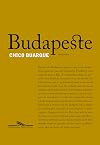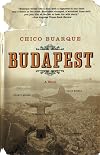
Budapest
by Chico Buarque
On This Page
Description
Fascinated by the Hungarian language - he is after all a man who lives by language, ghost writing speeches. advertisements, books - he spends the night watching television, trying to pick out words in this tongue, 'the only one the devil respects.' In charting the life of a Brazilian ghostwriter enamoured with the Magyar, Chico Buarque has created his most original fiction yet. The novel coils round the reader like a magical snake from The Arabian Nights. It is a storytelling labyrinth in show more Borges or Calvino mode, as Costa's myth-making, love-making and essays into another culture become mired in the world where celebrities make reputations and fortunes from the writing of anonymous others, where the reader is not sure what language, what reality is being offered. show lessTags
Recommendations

















Member Reviews
Those of you following Three Percent’s enormously silly and rather uninformative (there’s a reason book reviews aren’t written like sports announcements) “World Cup of Literature” will have noticed the high praise this novel received in the opening match, where Brazil beat Cameroon 4-0 (it then lost the next round because it was facing South America’s literary titan Roberto Bolaño). Budapest had been on my radar ever since learning that Luisa Valenzuela’s ‘I’m Your Horse in the Night’ took its title from a Chico Buarque lyric (in Brazil the man is known primarily as a songwriter). Having won praise on so distinguished a site, I thought I’d better bump this novel up my reading list.
On the surface, Budapest is a show more small book about nothing, a fluid account of one man’s love affair with the Hungarian language. It was first published in 2003 and translated in 2004 by Alison Entrekin (who does a marvelous job making total immersion in José Costa’s head somewhat easy to digest). Costa is a ghostwriter who, on a whim, abandons his wife Vanda, their son and his job in Rio de Janeiro, taking off for Budapest to learn "the only tongue in the world the devil respects." Soon upon arrival he hooks up with the aloof and disciplined Kriska, who volunteers to teach him the language.
Costa’s narrative glides along in chapters alternating Brazil with Budapest, playing parallels for all they are worth. At home he is employed and even has a certain invisible prestige. In Hungary he finds himself nobody, starting from scratch to recreate his late departed career. Kriska has a son the same age as his boy, offering a replacement family. However, it’s not the story of a conflict, a 'troubled man caught between two worlds' and all that. Costa is a remarkably unreflective narrator, an individual so abominably self-centered it doesn’t even occur to him to moralize about his actions. The effect is almost comical. He swears up and down vouching for his purity as a ghostwriter while it becomes more and more obvious that he burns with vanity and when a book of his becomes a hit he transforms into a ludicrous peacock, strutting about with his autographed copy, watching people read it on the beach, standing in bookshops watching it fly off the shelves and thinking "words of contempt, because if it weren’t for my book, that dump would already have closed down."
Just as often, paralleling only takes place in Costa’s imagination, as when he discovers his wife’s adultery during his absence and pictures her lover doing all the things he did in their first meeting, melding linguistic fetishism, erotic obsession and identity crisis in a curious mix. "It would make no sense to wish him ill for having done what I would have done if I were him…" Costa never considers his wife’s feelings or confronts his own hypocrisy in the matter – never, in fact, does Costa account for the feelings of Vanda or Kriska, only stopping to envision their erotic reaction to language (written or spoken and preferably his). The solipsism beggars belief. "…she would forget the German, who would also forget her, as she had been forgetting her husband who was forgetting her in Budapest, and there you go. The only thing left to say to the German now would be: How are you?"
Were Budapest of any length, I might have reservations about recommending it due to the difficulty many readers have with unsympathetic protagonists. But what is most odd about Buarque’s book is how it avoids being disagreeable. Buarque has a light touch and I feel that he invites laughter toward Costa (at least I hope that was the case). Combining that with the shortness of the book, Budapest never outlasts its welcome. I should think anyone who can tolerate streams-of-conciousness could get some enjoyment out of it.
The other praiseworthy element here is how in tone and style it looks meandering and self-indulgent but as you progress through the text it becomes more imaginative. There are doppelgängers in his office, an encounter involving Russian Roulette and a ghostwriters’ society full of intrigue and backbiting to liven things up. The ghostwriting drama heats up the narrative and becomes a highlight as the business relationships between employers, craftsmen and customers quickly become fraught: "He went out late every night to buy the following day’s papers, which he scrutinised right there at the news-stand, scanning the cultural sections for an article of mine, a letter of mine in the readers’ section, a paid public notice claiming authorship of The Gynographer. On autograph nights, during radio interviews or television talk shows, even during an informal chat with Vanda on the evening news, he was tense, glanced from side to side, twisted around, imagined that I might burst in at any moment to unmask him."
The ending is also commendable, delicious irony being served up for a finish. You never do get a particular sense of Hungary or its people but that’s hardly surprising given who’s telling this story. I did have to backtrack on occasion to reclaim the thread of the plot, but as I adjusted to the style confusion cleared and it ceased to be necessary. It’s really a fun little read, quick and quirky and just a touch comedic. Recommended.
http://pseudointellectualreviews.wordpress.com/2014/07/02/budapest-chico-buarque... show less
On the surface, Budapest is a show more small book about nothing, a fluid account of one man’s love affair with the Hungarian language. It was first published in 2003 and translated in 2004 by Alison Entrekin (who does a marvelous job making total immersion in José Costa’s head somewhat easy to digest). Costa is a ghostwriter who, on a whim, abandons his wife Vanda, their son and his job in Rio de Janeiro, taking off for Budapest to learn "the only tongue in the world the devil respects." Soon upon arrival he hooks up with the aloof and disciplined Kriska, who volunteers to teach him the language.
Costa’s narrative glides along in chapters alternating Brazil with Budapest, playing parallels for all they are worth. At home he is employed and even has a certain invisible prestige. In Hungary he finds himself nobody, starting from scratch to recreate his late departed career. Kriska has a son the same age as his boy, offering a replacement family. However, it’s not the story of a conflict, a 'troubled man caught between two worlds' and all that. Costa is a remarkably unreflective narrator, an individual so abominably self-centered it doesn’t even occur to him to moralize about his actions. The effect is almost comical. He swears up and down vouching for his purity as a ghostwriter while it becomes more and more obvious that he burns with vanity and when a book of his becomes a hit he transforms into a ludicrous peacock, strutting about with his autographed copy, watching people read it on the beach, standing in bookshops watching it fly off the shelves and thinking "words of contempt, because if it weren’t for my book, that dump would already have closed down."
Just as often, paralleling only takes place in Costa’s imagination, as when he discovers his wife’s adultery during his absence and pictures her lover doing all the things he did in their first meeting, melding linguistic fetishism, erotic obsession and identity crisis in a curious mix. "It would make no sense to wish him ill for having done what I would have done if I were him…" Costa never considers his wife’s feelings or confronts his own hypocrisy in the matter – never, in fact, does Costa account for the feelings of Vanda or Kriska, only stopping to envision their erotic reaction to language (written or spoken and preferably his). The solipsism beggars belief. "…she would forget the German, who would also forget her, as she had been forgetting her husband who was forgetting her in Budapest, and there you go. The only thing left to say to the German now would be: How are you?"
Were Budapest of any length, I might have reservations about recommending it due to the difficulty many readers have with unsympathetic protagonists. But what is most odd about Buarque’s book is how it avoids being disagreeable. Buarque has a light touch and I feel that he invites laughter toward Costa (at least I hope that was the case). Combining that with the shortness of the book, Budapest never outlasts its welcome. I should think anyone who can tolerate streams-of-conciousness could get some enjoyment out of it.
The other praiseworthy element here is how in tone and style it looks meandering and self-indulgent but as you progress through the text it becomes more imaginative. There are doppelgängers in his office, an encounter involving Russian Roulette and a ghostwriters’ society full of intrigue and backbiting to liven things up. The ghostwriting drama heats up the narrative and becomes a highlight as the business relationships between employers, craftsmen and customers quickly become fraught: "He went out late every night to buy the following day’s papers, which he scrutinised right there at the news-stand, scanning the cultural sections for an article of mine, a letter of mine in the readers’ section, a paid public notice claiming authorship of The Gynographer. On autograph nights, during radio interviews or television talk shows, even during an informal chat with Vanda on the evening news, he was tense, glanced from side to side, twisted around, imagined that I might burst in at any moment to unmask him."
The ending is also commendable, delicious irony being served up for a finish. You never do get a particular sense of Hungary or its people but that’s hardly surprising given who’s telling this story. I did have to backtrack on occasion to reclaim the thread of the plot, but as I adjusted to the style confusion cleared and it ceased to be necessary. It’s really a fun little read, quick and quirky and just a touch comedic. Recommended.
http://pseudointellectualreviews.wordpress.com/2014/07/02/budapest-chico-buarque... show less
This is an easy, intelligent story, written in the first person. It’s only 183 pages long, printed in a reasonably large font, so probably more of a novella than a novel. Anyway, it didn’t outstay its welcome. Any longer, and it might have done.
The narrator is a ghost-writer. On his way back from a conference in Istanbul, he’s forced to make a stop-off in Budapest. After wards, he goes back to Brazil, and we learn of his relationship with Vanda, whom he marries, and with whom he has a son. But he pines for Hungary and the Magyar language. So he returns, and takes up with his Hungarian language-teacher, Kriska. Then he dumps Kriska and returns to Vanda. But of course Vanda’s not really there for him, so he goes back to Kriska show more again.
Not a book for feminists, you might think. Probably not, but the apparent brutality of all this is mitigated by the fact that it’s not really a book about relationships: it’s a book about language and storytelling. Tales within tales, unexpected mirror-images (eg, Kriska’s son is the same as his own son), semi-portentous coincidences, the supposed fuzziness of the fiction-reality border - that sort of thing. The sort of thing Jorge Luis Borges (an Argentinian, whereas Buarque is Brazilian) did so well.
In fact, Budapest is EXACTLY the sort of thing Borges did. Too much so. To the extent that Chico Buarque, at least in this book, stands in the same relation to Borges as Eric Van Lustbader stands to Robert Ludlum, or John Gardner did to Ian Fleming. In each case, we have a later writer, coming after the death of the principal, earnestly trying to extend the canon.
If you like Borges, this is a novel for you. If not …
But who doesn’t like Borges? At least in small doses. show less
The narrator is a ghost-writer. On his way back from a conference in Istanbul, he’s forced to make a stop-off in Budapest. After wards, he goes back to Brazil, and we learn of his relationship with Vanda, whom he marries, and with whom he has a son. But he pines for Hungary and the Magyar language. So he returns, and takes up with his Hungarian language-teacher, Kriska. Then he dumps Kriska and returns to Vanda. But of course Vanda’s not really there for him, so he goes back to Kriska show more again.
Not a book for feminists, you might think. Probably not, but the apparent brutality of all this is mitigated by the fact that it’s not really a book about relationships: it’s a book about language and storytelling. Tales within tales, unexpected mirror-images (eg, Kriska’s son is the same as his own son), semi-portentous coincidences, the supposed fuzziness of the fiction-reality border - that sort of thing. The sort of thing Jorge Luis Borges (an Argentinian, whereas Buarque is Brazilian) did so well.
In fact, Budapest is EXACTLY the sort of thing Borges did. Too much so. To the extent that Chico Buarque, at least in this book, stands in the same relation to Borges as Eric Van Lustbader stands to Robert Ludlum, or John Gardner did to Ian Fleming. In each case, we have a later writer, coming after the death of the principal, earnestly trying to extend the canon.
If you like Borges, this is a novel for you. If not …
But who doesn’t like Borges? At least in small doses. show less
A very pleasant read. It turned out to remind me of Calvino and Borges but I first put it on my wishlist due to my love of Latin American literature and my fascination with Hungarian as an exotic language.
By the Brazilian superstar ('composer and musician… highly praised poet, playwright, and novelist'). It is sharply and efficiently executed, and closely mimics good literature. In a number of places it is clear that Buarque has thought about the problems of translation, the ways literary novels are constructed, the kinds of plots that international fiction might have, the speed they need, the flash of images, the hints of depth. On some pages, in some strong images, with some sharp ideas, it is infinitesimally close to literature. It's like a mix of William Gibson (not the science fiction, but the chic details of 'Pattern Recognition') and Cees Nooteboom (not the Nooteboom of the occasional page of good prose, but the ridiculously show more over-rated author, who flutters through simplistic cultural clichés).
For an introduction to Buarque, in English, see 'The Boston Review,' July/August 2007, 35. show less
For an introduction to Buarque, in English, see 'The Boston Review,' July/August 2007, 35. show less
I liked this book because i read it in portuguese, but not the portuguese that i am used to, Chico Buarque is brazilian and i am portuguese. I appreciated the linguistic differences. Besides that i enjoyed the indecision of the main character, that becomes suspended between two cities, two women, two lives. It's a book that is easily read.
The story of a brazilian "anonymous writer" and what happens when he finds himself in Budapest, without any understanding of the language (or the city or its people). The final pages manage to make you reevaluate everything you have read until then. Fascinating novel from one of the figures of Brazilian Popular Music.
Romance de Chico Buarque
Members
- Recently Added By
Lists

Books Read in 2017
4,249 works; 130 members
Author Information

86+ Works 2,142 Members
Awards and Honors
Awards
Distinctions
Series
Belongs to Publisher Series
Ficção Universal (338)
Gallimard, Folio (4452)
Common Knowledge
- Canonical title
- Budapest
- Original title
- Budapeste
- Original publication date
- 2003
- People/Characters
- José Costa
- Important places
- Australia; Budapest, Hungary; Melbourne, Victoria, Australia; Rio de Janeiro, Rio de Janeiro, Brasil; Victoria, Australia
- Related movies*
- Budapeste (2009 | IMDb)
- First words
- It should be against the law to mock someone who tries his luck in a foreign language.
- Last words
- (Click to show. Warning: May contain spoilers.)And my beloved, of whose milk I had partaken, made me drink from the water in which she had washed her blouse.
- Blurbers
- Saramago, José; Michaels, Anne; Flanagan, Richard; Veloso, Caetano
*Some information comes from Common Knowledge in other languages. Click "Edit" for more information.
Classifications
- Genres
- Fiction and Literature, General Fiction, Romance
- DDC/MDS
- 869.342 — Literature & rhetoric Spanish Literature Literatures of Portuguese and Galician languages Portuguese fiction 20th Century 1945-1999
- LCC
- PQ9698.18 .O35 .B83 — Language and Literature French, Italian, Spanish and Portuguese literatures Portuguese literature Provincial, local, colonial, etc. Brazil
- BISAC
Statistics
- Members
- 569
- Popularity
- 52,209
- Reviews
- 13
- Rating
- (3.57)
- Languages
- 12 — Catalan, Czech, Dutch, English, French, German, Hebrew, Hungarian, Italian, Portuguese (Brazil), Spanish, Swedish
- Media
- Paper, Ebook
- ISBNs
- 23
- ASINs
- 5