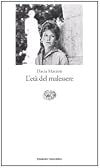
The Age of Discontent
by Dacia Maraini
On This Page
Description
The Cheeky Monkey is back! Wendy has a treasure map and she is off to find the treasure. But a cheeky monkey comes along too... is he really going to help Wendy? The Leapfrog series is perfect for children who are reading on their own, with fun stories of no more than 180 words.Tags
Recommendations





















Member Reviews
I picked up the Italian version of this book (L'Eta del Malessere) while on vacation in Paris last March. I still remember from my Italian text book in college that one of the characters in the "dialoghi lampi" portions was reading the latest book by Dacia Maraini and adored everything she had written. Wow, I thought, to end up in a text book destined for a foreign market, this writer had to be the human equivalent of champagne. I only recently discovered that Maraini was for over twenty years the live-in companion of Alberto Moravia, another glum Italian author who I favor. But all this has little to do with the book. The Age of Discontent is a very elegant, compact story of a young woman grappling with constrictive circumstances show more (parents, love, class, etc.) and eventually achieving release (of a sort) at the end. Enrica starts as a passive, somewhat self-destructive teenager, unconsciously responding to her mother's obession with wealth and status. Over the course of her last school year, she discovers the infructuousness of looking to others, men in particular but also women, to safeguard her own livelihood and happiness. show less
Another little gem of what I call Italian neo-realism (not sure if there's a preferred literary term for this style/genre, so I just use the cinematographic term). There's no plot, but there's a story. The story is simple, but contains multitudes. The characters aren't wacky, but real, true.
Here we see a girl with an "arid heart" (as in Cassola's novel), perhaps a confused heart, a lost soul, but we grow up, time passes, one age (età) of malaise (malessere) passes into another age of... well, that would be another novel....
Here we see a girl with an "arid heart" (as in Cassola's novel), perhaps a confused heart, a lost soul, but we grow up, time passes, one age (età) of malaise (malessere) passes into another age of... well, that would be another novel....
The main protagonist, seventeen year old Enrica, goes through the motions of a struggling life made by an absent, inept father, an embittered mother, a careless, selfish lover and a sub par educational system.
There are parts that hit like a punch in the stomach, especially the depiction of poverty in the struggling household where all three share the same, unique towel (which is in fact a tablecloth) and money simply isn't enough, though not with the same desperate intensity of [b:Il maestro di Vigevano|16009442|Il maestro di Vigevano|Lucio Mastronardi|http://photo.goodreads.com/books/1347716294s/16009442.jpg|21776160]. But there is something almost excessive in Enrica's apathy, which leads her to not "just" be almost too casual with show more her sexual encoutners, but also toprostitute herself by chance. She gets pregnant (by her steady boyfriend, who is about to marry so as to be able to give up college to work for his future wife's father, though it could be any's of her other two partners) and gets an abortion .
It did not work for me - after Moravia's [b:The Time of Indifference|67145|The Time of Indifference|Alberto Moravia|http://photo.goodreads.com/books/1347231801s/67145.jpg|1883062], this did not strike a chord. show less
There are parts that hit like a punch in the stomach, especially the depiction of poverty in the struggling household where all three share the same, unique towel (which is in fact a tablecloth) and money simply isn't enough, though not with the same desperate intensity of [b:Il maestro di Vigevano|16009442|Il maestro di Vigevano|Lucio Mastronardi|http://photo.goodreads.com/books/1347716294s/16009442.jpg|21776160]. But there is something almost excessive in Enrica's apathy, which leads her to not "just" be almost too casual with show more her sexual encoutners, but also to
It did not work for me - after Moravia's [b:The Time of Indifference|67145|The Time of Indifference|Alberto Moravia|http://photo.goodreads.com/books/1347231801s/67145.jpg|1883062], this did not strike a chord. show less
Die junge Enrica lässt sich treiben: Sie trifft sich mit Cesare, wenn der sich von Examen und Braut lösen kann, versucht Carlo loszuwerden, der ihr auf Schritt und Tritt folgt und den sie nicht will und flieht ihren Vater, der in den römischen Vorstadtkneipen das knappe Geld vertrinkt...Doch sie fängt an zu ahnen, dass sie einen Beruf, eine Arbeit braucht, um wirklich selbstständig zu werden.
Kühl und genau entwickelt Dacia Maraini die Geschichte einer Frau, die auf dem Weg ist, ihr Leben selbst in die Hand zu nehmen.
Dacia Maraini, 1936 in Florenz geboren und bis 1946 in Japan aufgwachsen, lebte danach erst in Palermo, jetzt in Rom. Nach journalistischen Anfängen erschien 1962 ihr erster Roman, und bereits 1963 "Zeit des show more Unbehagens" als zweiter. Für ihn erhielt sie den 'Prix Formentor'. Bis heute zieht sich das Thema Emanzipation beinahe leitmotivisch durch ihr Werk. show less
Kühl und genau entwickelt Dacia Maraini die Geschichte einer Frau, die auf dem Weg ist, ihr Leben selbst in die Hand zu nehmen.
Dacia Maraini, 1936 in Florenz geboren und bis 1946 in Japan aufgwachsen, lebte danach erst in Palermo, jetzt in Rom. Nach journalistischen Anfängen erschien 1962 ihr erster Roman, und bereits 1963 "Zeit des show more Unbehagens" als zweiter. Für ihn erhielt sie den 'Prix Formentor'. Bis heute zieht sich das Thema Emanzipation beinahe leitmotivisch durch ihr Werk. show less
May 21, 2007German
Ratings
Members
- Recently Added By
Lists

le donne raccontano
116 works; 1 member
Author Information

143+ Works 2,503 Members
The Florentine Maraini published her first novel, "La Vacanza" (The Holiday), which treats the theme of contemporary female sexuality, in 1962. The next year, she was awarded the Formentor Prize for the novel "L'Era del Malessere" (The Age of Malaise). Later in the decade, she moved almost exclusively to theater, establishing the Teatro di show more Centocelle in Rome in 1969. Though she resumed prose writing, and also has published numerous collections of poetry, she is best known as one of the most important voices in contemporary Italian theater, a writer, director, and producer. In all of her works, Maraini's protaganists are women, often in conflict with men, who are seeking female solidarity. (Bowker Author Biography) show less
Some Editions
Awards and Honors
Awards
Work Relationships
Is contained in
Common Knowledge
- Canonical title
- The Age of Discontent
- Original publication date
- 1963
Classifications
- Genres
- Fiction and Literature, General Fiction
- DDC/MDS
- 853.914 — Literature & rhetoric Italian, Romanian & related literatures Italian fiction 1900- 20th Century 1945-1999
- LCC
- PZ4 .M3115 .A — Language and Literature Fiction and juvenile belles lettres Fiction and juvenile belles lettres Fiction in English
Statistics
- Members
- 66
- Popularity
- 473,486
- Reviews
- 4
- Rating
- (3.58)
- Languages
- English, German, Italian
- Media
- Paper, Ebook
- ISBNs
- 6
- ASINs
- 7