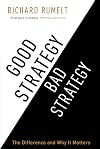
Good Strategy Bad Strategy: The Difference and Why It Matters
by Richard Rumelt
On This Page
Description
Argues that a manager's central responsibility is to create and implement strategies, challenges popular motivational practices, and shares anecdotes discussing how to enable action-oriented plans for real-world results.Tags
Recommendations



Member Recommendations

Member Reviews
Richard Rumelt obviously knows what there is to know about strategy work, and I love his candour when dealing with leaders focusing on vision and goals without planning - or knowing - how to get there. You can't wish yourself to success, you have to work meticulously to build a strategy with coherent elements, test it like a scientist would test a hypothesis. His many examples from business and politics underline his points well. Still there is a lack of passion, it all becomes a bit mechanical, both in the writing and the execution of his ideas. However, I have learnt more about the building blocks of strategy work in this book than in any other business book, so it was worth the read.
Rumelt provides a fascinating discussion of strategy, but don't expect any easy models for good strategy. For Rumelt, good strategy requires both hard work, analysing issues, and a creative insight. In contrast bad strategy appears to be everywhere (often camouflaged - or revealed - by a cloud of gobbledegook) touted by consultants with out of the box models and managers with complete faith in their capacity for charismatic leadership.
Another book too full of itself and another author too full of himself. A plethora of repetitious anecdotes and little value from them. Rumelt accuses Cornell University of bloviating, but doesn't turn his acerbic lens to a mirror. He clearly misunderstands (or deliberately misunderstands) the difference between mission and vision, and strategy.
With respect to the anecdotes, assuming his analysis is correct, it is stunning to me that there are so many examples of non-strategic notions. Strategy is "how", not "what" (it could be the author's perception, but he does have a pedigree, so...) End results are not strategy, and the author seems to want to lead the reader to believe all of his bad examples don't get this. I find that hard to show more believe. And as such, I wonder if Rumelt didn't craft his story to the shape of his story.
Bottom line, there are good strategies and bad strategies. And I gather the author has experience with each. But he doesn't do a good job relating which is which. Oh, he does explain his positions...but I think he cherry-picks his examples. And that is disingenuous. So...loses points.
I have a lot more notes, but I don't think this is worth the time to transcribe them. Pretentious of me? Perhaps. Okay, yes. But that's the impression I got of Rumelt. Pretentious. Unbecoming of me, and I should take the higher road.
So I did. (thus 2 stars) show less
With respect to the anecdotes, assuming his analysis is correct, it is stunning to me that there are so many examples of non-strategic notions. Strategy is "how", not "what" (it could be the author's perception, but he does have a pedigree, so...) End results are not strategy, and the author seems to want to lead the reader to believe all of his bad examples don't get this. I find that hard to show more believe. And as such, I wonder if Rumelt didn't craft his story to the shape of his story.
Bottom line, there are good strategies and bad strategies. And I gather the author has experience with each. But he doesn't do a good job relating which is which. Oh, he does explain his positions...but I think he cherry-picks his examples. And that is disingenuous. So...loses points.
I have a lot more notes, but I don't think this is worth the time to transcribe them. Pretentious of me? Perhaps. Okay, yes. But that's the impression I got of Rumelt. Pretentious. Unbecoming of me, and I should take the higher road.
So I did. (thus 2 stars) show less
One of the best book on strategy I have ever read. At first, I checked the author, Richard Rumelt and found out that he is a college professor. This fact brought some doubts regarding his authentic experience in the field of corporate strategy. At the moment, I can admit that my prejudice was without merit. Moreover, even some classroom narratives turned out to be in-depth and accurate case studies.
The key message of the book is an honest, intellectual assessment of your own thinking. Good Strategy Bad Strategy is full of relevant and incisive cases in business, government and military sectors – presenting those fine strategies are built on sincere mindset.
Getting down to essentials, the book is divided into three major chunks:
1. Good show more and bad strategies which addresses the differences between these two groups.
2. Sources of power... (if you like to read my full review please visit my blog: https://leadersarereaders.blog/2018/11/05/good-strategy-bad-strategy-the-differe... show less
The key message of the book is an honest, intellectual assessment of your own thinking. Good Strategy Bad Strategy is full of relevant and incisive cases in business, government and military sectors – presenting those fine strategies are built on sincere mindset.
Getting down to essentials, the book is divided into three major chunks:
1. Good show more and bad strategies which addresses the differences between these two groups.
2. Sources of power... (if you like to read my full review please visit my blog: https://leadersarereaders.blog/2018/11/05/good-strategy-bad-strategy-the-differe... show less
This book is excellent. If you ever wonder why people or organisations are getting to where they want to be while other don't, this is it. The very clear distinction between good strategy (the identification of what is in your way and how to bundle and focus what you have to get there while leaving your competition behind) and bad strategy (Imagine where you would like to be, describe it in rosy colours, select as many objectives as you can and then do not waste any time on thinking how to get there more than setting a deadline) explains it.
The book is written in clear language with a lot of impressive examples for both approaches.
This book certainly has opened my eyes on what successful strategy means, and how it can be formulated. I show more warmly recommend it after reading it twice in three months. show less
The book is written in clear language with a lot of impressive examples for both approaches.
This book certainly has opened my eyes on what successful strategy means, and how it can be formulated. I show more warmly recommend it after reading it twice in three months. show less
A business view of strategy but also one of the few to make strategic thinking something more specific than post-hoc history written by the winner.
The book could be condensed to something much shorter...
The book could be condensed to something much shorter...
R. Rumelt fully justifies his position on what defines good strategy, and why there is so much bad strategy out there. Extraordinary well written. R. Rumelt has the clear, elegant framework in what he calls the "kernel"--a diagnosis explaining the nature of the challenge, a guiding policy for dealing with it, and a set of coherent actions for carrying out the policy. A must read for poeple involved in strategy creation or with an interest in strategy in general.
Members
- Recently Added By
Lists

Strategist
1 work; 1 member
Author Information
5 Works 864 Members
Awards and Honors
Classifications
- Genres
- Business, Nonfiction, General Nonfiction
- DDC/MDS
- 658.4012 — Applied science & technology Management & public relations General management Executive Planning, control, strategy Strategy
- LCC
- HD30.28 .R854 — Social sciences Industries. Land use. Labor Industries. Land use. Labor Management. Industrial management
- BISAC
Statistics
- Members
- 826
- Popularity
- 33,357
- Reviews
- 9
- Rating
- (4.09)
- Languages
- Chinese, English
- Media
- Paper, Audiobook, Ebook
- ISBNs
- 14
- ASINs
- 7