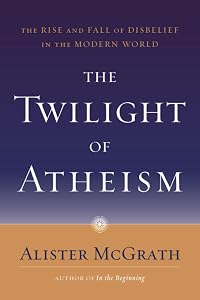
The Twilight of Atheism: The Rise and Fall of Disbelief in the Modern World
by Alister McGrath
On This Page
Description
Atheism is one of the most important movements in modern Western culture. For the last two hundred years, it seemed to be on the verge of eliminating religion as an outmoded and dangerous superstition. Recent years, however, have witnessed the decline of disbelief and a rise in religious/spiritual devotion throughout the world. In this highly readable book, the distinguished historian and theologian, Alister McGrath examines what went wrong with the atheist dream and explains why religion show more and faith are destined to play a central role in the twenty-first century. A former atheist who is now one of Christianity's foremost scholars, McGrath traces the history of atheism from its emergence in eighteenth-century Europe as a revolutionary worldview that offered liberation from the rigidity of traditional Christianity and the oppression of tyrannical monarchs, to its golden age in the first half of the twentieth century. Blending thoughtful, authoritative historical analysis with incisive portraits of such leading and influential atheists as Sigmund Freud, Marx and Richard Dawkins, McGrath exposes the flaws at the heart of atheism and argues that the renewal of faith is a natural, inevitable and necessary response to its failures. show lessTags
Recommendations











Member Reviews
I learned quite a lot from this book. It is good to see that even the evangelical wing of the Church of England can produce someone who can give such a clear-eyed assessment of the failings of Protestantism. He also takes seriously the religious views of figures such as Marx and Nietzsche, who most evangelical writers would, I think, simply write off as godless and irrelevant to the faithful, and grapples intelligently with the issues they raise.
Where the book didn't quite grab me was in its focus on positive, militant atheism. The book does not really set out to be an apologetic in favour of theism, but it has little to say about (or for) those who simply lose their grip on belief, rather than those who actively reject it. But I expect show more to read more McGrath, since although I don't share his fairly traditional approach to Christian faith, he is a much more sophisticated thinker than many on the orthodox side of the Church, and runs rings around Richard Dawkins's frankly naive views on religion.
MB 28-ix-2010 show less
Where the book didn't quite grab me was in its focus on positive, militant atheism. The book does not really set out to be an apologetic in favour of theism, but it has little to say about (or for) those who simply lose their grip on belief, rather than those who actively reject it. But I expect show more to read more McGrath, since although I don't share his fairly traditional approach to Christian faith, he is a much more sophisticated thinker than many on the orthodox side of the Church, and runs rings around Richard Dawkins's frankly naive views on religion.
MB 28-ix-2010 show less
An excellent historical analysis of the phenomenology of atheism-- the reasons for its promotion, the climate that facilitated its growth and promotion, and the factors that are now leading to its decline as a cultural and social force.
McGrath is well-read in these matters, having come out of atheism itself. He is fair-- even seemingly sympathetic-- toward the ideology of atheism, understanding that atheism grew strongly because of disenchantment and disillusionment with the institutional denominations of the day. Nevertheless, he is very open and evident about the fundamental flaws of the atheistic ideologies that came out of the 18th and 19th centuries, exposing them for being hyper-simplistic and that they didn't turn out too well in show more reality in the Soviet Union in the 20th century. In the end, "oppression" and "liberation" can happen either through atheism or through theism. Both atheists and theists must start out assuming an otherwise unprovable proposition of belief (or unbelief) in order to make any coherent statement of belief (or unbelief).
This book is excellent reading in order to understand not just the phenomenology of atheism but the ironic role Protestantism played in the development of atheism by, for all intents and purposes, disassociating the sacred from regular life. As McGrath indicates, it was not a long journey between "living as if there were no God" to "believing there is no God."
A book with plenty of insight for believer and unbeliever alike. An excellent warning for believers in regards to the challenges faced by culture. show less
McGrath is well-read in these matters, having come out of atheism itself. He is fair-- even seemingly sympathetic-- toward the ideology of atheism, understanding that atheism grew strongly because of disenchantment and disillusionment with the institutional denominations of the day. Nevertheless, he is very open and evident about the fundamental flaws of the atheistic ideologies that came out of the 18th and 19th centuries, exposing them for being hyper-simplistic and that they didn't turn out too well in show more reality in the Soviet Union in the 20th century. In the end, "oppression" and "liberation" can happen either through atheism or through theism. Both atheists and theists must start out assuming an otherwise unprovable proposition of belief (or unbelief) in order to make any coherent statement of belief (or unbelief).
This book is excellent reading in order to understand not just the phenomenology of atheism but the ironic role Protestantism played in the development of atheism by, for all intents and purposes, disassociating the sacred from regular life. As McGrath indicates, it was not a long journey between "living as if there were no God" to "believing there is no God."
A book with plenty of insight for believer and unbeliever alike. An excellent warning for believers in regards to the challenges faced by culture. show less
A very interesting trip through atheism as conceived from the French Revolution to the fall of the Berlin Wall two centuries later. McGrath makes an interesting case for atheism as a leech philosophy (in that it is simply a case of denying what others assert), and gives an good overview of how movements within Christianity like Pentecostalism show that religious belief adapts and in doing so shows that it is a permanent feature of human life. As a Protestant McGrath’s focus is on his own religion but the same would apply elsewhere.
There are, I think, two significant problems with McGrath’s thesis that atheism is in twilight. Firstly he makes the case himself that, historically, popular forms of atheism have risen in response to show more violent and aggressive forms of religion – a thesis borne out after the publication of this work by the batch of remarkably popular atheist books, provoked by the prominence of Christian and Islamic fundamentalisms. All the religions have been periodically violent and aggressive throughout their history (alongside other things), and there is nothing to indicate that this cycle is going to stop. Secondly, in the secular West (at least) there are vast numbers of people for whom religion and spirituality more generally have little or no importance – non-intellectual atheists, if you like – who do not have this aspect to their lives or see why they need it. That constituency may well be of limited scale, but it seems to be as solid and sure of itself as any other body. Probably of course there have always been many such people, even in deeply religious societies, only now they have no reason to hide it. And that is, of course, only another reason that they will not be going anywhere. show less
There are, I think, two significant problems with McGrath’s thesis that atheism is in twilight. Firstly he makes the case himself that, historically, popular forms of atheism have risen in response to show more violent and aggressive forms of religion – a thesis borne out after the publication of this work by the batch of remarkably popular atheist books, provoked by the prominence of Christian and Islamic fundamentalisms. All the religions have been periodically violent and aggressive throughout their history (alongside other things), and there is nothing to indicate that this cycle is going to stop. Secondly, in the secular West (at least) there are vast numbers of people for whom religion and spirituality more generally have little or no importance – non-intellectual atheists, if you like – who do not have this aspect to their lives or see why they need it. That constituency may well be of limited scale, but it seems to be as solid and sure of itself as any other body. Probably of course there have always been many such people, even in deeply religious societies, only now they have no reason to hide it. And that is, of course, only another reason that they will not be going anywhere. show less
This book should be read by every secularist. It cannot be dismissed lightly, but neither need the secularist overly fear it. I enjoyed it in part because it introduced me to some old atheistic writers that I will want to pursue. While rightly pointing out the failures of establishment atheism (USSR, etc), I think that this book should remind us to review the realities of established Christianity in Europe. Pentecostalism is presented to remind that Christianity is a moving target, but is Pentecostalism so far removed from the vulnerabilities of the old Christian orthodoxies? McGrath almost insists on the hard definition of atheism, but is it not possible that atheism can also re-imagine itself? I think it is a little strange, but no show more less refreshing, that this polemic against atheism appeals to "postmodern" pluralism. show less
http://nwhyte.livejournal.com/1430527.html
Yet another book on religion where I basically agree with the author but found the book itself really unsatisfactory.
Basically, McGrath seemed to me to be asking the wrong question. His argument identifies 'atheism' as a collective identity more than is really warranted by his own evidence; towards the end he seems to almost criticize atheists for not being as well organised as the Church, which sort of misses the point. More widely, he never makes it clear whose atheism or belief is under discussion, though I felt that in the present day he really just means Oxford dons. Non-Christian faiths are barely mentioned; there is an anecdote about the triumph of Christianity in Korea in the 20th show more century which simply does not refer to other religions practised by Koreans. This really isn't good enough.
The internal structure puzzled me as well. I would have preferred a more strictly chronological organisation. But instead we have a chapter on Feuerbach, Marx and Freud, followed by one on the sciences post-Darwin, followed by an examination of atheism in classic literature from the Enlightenment on (that last being one of the better chapters in the book). It is as if Freud knew nothing of Darwin, and Darwin knew nothing of Keats. (I confess I had not preeviously heard of Feuerbach, but that may just be my ignorance.)
Other irritations: James II was not Charles II's son (p 14). I was surprised to read (p 264-265) that 'The role of religion in creating and sustaining communal identity has been known for some considerable time, and has become increasingly important since about 1965'; I think it's just possible that religion played an important role in creating and sustaining communal identity for quite a long time prior to that date.
I suspect that this book was intended to be in part a rebuttal to Richard Dawkins, who is very briefly dissected, but unfortunately it is too full of its own complacency to be effective. show less
Yet another book on religion where I basically agree with the author but found the book itself really unsatisfactory.
Basically, McGrath seemed to me to be asking the wrong question. His argument identifies 'atheism' as a collective identity more than is really warranted by his own evidence; towards the end he seems to almost criticize atheists for not being as well organised as the Church, which sort of misses the point. More widely, he never makes it clear whose atheism or belief is under discussion, though I felt that in the present day he really just means Oxford dons. Non-Christian faiths are barely mentioned; there is an anecdote about the triumph of Christianity in Korea in the 20th show more century which simply does not refer to other religions practised by Koreans. This really isn't good enough.
The internal structure puzzled me as well. I would have preferred a more strictly chronological organisation. But instead we have a chapter on Feuerbach, Marx and Freud, followed by one on the sciences post-Darwin, followed by an examination of atheism in classic literature from the Enlightenment on (that last being one of the better chapters in the book). It is as if Freud knew nothing of Darwin, and Darwin knew nothing of Keats. (I confess I had not preeviously heard of Feuerbach, but that may just be my ignorance.)
Other irritations: James II was not Charles II's son (p 14). I was surprised to read (p 264-265) that 'The role of religion in creating and sustaining communal identity has been known for some considerable time, and has become increasingly important since about 1965'; I think it's just possible that religion played an important role in creating and sustaining communal identity for quite a long time prior to that date.
I suspect that this book was intended to be in part a rebuttal to Richard Dawkins, who is very briefly dissected, but unfortunately it is too full of its own complacency to be effective. show less
Usually I won't count a book if I was forced to read it for school, but this book was so good I couldn't deny that I read it for pleasure instead of picking out quotes. The thesis is easy to follow, the history passionate and the language entertaining. My thesis was on atheism, secularization and religion and my paper was a much better one for having read this book.
An interesting survey of an intellectual movement, full of lapses and clumsy execution.
I'm only on page 20 so far, and have found a number of factual errors, such as the assertion that Lucretius was an atheist, that Homer wrote the judgement of Paris episode, and others. Obviously he hasn't read the primary sources.
However I bought the book because of what's promised in the table of contents- a lengthy treament of more modern movements and individuals (including a section on one of my favourite atheist poets A. C. Swinburne). The book looks to be a readable introduction to a number of figures, unfortunately one which will necessitate going to the sources he mentions, to get an accurate picture.
I'm only on page 20 so far, and have found a number of factual errors, such as the assertion that Lucretius was an atheist, that Homer wrote the judgement of Paris episode, and others. Obviously he hasn't read the primary sources.
However I bought the book because of what's promised in the table of contents- a lengthy treament of more modern movements and individuals (including a section on one of my favourite atheist poets A. C. Swinburne). The book looks to be a readable introduction to a number of figures, unfortunately one which will necessitate going to the sources he mentions, to get an accurate picture.
Members
- Recently Added By
Author Information

237+ Works 23,863 Members
Alister McGrath is currently professor of theology at Oxford and principal of Wycliffe Hall. He is a consulting editor, general editor and author of several books. He lives in Oxford, England.
Awards and Honors
Distinctions
Common Knowledge
- Canonical title
- The Twilight of Atheism: The Rise and Fall of Disbelief in the Modern World
Classifications
- Genres
- Religion & Spirituality, Nonfiction, Philosophy, History, General Nonfiction
- DDC/MDS
- 211.809 — Religion Philosophy & theory of religion Concepts of God Atheism Biography And History
- LCC
- BL2747.3 .M355 — Philosophy, Psychology and Religion Religions. Mythology. Rationalism Religions. Mythology. Rationalism Rationalism
- BISAC
Statistics
- Members
- 500
- Popularity
- 60,296
- Reviews
- 8
- Rating
- (3.79)
- Languages
- Dutch, English, Finnish
- Media
- Paper, Ebook
- ISBNs
- 8
- ASINs
- 3