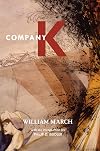
Company K
by William March
On This Page
Description
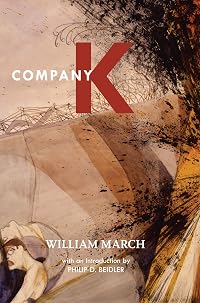
With an Introduction by Philip D. Beidler This book was originally published in 1933. It is the first novel by William March, pen name for William Edward Campbell. Stemming directly from the author's experiences with the U.S. Marines in France during World War I, the book consists of 113 sketches, or chapters, tracing the fictional Company K's war exploits and providing an emotional history of the men of the company that extends beyond the boundaries of the war itself. William Edward show more Campbell served courageously in France as evidenced by his chest show lessTags
Recommendations



























Member Reviews
William March's COMPANY K is definitely a forgotten classic of the Great War. I only heard of it recently when it was cited in an essay about war writing by Phil Klay, whose own story collection, REDEPLOYMENT, won the NBA a few years back.
COMPANY K is a novel in a unique form, told in the personal voices of the men and officers of the unit, which served in France in the last year of the war. There are over a hundred 'voices ' heard from here, each telling their story in a short statement or anecdote, seldom more than a page or two. There is little or nothing said of glory or honor of heroism. Instead we hear of fear and hunger, cowardice and theft, buggery and murder, and on and on. In the words of one Private who worked as a court show more reporter at regimental court martial hearings -
"I wish the lads who talk about the nobility and comradeship of war could listen to a few general courts. They'd soon change their minds, for war is as mean as poor-farm soup and as petty as an old maid's gossip."
March's serial, plain-spoken narrators being to mind other classics of American letters which have NOT been forgotten. Crane's RED BADGE OF COURAGE, of course, but K is also a kind of WINESBURG of war, or even, since many of the the men are speaking from the grave, SPOON RIVER.
Some of the stories here are from after the war, and PTSD, as yet unnamed and unknown, figures prominently, with some sad examples of mental illness and suicides. As a reader, I couldn't help but wonder if March himself might have suffered far-reaching negative effects of his wartime experiences. Indeed, the author (whose real name was William Edward Campbell) was highly decorated for his service with the Marines. COMPANY K, originally published in 1933, was his first book. He published several more, but is probably best remembered for his last, THE BAD SEED. He died soon after, in 1954. He was just 61.
Written in a very unique style, with piercing honesty, COMPANY K deserves a much higher place in the pantheon of war lit. The University of Alabama Press deserves kudos for bringing the book back into print for a new generation of readers. My highest recommendation.
- Tim Bazzett, author of the Cold War memoir, SOLDIER BOY: AT PLAY IN THE ASA show less
COMPANY K is a novel in a unique form, told in the personal voices of the men and officers of the unit, which served in France in the last year of the war. There are over a hundred 'voices ' heard from here, each telling their story in a short statement or anecdote, seldom more than a page or two. There is little or nothing said of glory or honor of heroism. Instead we hear of fear and hunger, cowardice and theft, buggery and murder, and on and on. In the words of one Private who worked as a court show more reporter at regimental court martial hearings -
"I wish the lads who talk about the nobility and comradeship of war could listen to a few general courts. They'd soon change their minds, for war is as mean as poor-farm soup and as petty as an old maid's gossip."
March's serial, plain-spoken narrators being to mind other classics of American letters which have NOT been forgotten. Crane's RED BADGE OF COURAGE, of course, but K is also a kind of WINESBURG of war, or even, since many of the the men are speaking from the grave, SPOON RIVER.
Some of the stories here are from after the war, and PTSD, as yet unnamed and unknown, figures prominently, with some sad examples of mental illness and suicides. As a reader, I couldn't help but wonder if March himself might have suffered far-reaching negative effects of his wartime experiences. Indeed, the author (whose real name was William Edward Campbell) was highly decorated for his service with the Marines. COMPANY K, originally published in 1933, was his first book. He published several more, but is probably best remembered for his last, THE BAD SEED. He died soon after, in 1954. He was just 61.
Written in a very unique style, with piercing honesty, COMPANY K deserves a much higher place in the pantheon of war lit. The University of Alabama Press deserves kudos for bringing the book back into print for a new generation of readers. My highest recommendation.
- Tim Bazzett, author of the Cold War memoir, SOLDIER BOY: AT PLAY IN THE ASA show less
This novel of WWI, written by William March, an American veteran of the Great War, was first published in 1933. Company K consists of 113 short episodes, each told by a different man in the company. A number of the episodes are related, which allows readers to see events through more than one pair of eyes. One major event that has repercussions for several of the men is the order to shoot a group of unarmed German prisoners; another is an officer's stubborn insistence on locating an outpost in an exposed location, with disastrous results.
Pvt. Joseph Delaney's musings open the novel; he is identified as the (fictional) writer. Among his thoughts: "This book started out to be a record of my own company, but I do not want it to be that show more now. I want it to be a record of every company in every army. . .. With different names and different settings, the men of whom I have written could, as easily, be French, German, English or Russian for that matter. . . . I wish there were some way to take these stories and pin them to a huge wheel, each story hung on a dfferent peg until the circle was completed. Then I would like to spin the wheel, faster and faster, until the things of which I have written took life and were recreated, and became part of the whole, flowing toward each other, and into each other; blurring, and then blending together into a composite whole, an unending circle of pain. . . . That would be the picture of war."
Company K is simply told, and easily read. What remains in my mind, having read it, is something like the circular blur of experience described by Pvt. Delaney. The novel does not operate as a linear narrative; rather, it is a blending of many voices and images. While it offers glimpses of soldiers' individual experiences, it also presents a complex and thought-provoking picture of the human cost of World War I. Highly recommended. show less
Pvt. Joseph Delaney's musings open the novel; he is identified as the (fictional) writer. Among his thoughts: "This book started out to be a record of my own company, but I do not want it to be that show more now. I want it to be a record of every company in every army. . .. With different names and different settings, the men of whom I have written could, as easily, be French, German, English or Russian for that matter. . . . I wish there were some way to take these stories and pin them to a huge wheel, each story hung on a dfferent peg until the circle was completed. Then I would like to spin the wheel, faster and faster, until the things of which I have written took life and were recreated, and became part of the whole, flowing toward each other, and into each other; blurring, and then blending together into a composite whole, an unending circle of pain. . . . That would be the picture of war."
Company K is simply told, and easily read. What remains in my mind, having read it, is something like the circular blur of experience described by Pvt. Delaney. The novel does not operate as a linear narrative; rather, it is a blending of many voices and images. While it offers glimpses of soldiers' individual experiences, it also presents a complex and thought-provoking picture of the human cost of World War I. Highly recommended. show less
I actually read this around 40 years ago but for some reason it has just come back into my mind unbidden after all these years.
I think it was the first book to really bring home to me the spectrum of damage that war causes outside of the plain physical. It also illustrates that there are many different types of people drafted into war, some keen and some not so keen.
The biggest impact was realising that this book was written by someone who had been there. It doesn't carry as single anti-war message as such, rather a whole host of individual messages. It reeks of authenticity.
Written in the form of a chapter per soldier, some barely a few sentences long, others take time to read. Would be a great book for schools because everyone could show more find one or more chapters that resonate, irrespective of reading style.
Glad I remembered it. show less
I think it was the first book to really bring home to me the spectrum of damage that war causes outside of the plain physical. It also illustrates that there are many different types of people drafted into war, some keen and some not so keen.
The biggest impact was realising that this book was written by someone who had been there. It doesn't carry as single anti-war message as such, rather a whole host of individual messages. It reeks of authenticity.
Written in the form of a chapter per soldier, some barely a few sentences long, others take time to read. Would be a great book for schools because everyone could show more find one or more chapters that resonate, irrespective of reading style.
Glad I remembered it. show less
I didn't expect to really like this book, but it grew on me. It's about WWI, a company of men marching through France, little stories from each of them. Some only a couple of paragraphs long, others several pages. Often two paired together showing the same incident from their different viewpoints. The voices are not very distinct, but the individual responses to the horrors and senselessness of war are. Men befriending enemies and killing friends, injuring themselves on purpose to get out of fighting, searching for solace with women along the way, misunderstanding the locals in the countryside, insurgency and bravery and cowardice, pain and suffering and bewilderment. It's gruesome in many parts, in a straightforward, matter-of-fact show more way. Roughly chronological, although there really is no storyline to follow, just pieces here and there of each man's experience. Eagerness at the beginning when the men are first enlisted and training, the long slog, the growing horrors, the numbness and fear and everything else, what it was like for many of them to come home. Lauded when they didn't deserve or want it, others ignored when they had gone through the worst, the difficulties in making their lives again. Reminded me some of Strange Meeting by Susan Hill.
from the Dogear Diary show less
from the Dogear Diary show less
William March’s 1933 novel, Company K, about an American Marine company in France for 9 months at the end of WW I is a strange little novel. With no narrative arc, no omniscient narrator, it is composed of short, first person stories from 118 men. It’s as though each man was asked to write down, in 250 words or less, one memory of their time at war. They are then arranged by time. The first several are pre-war, the exuberance and naivete of the youngsters going over, the exhortations of the chaplains to conduct themselves like crusaders. They arrive in March of 1918 and fight in several famous-to-history battles, including that of Belleau Wood, and through to the Armistice on November, 11. No detail is spared, including cutting of show more ears, taking memorabilia from corpses and the most inflammatory, Americans shooting German prisoners of war, not in ones or twos but en-masse: line ‘em up and mow ‘em down. The last third of the book is in the post war, stories of the welcomes back, the loans to start a farm refused, the war injuries hobbling some, one in prison for cop-killing, one in an insane asylum.
All is delivered in a spare, un-melodramatic prose. A matter-of-fact, “This is what happened. I was there. I saw it.”
It’s a strange book, and it grows on you
- See more at: http://www.allinoneboat.org/2013/11/09/company-k-americans-in-france-ww-i/#sthas... show less
All is delivered in a spare, un-melodramatic prose. A matter-of-fact, “This is what happened. I was there. I saw it.”
It’s a strange book, and it grows on you
- See more at: http://www.allinoneboat.org/2013/11/09/company-k-americans-in-france-ww-i/#sthas... show less
Great War fiction, published in 1933. The author was a U. S. Marine, and was awarded both the Distinguished Service Cross and Navy Cross, a feat that cannot have repeated many times. The novel is episodic, with each member of Company K receiving a few lines or at most a few pages, like a modern day oral history. The vignettes cover boyhood though death in old age, all tied to their time in the trenches but of course most take place in 1918 France. Deserters are shot, cowards survive, officers fragged, prisoners executed, Marines are gassed, a pet goat stewed, and we share it all through their individual voices. Powerful.
Sometimes the truth can only be told via the anguish of Fiction
Members
- Recently Added By
Lists

World War I Fiction
94 works; 15 members

r/AskHistorians' Recommended Books
1,068 works; 19 members
THE WAR ROOM
813 works; 24 members

Ryan Holiday's Books To Base Your Life On
97 works; 2 members
Author Information

15+ Works 1,404 Members
Some Editions
Awards and Honors
Notable Lists
Series
Belongs to Publisher Series
Work Relationships
Is abridged in
Common Knowledge
- Canonical title
- Company K
- Original title
- Company K
- Original publication date
- 1933
- Important events
- World War I
- Related movies
- Company K (2004 | IMDb)
Classifications
Statistics
- Members
- 291
- Popularity
- 110,592
- Reviews
- 11
- Rating
- (4.10)
- Languages
- 6 — Dutch, English, Finnish, French, Italian, Spanish
- Media
- Paper, Ebook
- ISBNs
- 20
- ASINs
- 9