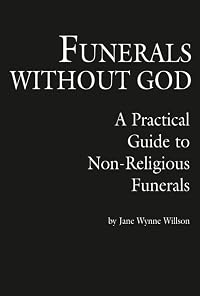
Funerals Without God : A Practical Guide to Non-Religious Funerals
by Jane Wynne Willson, Richard Brown
36 Members (3.33)
On This Page
Description
The main purpose of this booklet is twofold: to help Humanists who are thinking of becoming officiants on a regular basis; and to help families and friends who are faced with the need to organize a ceremony themselves at short notice. A third group who may find parts of it useful are funeral directors coping with funerals where there is no officiant and the family has no wish to play an active role. The booklet aims to set out clearly the basic format of a Humanist ceremony, to suggest show more possible readings and turns of phrase, and to state simply the various practical measures that need to be taken. In short, it is a straightforward working manual. "[It was] the first funeral I had attended where I felt comfortable, and comforted by the words spoken." " . . . it gave me a sense of great peace." "To hear others publicly proclaim their love, respect and admiration for my husband made the funeral an uplifting experience. Afterwards so many who had attended told me that it was the most interesting, most moving, most relevant and best funeral that they had ever been to. Their remarks gave me a great deal of comfort and I knew that I had treated my husband's atheism with the respect and dignity that it deserved." "A large number of those present, from a wide range of beliefs and backgrounds, later expressed what we can only call enthusiasm for an experience that was new to them, and in many cases compared very favourable with the often awkward and impersonal alternatives with which they were familiar." "Bearing in mind that this is a form of ceremony which has not yet gained wide acceptance, we consider ourselves fortunate . . . to have received such expert and personal attention." show lessTags
Recommendations






















Member Reviews
Members
- Recently Added By
Author Information
3+ Works 45 Members
4+ Works 30 Members
Common Knowledge
- Canonical title
- Funerals Without God : A Practical Guide to Non-Religious Funerals
- First words
- 1 Introduction
The Need for Ceremony
We know that throughout history, and indeed pre-history, ceremonies have been used to mark important events in people's lives, and a formal occasion can be particulary hel... (show all)pful in the early days of bereavement. The public expresssion and sharing of grief is generally considered an essential part of recovery after the death of someone close, and the opportunity for this shared grieving is provided by the various world religions according to their own rites. But it can be both distasteful and distressing for those present if a religious service is carried out for someone who had no religious belief. - Quotations
- There is an intimacy about a ceremony that is organized by those immediately involved, which cannot be achieved when it is conducted by an outsider. It seems the natural thing to do—the last service to someone for whom you ... (show all)have cared.
- Last words
- (Click to show. Warning: May contain spoilers.)Other Arrangements
When the body is not there, either because it was left to medical research or following some accident or disaster, the ceremony will inevitably take the form of a memorial meeting, with no committal. When the family are anxious to organize a ceremony to bury or scatter ashes, this can involve a brief tribute and some appropriate words. - Original language
- English
Classifications
- Genres
- Nonfiction, Sociology, Religion & Spirituality
- DDC/MDS
- 393.9 — Society, government, & culture Customs, etiquette & folklore Death customs Funeral customs
- LCC
- GT3150 .W55 — Geography, Anthropology and Recreation Manners and customs (General) Manners and customs (General) Customs relative to private life
- BISAC
Statistics
- Members
- 36
- Popularity
- 798,363
- Rating
- (3.33)
- Languages
- English, Italian
- Media
- Paper, Ebook
- ISBNs
- 5
- ASINs
- 1