
On This Page
Description
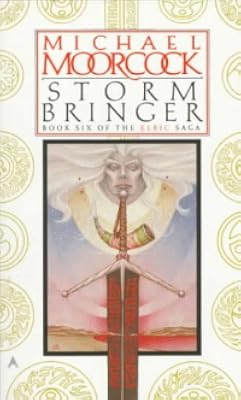
Feared by enemies and friends alike, Elric of Melniboné walks a lonely path among the worlds of the multiverse. The destroyer of his own cruel and ancient race, as well as its final ruler, Elric is the bearer of a destiny as dark and cursed as the vampiric sword he carries the sentient black blade known as Stormbringer. Contains both the novel Stormbringer and associated short stories and other material.Tags
Recommendations
















Member Reviews
An absolutely perfect—if perhaps slightly drawn out—end to the Elric saga.
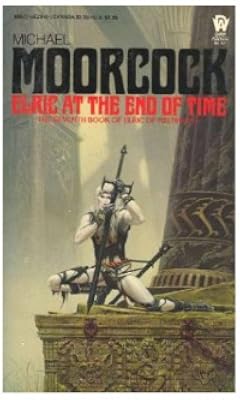
And a note on that. There is a seventh volume, Elric at the End of Time that I read and remember being exceptionally disappointed in. I've since found out it was not written sequentially, and really isn't an official part of the series. So I won't be reading it again. I'm going to let Elric go here, the way it was intended.
We see Elric, who is surely one of the most tragic fantasy heroes ever written, stretched to his limit, and it's actually quite devastating to read. No spoilers, but the end was completely fitting.
A fantastic series. Well worth the effort.
And a note on that. There is a seventh volume, Elric at the End of Time that I read and remember being exceptionally disappointed in. I've since found out it was not written sequentially, and really isn't an official part of the series. So I won't be reading it again. I'm going to let Elric go here, the way it was intended.
We see Elric, who is surely one of the most tragic fantasy heroes ever written, stretched to his limit, and it's actually quite devastating to read. No spoilers, but the end was completely fitting.
A fantastic series. Well worth the effort.
What an impressive "end"! :) Of course, I already know there are a number of books that continue on, but I have to assume they take place before this Final Battle.
The black blade always gets the final laugh. Indeed.
I need to back up. These Elric tales are epic in the purest sense of the word. Forces of Chaos and Law rage across all lands and the multiverse... all time, as well. Elric's sword, Stormbringer, was designed to destroy the gods of Chaos together its twin, a blade of Law. Both are intelligent, drinkers of souls, and bloodthirsty as hell.
Elric straddles the line between both forces, focused on revenge as everything he's ever known or loved dies before him. He's a god-killer.
You know all those epic fantasies we love so much by show more all the biggest names in fantasy? Robert Jordan, Neil Gaiman, or hell, all of D&D pull from this author's epic ideas. Incarnations of Chaos, elementals, incarnations of Law (order), and Men. So many huge armies live and die, the continents change, the death toll utterly immense. Think about the fourth season of Babylon 5. It's this scope. This immensity.
But realize Elric came out long before all those. This is what Tolkien COULD have been had he gotten out of the minor details of all these lives and not fought for the static continuation of everyone's lives as the greatest good. Moorcock ramped up the stakes to the same level of Melkor versus all the Illuvatar and beyond since the stakes were for all time and all worlds across the multiverse. :)
Just saying... this is some impressive stuff. :) show less
The black blade always gets the final laugh. Indeed.
I need to back up. These Elric tales are epic in the purest sense of the word. Forces of Chaos and Law rage across all lands and the multiverse... all time, as well. Elric's sword, Stormbringer, was designed to destroy the gods of Chaos together its twin, a blade of Law. Both are intelligent, drinkers of souls, and bloodthirsty as hell.
Elric straddles the line between both forces, focused on revenge as everything he's ever known or loved dies before him. He's a god-killer.
You know all those epic fantasies we love so much by show more all the biggest names in fantasy? Robert Jordan, Neil Gaiman, or hell, all of D&D pull from this author's epic ideas. Incarnations of Chaos, elementals, incarnations of Law (order), and Men. So many huge armies live and die, the continents change, the death toll utterly immense. Think about the fourth season of Babylon 5. It's this scope. This immensity.
But realize Elric came out long before all those. This is what Tolkien COULD have been had he gotten out of the minor details of all these lives and not fought for the static continuation of everyone's lives as the greatest good. Moorcock ramped up the stakes to the same level of Melkor versus all the Illuvatar and beyond since the stakes were for all time and all worlds across the multiverse. :)
Just saying... this is some impressive stuff. :) show less
Stormbringer is the tale of Elric, last king of faded Melniboné, who must once more pick up his evil and sentient runesword Stormbringer in an almost hopeless effort to save the world from ultimate Chaos. Moorcock delivers fast-paced action on a grand scale, rapidly moving from battle to battle, with some gods and demons put in for good measure. It is good if undemanding fun, but one senses that Moorcock is trying to achieve effects that he never quite pulls off. The personal tragedies that the protagonist experiences are surely meant to stir the reader’s emotions, but the characters are underdeveloped and often little more than cyphers. In the same vein, the book spends quite some time talking about the cosmic balance between Law show more and Chaos, but the theories expounded are both confused and shallow. Stormbringer never rises above the level of an enjoyable fantasy romp.
It is unfortunate that this enjoyment is sometimes diminished by sloppy or lazy writing. Here is a particularly bad example: ‘Stormbringer radiated an evil poison which more than slew Elric’s attackers – it drank their souls[...]’ “Evil poison” is a metaphor that manages to be both forced and clichéd; and how poison can be “radiated” is a mystery only matched by the mystery of how it can drink something. I was also fascinated to read about a room that extended into dimensions that were spaceless and timeless – mr. Moorcock evidently knowing about kinds of extension that I have never dreamt about. The book, then, is best enjoyed with one’s critical faculties turned off or at least toned down… which is not true about the works of better writers, among whom, I believe, mister Moorcock at other times might be ranked. show less
It is unfortunate that this enjoyment is sometimes diminished by sloppy or lazy writing. Here is a particularly bad example: ‘Stormbringer radiated an evil poison which more than slew Elric’s attackers – it drank their souls[...]’ “Evil poison” is a metaphor that manages to be both forced and clichéd; and how poison can be “radiated” is a mystery only matched by the mystery of how it can drink something. I was also fascinated to read about a room that extended into dimensions that were spaceless and timeless – mr. Moorcock evidently knowing about kinds of extension that I have never dreamt about. The book, then, is best enjoyed with one’s critical faculties turned off or at least toned down… which is not true about the works of better writers, among whom, I believe, mister Moorcock at other times might be ranked. show less
The Elric saga comes to close and a very satisfying conclusion with Elric, Moonglum and Stormbringer each playing their parts. A little more thoughtful then the previous volumes and the first since volume one that felt like a regular novel not three novellas tied together. But Moorcock did a fine job of string together the pieces from Books 1 - 5 that are woven into this finale.
A satisfying and appropriate ending (never mind Moorcock wrote more later) for a hell of a series. Classic big-idea fantasy at its best!
What can I say? I know this stuff is junk-food, but every now and then I need a hit. Back in college I used to gorge myself on Moorcock as an antidote to the reading imposed on me by professors.
Good, but I'm awfully tired of this overworked theme of heroes as playthings of the gods.
Members
- Recently Added By
Lists

Best Fantasy Novels
821 works; 361 members

NPRs your picks: top 100 Sci-Fi/Fantasy books
297 works; 80 members

The Seven-League Shelf
57 works; 3 members

David Pringle's Modern Fantasy: The 100 Best Novels
100 works; 5 members

Cawthorn and Moorcock's Fantasy: The 100 Best Books
110 works; 7 members

Books Read in 2023
5,547 works; 145 members

Books Read in 2017
4,249 works; 129 members

Mustich's 1000 Books to Read Before You Die: A Life Changing List
1,001 works; 19 members
Author Information

658+ Works 65,043 Members
Michael Moorcock, 1939 - Writer Michael Moorcock was born December 18, 1939 in Mitcham, Surrey, England. Moorcock was the editor of the juvenile magazine Tarzan Adventures from 1956-58, an editor and writer for the Sexton Blake Library and for comic strips and children's annuals from 1959-61, an editor and pamphleteer for Liberal Party in 1962, show more and became editor and publisher for the science fiction magazine New Worlds in 1964. He has worked as a singer-guitarist, has worked with the rock bands Hawkwind and Blue Oyster Cult and is a member of the rock band Michael Moorcock and the Deep Fix. Moorcock's writing covers a wide range of science fiction and fantasy genres. "The Chronicles of Castle Brass" was a sword and sorcery novel, and "Breakfast in the Ruins: A Novel of Inhumanity" uses the character Karl Glogauer as a different person in different times. Karl participates in the political violence of the French Revolution, the Paris Commune, and a Nazi concentration camp. Moorcock also wrote books and stories that featured the character Jerry Cornelius, who had no consistent character or appearance. "The Condition of Muzak" completed the initial Jerry Cornelius tetralogy and won Guardian Literary Prize in 1977. "Byzantium Endures" and "The Laughter of Carthage" are two autobiographical novels of the Russian emigre Colonel Pyat and were the closest Moorcock came to conventional literary fiction. "Byzantium Endures" focuses on the first twenty years of Pyat's life and tells of his role in the Russian revolution. Pyat survives the revolution and the subsequent civil war by working first for one side and then another. "The Laughter of Carthage" covers Pyat's life from 1920-1924 telling of his escape from Communist Russia and his travels in Europe and America. It's a sweeping picture of the world during the 1920's because it takes the character from living in Constantinople to Hollywood. Moorcock returned to the New Wave style in "Blood: A Southern Fantasy" (1994) and combined mainstream fiction with fantasy in "The Brothel of Rosenstrasse," which is set in the imaginary city of Mirenburg. MoorCock won the 1967 Nebula Award for Behold the Man and the 1979 World Fantasy Award for his novel, Gloriana. (Bowker Author Biography) show less
Some Editions
Awards and Honors
Series


Belongs to Publisher Series
Work Relationships
Is contained in
Contains
Common Knowledge
- Canonical title
- Stormbringer
- Original title
- Stormbringer
- Alternate titles
- Storm Bringer
- Original publication date
- 1965
- People/Characters
- Elric of Melniboné; Zarozinia; Lord Voashoon; Dyvim Slorm; Sarosto of Dharijor; Jagreen Lern (show all 37); Sepiriz; Yishana of Jharkor; Yedn-pad-Juizev; Orgon; Orozn; Darnizhaan; Montan; Jerned of Filkhor; Hozel of Argimiliar; Kolthak of Pikarayd; Moonglum of Elwher; Regent of Vilmir; Rakhir of Tanelorn; Kargan Sharpeyes; Ohada the Seer; Arioch; Balan; Maluk; Mordaga; Opluk; Straasha; Lord Pyaray of Chaos; Donblas the Justice Maker; Jermays the Crooked; Roland; Vivian; Flamefang; Chardros the Reaper; Mabelode; Slortar the Old; Lord Xiombarg
- Important places
- Argimiliar; Bakshaan; Karlaak
- Dedication
- For J. G. Ballard, whose enthusiasm for Elric gave me the courage to begin this particular book, my first attempt at a full-length novel, and for Jim Cawthorn, whose illustrations based on my ideas in turn gave me insipration... (show all) for certain scenes in this book, and for Dave Britton, who kept the magazines in which the serial first appeared and who kindly loaned them to me so that I could restore this novel to its original shape and length.
For HILARY - First words
- There came a time when there was great movement upon the Earth and above it, when the destiny of Men and Gods was hammered out upon the forge of Fate, when monstrous wars were brewed and mighty deeds were designed.
- Quotations
- He was suspicious of pattern, disliking shape, for he did not trust it. To him, life was chaotic, chance-dominated, unpredictable, It was a trick, an illusion of the mind, to be able to see a pattern to it.
"In these tragic times," he said, "there's little room for love-play and kind words. Love must be deep and strong, manifesting itself in our actions. Seek no courtly words from me, Zarozinia, but remember earlier nights when ... (show all)the only turbulence was our pulse-beats blending."
"If we are the toys of the gods -- are not the gods themselves mere children?"
"Logic! The world cries for logic. I have none, yet here I am, formed as a man with mind, heart and vitals, yet formed by a chance coming together of certain elements. The world needs logic. Yet all the logic in the world is ... (show all)worth as much as one lucky guess. Men take pains to weave a web of careful thoughts -- yet others thoughlessly weave a random pattern and achieve the same result. So much for the thoughts of the sage."
Time has stopped. Time waits. But waits for what? More confusion, further disorder? - Last words
- (Click to show. Warning: May contain spoilers.)And then it leapt from the Earth and went spearing upwards, its wild voice laughing mockery at the Cosmic Balance; filling the universe with its unholy joy.
- Blurbers
- Ballard, J. G.
- Original language
- English
- Canonical DDC/MDS
- 823.087662
- Disambiguation notice
- This is a novel. There is an omnibus with the same name which contains this novel. Please do not combine the two. Also, please do not combine this with the graphic novel (illustrated by P. Craig Russell) of the same name; the... (show all) texts are substantially different and they constitute different works.
Centipede Press edition which is not simply "Stormbringer".
Classifications
- Genres
- Fantasy, Fiction and Literature
- DDC/MDS
- 823.087662 — Literature & rhetoric English & Old English literatures English fiction By type Genre fiction Adventure fiction Speculative fiction Fantasy fiction Sword and Sorcery
- LCC
- PR6063 .O538 — Language and Literature English English Literature 1961-2000
- BISAC
Statistics
- Members
- 1,692
- Popularity
- 13,125
- Reviews
- 23
- Rating
- (3.90)
- Languages
- 7 — English, French, German, Italian, Spanish, Swedish, Turkish
- Media
- Paper, Ebook
- ISBNs
- 27
- UPCs
- 1
- ASINs
- 18