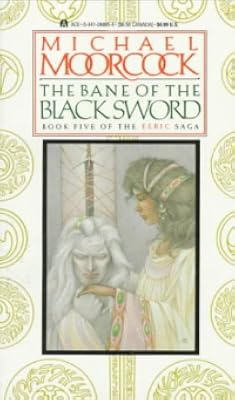
The Bane of the Black Sword
by Michael Moorcock
Elric (novella collection†‡), The Eternal Champion (Elric novella collection)
On This Page
Description
Elric, the brooding albino emperor of the dying nation of Melnibone, returns to Yishana with the sorcerous blade, Stormbringer, while a monstrous horde moves on the fabled city of Tanelorn.Tags
Recommendations

















Member Reviews
A nice addition to the Elric Saga. Elric has found an uneasy peace, love and it seems a chance to put his past behind him. Things go south very quickly as he is drawn into a world that has other plans for him and Stormbringer.
Book Five. Every time I finish one of the books in this series I think, I'll read something else before the next one...but end up slavering for another one of these cookies instead. Though the writing in these books lacks polish—a red pen in the hands of an editor these days might leave it looking like one of the gory slaughterfests the author so graphically describes—I'm not that concerned.
Elric is the ultimate tortured soul. Not a good man, he is steeped in ten thousand years of sorcerous ancestry and willing to do just about anything to achieve his ends; but he pulls it off in such a graceful way I end up rooting for him. So do his friends and lovers; they fear him, but they stick around. His bottomless suffering softens and show more hardens him at the same time, making him unpredictable, scary and fascinating.
I thought Book 5 was a bit more focused than some previous installments. Here Elric finds peace at last, but of course I don't trust that. He has too many demons. What keeps me reading these books is the classic heroic tension between love and hate, beauty and desolation. Despite formidable hardpan weaknesses, Elric wreaks mayhem on his terms, sometimes just because he can. He is very creative about it. A proper hero if ever there was one. show less
Elric is the ultimate tortured soul. Not a good man, he is steeped in ten thousand years of sorcerous ancestry and willing to do just about anything to achieve his ends; but he pulls it off in such a graceful way I end up rooting for him. So do his friends and lovers; they fear him, but they stick around. His bottomless suffering softens and show more hardens him at the same time, making him unpredictable, scary and fascinating.
I thought Book 5 was a bit more focused than some previous installments. Here Elric finds peace at last, but of course I don't trust that. He has too many demons. What keeps me reading these books is the classic heroic tension between love and hate, beauty and desolation. Despite formidable hardpan weaknesses, Elric wreaks mayhem on his terms, sometimes just because he can. He is very creative about it. A proper hero if ever there was one. show less
So close to contentment, and then it is ripped away.
I think this typifies the Elric experience. Pure melancholy undiluted by even a shard of true happiness...
I think this typifies the Elric experience. Pure melancholy undiluted by even a shard of true happiness...
Elric adventures again with Moonglum, gets vengeance on an old foe, finds love, and is responsible for fewer friends than usual dying. Also an interesting epilogue that contains absolutely no Elric other than a mention in passing, although it features an old ally of his, last seen several books ago. Happy to have read it again after so many years, and glad to now be passing it on to a friend.
I almost wondered if Moorcock originally planned this as the end of the Elric saga, just the way he left Elric toward the end.
Regardless, still a hell of a lot of fun, and interesting to see the author taking Elric in different directions.
Two more books to go!
Regardless, still a hell of a lot of fun, and interesting to see the author taking Elric in different directions.
Two more books to go!
Definitely the pinnacle of Sword and Sworcery. Elric, the mage of legend, is a transformed warrior descending from lofty ideals into the realm of chaos and back again, casting off his allegiance to the goddess of chaos itself to battle... um... just about everything. :)
I can say this is less strange and less idealistic and mysterious and archetypal than the previous volumes, focusing more on the quest and the battle and retaining a core of his idealism, as corrupted as that has become.
Mister anti-hero Elric. :)
It isn't so challenging anymore. It IS pretty wonderful, however. Epic, even, for being so short. :)
I can say this is less strange and less idealistic and mysterious and archetypal than the previous volumes, focusing more on the quest and the battle and retaining a core of his idealism, as corrupted as that has become.
Mister anti-hero Elric. :)
It isn't so challenging anymore. It IS pretty wonderful, however. Epic, even, for being so short. :)
I wonder whether one can consider Elric's sword Stormbringer to actually be a character in itself. Okay, the sword doesn't speak, but it does seem to have a will of its own, which is probably why I had the sword turn on Elric in the short story that I wrote for year 12 English. Well, I think to suggest that the sword is a character is a little misleading since it is not actually the sword that is the character but rather the demon that has been imprisoned within.
As I have said before I think Stormbringer is one of the coolest swords ever to come from the imagination of a fantasy writer. Okay, I probably would not like to actually own it since it is a demonic sword that hungers for the souls of its victims. Stormbringer doesn't simply show more kill people like a normal sword does but it rather drinks their souls – in a sense annihilating them from existence. Okay, that probably means little to us in this world where we have little understanding of what lies beyond death, but then for those of us (and I am not one of them) that believe that when we die then we cease to exist, the idea of having our souls drunk doesn't really put a shiver down our spine.
I guess the idea of the soul goes back to the Ancient Greeks (though I doubt the Greeks were the only ones who had this idea) who believed that our souls live on after death. Okay, some of us still believe that today, though once again I am not one of them. I probably have a more biblical view of death and the afterlife, and while you may suggest that that does involve souls, I would disagree. My understanding (or belief if you want to call it that) is that we don't actually have souls, but any soul that we have is intrinsically connected to our body. My belief with regards to the afterlife is that it begins at a future point in time that is the same for everybody and our body undergoes a physical resurrection. It is sort of like, using computer jargon, a concept called firmware. Firmware is a cross between hardware and software. Hardware is the computer (namely the body) and software is the soul. However firmware is software that is intrinsically tied to the hardware, so while you can move software, you cannot necessarily move firmware. However, the more I think about it the more I realise that software cannot exist without hardware. Anyway, this has gotten way off topic, but at least I started the commentary talking about Elric. show less
As I have said before I think Stormbringer is one of the coolest swords ever to come from the imagination of a fantasy writer. Okay, I probably would not like to actually own it since it is a demonic sword that hungers for the souls of its victims. Stormbringer doesn't simply show more kill people like a normal sword does but it rather drinks their souls – in a sense annihilating them from existence. Okay, that probably means little to us in this world where we have little understanding of what lies beyond death, but then for those of us (and I am not one of them) that believe that when we die then we cease to exist, the idea of having our souls drunk doesn't really put a shiver down our spine.
I guess the idea of the soul goes back to the Ancient Greeks (though I doubt the Greeks were the only ones who had this idea) who believed that our souls live on after death. Okay, some of us still believe that today, though once again I am not one of them. I probably have a more biblical view of death and the afterlife, and while you may suggest that that does involve souls, I would disagree. My understanding (or belief if you want to call it that) is that we don't actually have souls, but any soul that we have is intrinsically connected to our body. My belief with regards to the afterlife is that it begins at a future point in time that is the same for everybody and our body undergoes a physical resurrection. It is sort of like, using computer jargon, a concept called firmware. Firmware is a cross between hardware and software. Hardware is the computer (namely the body) and software is the soul. However firmware is software that is intrinsically tied to the hardware, so while you can move software, you cannot necessarily move firmware. However, the more I think about it the more I realise that software cannot exist without hardware. Anyway, this has gotten way off topic, but at least I started the commentary talking about Elric. show less
Members
- Recently Added By
Lists

NPRs your picks: top 100 Sci-Fi/Fantasy books
297 works; 80 members

The Seven-League Shelf
57 works; 3 members

Books Read in 2023
5,617 works; 145 members

Books Read in 2016
4,666 works; 197 members

A Rainbow of Books: Colors in the Title
570 works; 24 members
Author Information

659+ Works 65,141 Members
Michael Moorcock, 1939 - Writer Michael Moorcock was born December 18, 1939 in Mitcham, Surrey, England. Moorcock was the editor of the juvenile magazine Tarzan Adventures from 1956-58, an editor and writer for the Sexton Blake Library and for comic strips and children's annuals from 1959-61, an editor and pamphleteer for Liberal Party in 1962, show more and became editor and publisher for the science fiction magazine New Worlds in 1964. He has worked as a singer-guitarist, has worked with the rock bands Hawkwind and Blue Oyster Cult and is a member of the rock band Michael Moorcock and the Deep Fix. Moorcock's writing covers a wide range of science fiction and fantasy genres. "The Chronicles of Castle Brass" was a sword and sorcery novel, and "Breakfast in the Ruins: A Novel of Inhumanity" uses the character Karl Glogauer as a different person in different times. Karl participates in the political violence of the French Revolution, the Paris Commune, and a Nazi concentration camp. Moorcock also wrote books and stories that featured the character Jerry Cornelius, who had no consistent character or appearance. "The Condition of Muzak" completed the initial Jerry Cornelius tetralogy and won Guardian Literary Prize in 1977. "Byzantium Endures" and "The Laughter of Carthage" are two autobiographical novels of the Russian emigre Colonel Pyat and were the closest Moorcock came to conventional literary fiction. "Byzantium Endures" focuses on the first twenty years of Pyat's life and tells of his role in the Russian revolution. Pyat survives the revolution and the subsequent civil war by working first for one side and then another. "The Laughter of Carthage" covers Pyat's life from 1920-1924 telling of his escape from Communist Russia and his travels in Europe and America. It's a sweeping picture of the world during the 1920's because it takes the character from living in Constantinople to Hollywood. Moorcock returned to the New Wave style in "Blood: A Southern Fantasy" (1994) and combined mainstream fiction with fantasy in "The Brothel of Rosenstrasse," which is set in the imaginary city of Mirenburg. MoorCock won the 1967 Nebula Award for Behold the Man and the 1979 World Fantasy Award for his novel, Gloriana. (Bowker Author Biography) show less
Some Editions
Series


Belongs to Publisher Series
Work Relationships
Is contained in
Contains
Has the adaptation
Common Knowledge
- Canonical title
- The Bane of the Black Sword
- Original title
- The Bane of the Black Sword
- Original publication date
- 1977-08
- People/Characters
- Elric of Melniboné; Yishana of Jharkor; Theleb K'aarna; Moonglum of Elwher; Pilarmo; Nikorn of Ilmar (show all 33); Tormiel; Kelos; Silent Deinstaf; Dyvim Tvar; Quaolnargn; Misha Lord of the Winds; Kakatal the Fire Lord; Faratt; Zarozinia; King Gutheran of Org; Veerkad; Prince Hurd; Meerclar; Lord Narjhan; Rackhir; Brut of Lashmar; Uroch of Nieva; Zas the One-handed; Lamsar the Hermit; Yerleroo; Hionhurn the Executioner; Drinij Bara; Dyvim Slorm; Sorana; Eequor; Friagho; Terarn Gashtek
- Important places
- Melniboné; The Young Kingdoms; Tanelorn
- Dedication
- To the memory of Hans Stefan Santesson, and editor of great patience and kindness who, with L. Sprague de Camp, encouraged me in the late 1950s to write heroic fantasy. His magazine, Fantastic Universe, ceased publica... (show all)tion before I could contribute, much to my regret, for it was, in my opinion, one of the best fantasy magazines ever produced.
- First words
- In a city called Bakshaan, which was rich enough to make all other cities of the North East seem poor, in a tall-towered tavern one night, Elric, Lord of the smoking ruins of Melniboné, smiled like a shark and drily jeste... (show all)d with four powerful merchant princes whom, in a day or two, he intended to pauperize.
- Quotations
- "I'm tired of swords and sorcery, Zarozinia, that is all."
"Here there are subtler hypocrisies--and the subtlest lie of all is full truth," she said ... - Last words
- (Click to show. Warning: May contain spoilers.)And Lamsar smiled.
- Original language
- English
- Canonical DDC/MDS
- 823.087662
- Disambiguation notice
- Novella collection, these novellas are included:
- The Stealer of Souls
- Kings in Darkness
- The Caravan of Forgotten Dreams ("The Flame Bringers")
- To Rescue Tanelorn...... (show all)li>
Classifications
- Genres
- Fantasy, Fiction and Literature
- DDC/MDS
- 823.087662 — Literature & rhetoric English & Old English literatures English fiction By type Genre fiction Adventure fiction Speculative fiction Fantasy fiction Sword and Sorcery
- LCC
- PR6063 .O538 — Language and Literature English English Literature 1961-2000
- BISAC
Statistics
- Members
- 1,382
- Popularity
- 17,200
- Reviews
- 19
- Rating
- (3.71)
- Languages
- 7 — English, Estonian, French, German, Spanish, Swedish, Turkish
- Media
- Paper
- ISBNs
- 24
- UPCs
- 1
- ASINs
- 7