On This Page
Description
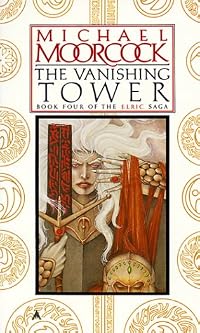
The Vanishing Tower is a continuation of "The Elric Saga" where the wandering albino prince makes the acquaintance of, and adventures with his multiverse brothers, and learns a great deal about his fate, and the fate of his world.Tags
Recommendations














Member Reviews
I continue to be amazed at how much each book of this series manages to pack into less than 200 pages. And yet, it rarely feels rushed! The writing continues to be lyrical and evocative ("The wings of gold and silver flapped with the sound of a hundred cymbals meeting..."); Elric continues to brood and despair; the Eternal Champion returns in various guises; and certain of Elric's friends and enemies meet their final fates, while others survive to see another day.
If you need 500 pages of backstory for a world and all its wonders, this is not the series for you. Otherwise, read on!
If you need 500 pages of backstory for a world and all its wonders, this is not the series for you. Otherwise, read on!
I don't know what it is about Elric, but damn, I just love this character, and this world. I wouldn't call Moorcock the best writer on the planet, not by a long shot, and there's honestly times when this series feels like he's making it up as he goes along, but overall, it's just an honestly enjoyable reading experience, and this one, with Elric chasing Theleb K'aarna hither and yon, is no exception.
It hurts me to say so, but these stories don't resonate with me now the way they did when I was a teen. Elric, who I used to consider an edgy anti-hero now comes across as a whiney bitch. His motivations are unclear and the story barely hangs together. Secondary characters are barely fleshed out.
It's not all bad though. The story moves along briskly with exciting set pieces (like Edgar Rice Burroughs) and a great sense of the macabre (like Robert E. Howard).
It's not all bad though. The story moves along briskly with exciting set pieces (like Edgar Rice Burroughs) and a great sense of the macabre (like Robert E. Howard).
I liked this somewhat less than a few of the previous books in the Elric Saga, but only because it had less of the nearly meta-multiple-worlds eternal hero/villain in it except for the last tale.
The rest of it seemed very natural for a sword and sorcery adventure and rather plain. You know, a mysterious woman, albeit overpowered and in need of more overpowered help, almost throwing herself at evil (debatable) albino Elric after he avows he needs nothing, not even a reason to do whatever he wants.
Eternal brooding nightmare of a man, serving chaos though not always being served BY chaos, always/never regretting, tossed by fate, used by his malicious soul-drinking sword, and in a never-ending search for wisdom.
Good. Very good stuff.
In show more general.
This one reads like what Stephen King will eventually do better in his Dark Tower. Still, interesting to see the seeds. :) show less
The rest of it seemed very natural for a sword and sorcery adventure and rather plain. You know, a mysterious woman, albeit overpowered and in need of more overpowered help, almost throwing herself at evil (debatable) albino Elric after he avows he needs nothing, not even a reason to do whatever he wants.
Eternal brooding nightmare of a man, serving chaos though not always being served BY chaos, always/never regretting, tossed by fate, used by his malicious soul-drinking sword, and in a never-ending search for wisdom.
Good. Very good stuff.
In show more general.
This one reads like what Stephen King will eventually do better in his Dark Tower. Still, interesting to see the seeds. :) show less
You always get the feeling that most of the shorter Eternal Champion novels were written on the run, kind of like Anthony Trollope sitting down for so many hours to write so many pages per day. The Deus ex machina is always too much a part of this sort of Moorcock's sloppier slap-dash fantasy writing.
A pretty good start rambles about in typical Moorcock fashion into various travels, adventures, and perils involving a powerful sorcerer with much fantastical mayhem and swashbuckling. The best thing about this is the conjunction of three incarnations of the Eternal Champion, the fabled city of Tanelorn, and a shout-out for Dorian Hawkmoon.
These Eternal Champion novellas are mostly reminiscent of sword and sorcery pulp writing with a show more little more edge to it. They are fun reads with favorite characters (Elric and Von Bek being my personal favs) but lack the depth and the atmosphere of the longer EC novels. show less
A pretty good start rambles about in typical Moorcock fashion into various travels, adventures, and perils involving a powerful sorcerer with much fantastical mayhem and swashbuckling. The best thing about this is the conjunction of three incarnations of the Eternal Champion, the fabled city of Tanelorn, and a shout-out for Dorian Hawkmoon.
These Eternal Champion novellas are mostly reminiscent of sword and sorcery pulp writing with a show more little more edge to it. They are fun reads with favorite characters (Elric and Von Bek being my personal favs) but lack the depth and the atmosphere of the longer EC novels. show less
In which our twisted hero plays paladin to Myshella, Empress of Dawn and muse to heroes, in his running contest against the vengeful wizard Theleb K'aarna. As in most of Elric's adventures, the results are less than hoped and he has to curse his fate. Unlike "Elric of Melnibone" and "The Weird of the White Wolf," this collection didn't have quite the same psychedelic flair, while some of the "Multiverse" elements of the story do feel a bit dated and clunky.
In this Elric story, our hero becomes more familiar and entwined in the multiverse. From this point on it seems that Moorcock really starts to develop Elric into a very complex character.
Members
- Recently Added By
Lists

Best Fantasy Novels
821 works; 357 members

NPRs your picks: top 100 Sci-Fi/Fantasy books
297 works; 79 members

The Seven-League Shelf
57 works; 3 members

Books Read in 2023
5,547 works; 145 members

Books Read in 2016
4,666 works; 197 members
Author Information

657+ Works 64,994 Members
Michael Moorcock, 1939 - Writer Michael Moorcock was born December 18, 1939 in Mitcham, Surrey, England. Moorcock was the editor of the juvenile magazine Tarzan Adventures from 1956-58, an editor and writer for the Sexton Blake Library and for comic strips and children's annuals from 1959-61, an editor and pamphleteer for Liberal Party in 1962, show more and became editor and publisher for the science fiction magazine New Worlds in 1964. He has worked as a singer-guitarist, has worked with the rock bands Hawkwind and Blue Oyster Cult and is a member of the rock band Michael Moorcock and the Deep Fix. Moorcock's writing covers a wide range of science fiction and fantasy genres. "The Chronicles of Castle Brass" was a sword and sorcery novel, and "Breakfast in the Ruins: A Novel of Inhumanity" uses the character Karl Glogauer as a different person in different times. Karl participates in the political violence of the French Revolution, the Paris Commune, and a Nazi concentration camp. Moorcock also wrote books and stories that featured the character Jerry Cornelius, who had no consistent character or appearance. "The Condition of Muzak" completed the initial Jerry Cornelius tetralogy and won Guardian Literary Prize in 1977. "Byzantium Endures" and "The Laughter of Carthage" are two autobiographical novels of the Russian emigre Colonel Pyat and were the closest Moorcock came to conventional literary fiction. "Byzantium Endures" focuses on the first twenty years of Pyat's life and tells of his role in the Russian revolution. Pyat survives the revolution and the subsequent civil war by working first for one side and then another. "The Laughter of Carthage" covers Pyat's life from 1920-1924 telling of his escape from Communist Russia and his travels in Europe and America. It's a sweeping picture of the world during the 1920's because it takes the character from living in Constantinople to Hollywood. Moorcock returned to the New Wave style in "Blood: A Southern Fantasy" (1994) and combined mainstream fiction with fantasy in "The Brothel of Rosenstrasse," which is set in the imaginary city of Mirenburg. MoorCock won the 1967 Nebula Award for Behold the Man and the 1979 World Fantasy Award for his novel, Gloriana. (Bowker Author Biography) show less
Some Editions
Series


Belongs to Publisher Series
Work Relationships
Is contained in
Has the adaptation
Common Knowledge
- Canonical title*
- La Torre Evanescente
- Original title
- The Sleeping Sorceress
- Alternate titles*
- The Vanishing Tower
- Original publication date
- 1978
- People/Characters*
- Elric of Melniboné; Moonglum of Elwher; Theleb K'aarna; Arioch; Fileet, Lady of the Birds; Myshella (show all 22); Prince Umbda; Urish the Seven-fingered; Avan Astran; Rakhir of Tanelorn; Checkalach; Lord Donblas the Justice Maker; Brut of Lashmar; Carkan; Corum Jhaelen Irsei; Mabelode; Bolorhiag; Voilodion; Ghagnasdiak; Erekosë; Jhary-a-Conel; Whiskers
- Dedication*
- Para Ken Bulmer, quien me pidió que escribiera esta obra como novela por entregas para su revista Sword and Sorcery. La publicación, que iba a hacer compañía a Visions of Tomorrow (Visiones del mañana), no ... (show all)llegó a aparecer debido a la retirada del apoyo financiero a ambas revistas.
- First words
- In the sky, a cold moon, cloaked in clouds, sent down faint light that fell upon a sullen sea where a ship lay at anchor off an uninhabited coast.
- Last words*
- (Click to show. Warning: May contain spoilers.)Pero quienes lo oyeron (y entre ellos debían de estar los dioses a los que se dirigía) sabían que era el propio Elric de Melniboné quien estaba verdaderamente maldito.
- Original language
- English
- Canonical DDC/MDS
- 823.087662
*Some information comes from Common Knowledge in other languages. Click "Edit" for more information.
Classifications
- Genres
- Fantasy, Fiction and Literature
- DDC/MDS
- 823.087662 — Literature & rhetoric English & Old English literatures English fiction By type Genre fiction Adventure fiction Speculative fiction Fantasy fiction Sword and Sorcery
- LCC
- PR6063 .O538 — Language and Literature English English Literature 1961-2000
- BISAC
Statistics
- Members
- 1,679
- Popularity
- 13,239
- Reviews
- 22
- Rating
- (3.64)
- Languages
- 9 — Dutch, English, Estonian, French, German, Lithuanian, Spanish, Swedish, Turkish
- Media
- Paper
- ISBNs
- 32
- ASINs
- 20