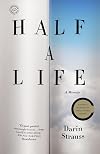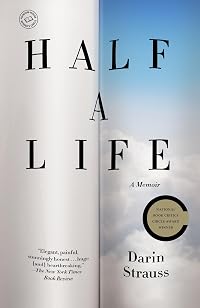
Half a Life
by Darin Strauss
On This Page
Description
Half a life after he killed a girl riding her bike with his car as a teenager, the author delves into the meaning and consequences of that fateful day, and all the culpability, anguish, and regret that continue to penetrate his every thought.Tags
Recommendations

















Member Recommendations
JanicsEblen I was so pleased to receive this book. The courage of Darin Stauss to write about the life impacting event in his life is unbelievable. I was both moved and touched by this book. It gives one pause - that could also be me. A book for both men and women to read.
Member Reviews
This little book is a memoir--but a memoir like none other I've read. The author (whose novel, "More Than it Hurts You" I have read and was impressed by) tells us on the first page that he killed a girl when he was eighteen. She was a schoolmate on a bicycle and he was driving the car that hit and ultimately killed her. Writing this book at age 38, he documents the painfully honest reflection on his feelings and behaviors over the years as a result of the accident. But it isn't just one more "accident memoir;" he didn't want to become "one more person creating an entertainment out of misfortune, distilling honey from vinegar." And somehow he didn't. Anyone reading this book who lives with a traumatic event/episode/memory that refuses to show more be erased by time will be drawn into Strauss' story and maybe even encouraged by its transparency. show less
 This review was written for LibraryThing Early Reviewers.
Darin Strauss formats his Half a Life in an unusual, organic way; the fragmented chapters and blank pages between them seem to mirror the workings of memory itself. Blank pages stand in for gaps in memory (or time), and details rise up abruptly, like memories bubbling to the surface of consciousness.
This book is, at its core, a man’s effort to understand how a tragic event in his youth – hitting and killing a girl on her bike with his car – has shaped his life. Half a Life spans the years from the accident to adulthood, and we witness the progression of his sadness and slow, gnawing guilt over time. Could he have done something differently? Had she committed suicide? Can he really embrace his own life after taking someone show more else’s? These are the questions he struggles to answer, though there are no definitive answers to be had.
While the narrative is occasionally bogged down by simile, Strauss provides vivid images of the connection he feels to the girl’s family and her “ghost” as it follows him through life. He constantly worries about how others perceive him, both in high school and years later. Is he seen as a careless murderer? A victim of coincidence? In a way true to life (as acknowledged by the author), there are no grand epiphanies to be found here. We feel both the weight of his remorse and, increasingly, a sense of calm. He finds a way to forgive himself while never forgetting the past that has defined him. show less
This book is, at its core, a man’s effort to understand how a tragic event in his youth – hitting and killing a girl on her bike with his car – has shaped his life. Half a Life spans the years from the accident to adulthood, and we witness the progression of his sadness and slow, gnawing guilt over time. Could he have done something differently? Had she committed suicide? Can he really embrace his own life after taking someone show more else’s? These are the questions he struggles to answer, though there are no definitive answers to be had.
While the narrative is occasionally bogged down by simile, Strauss provides vivid images of the connection he feels to the girl’s family and her “ghost” as it follows him through life. He constantly worries about how others perceive him, both in high school and years later. Is he seen as a careless murderer? A victim of coincidence? In a way true to life (as acknowledged by the author), there are no grand epiphanies to be found here. We feel both the weight of his remorse and, increasingly, a sense of calm. He finds a way to forgive himself while never forgetting the past that has defined him. show less
This review was written for LibraryThing Early Reviewers.From the back cover:
In the last month of his high school career, just after turning eighteen, Strauss is behind the wheel of his father's Oldsmobile, driving with friends, having 'thoughts of mini-golf, another thought of maybe just going to the beach.' Then, out of the blue: a collision that results in the death of a bicycling classmate and that shadows the rest of his life.
This memoir by Darin Strauss begins with one short, stark sentence: "Half my life ago, I killed a girl." He then recounts, almost frame-by-frame, the moments leading up to the auto accident that left a teenage girl dead, and changed the course of the rest of Strauss's life. And it was an accident, a tragic and seemingly random event:
The police, Celine's biking show more companion, and the recollection of five cars' worth of eyewitnesses all conspired to declare me blameless. No charges were filed. A police detective named Paul Vitucci later told the newspaper, 'For an unknown reason, her bicycle swerved into what you might call the traffic portion of the street, and she was immediately struck by the car. There was no way he' -- meaning me -- 'could have avoided the accident, no way whatsoever' (p. 29).
I read this book in just one day. It's a short book, yes, but it's also gripping. I want to call it a "psychological drama" of sorts. Strauss talks about what happened in the days, months, and years after the accident, in a mostly chronological narrative. But there's a constant tension inside his head, essentially a tug-of-war between his own feelings, and the way the accident impacts his life, and the overwhelming guilt he feels that someone died, and even though it wasn't "his fault," he happened to be the one at the wheel.
Strauss recounts an incident when the whole high school is gathered in the gym for an end-of-year assembly. During the event, the principal begins to talk about the tragic loss of Celine. Strauss writes:
So here was another ritual. As in all rituals, people had expectations about how it should be performed. It was as if every moment at which I could have expressed my real sense of what had happened -- my anxiety, confusion, queasy guilt; the Houdini sensation that everyone who escapes blame feels, everyone who has been pronounced blameless -- they all worked to obstruct that sense. It was blocked off by a completely different sense, that of other people watching me (p. 65).
Perhaps this example sums it up best: "But I did have a somewhat normal and fun middle-twenties, or at least a multi-faceted middle-twenties. ... And I was very mindful that Celine didn't have a fun or normal middle-twenties, or any middle-twenties at all" (p. 126). Whenever he feels pretty good, he feels guilty about feeling pretty good. His mind tries to protect itself, to keep up with everyday life and move forward, while Strauss is tormenting himself at the same time, with what-ifs, if-onlys, and a mountain of guilt.
To me, the great value in Strauss's memoir is that he puts the reader inside his mind, to allow us to feel what he feels, to come as close as we can to an awful experience without having lived it ourselves (as most of us haven't, and hopefully never will). It's not an apology, not an excuse, but an attempt to tell a whole story as honestly as he can -- from his perspective, but with great sympathy for Celine's family and friends. I think Strauss wrote the book because he had to, that he needed to write his way through the second half of his life, the accident and all that's come after, to lessen its grip on him and purge the years of guilt. Once he had written it, I don't know that he needed to publish it -- but I'm so glad that he did.
All quotes are taken from an advance reader's copy of the paperback edition, a Random House Reader's Circle publication. I received this advance copy through the LibraryThing Early Reviewers program. Many thanks to Random House and to LibraryThing for allowing me the opportunity to read and review this exceptional book. show less
In the last month of his high school career, just after turning eighteen, Strauss is behind the wheel of his father's Oldsmobile, driving with friends, having 'thoughts of mini-golf, another thought of maybe just going to the beach.' Then, out of the blue: a collision that results in the death of a bicycling classmate and that shadows the rest of his life.
This memoir by Darin Strauss begins with one short, stark sentence: "Half my life ago, I killed a girl." He then recounts, almost frame-by-frame, the moments leading up to the auto accident that left a teenage girl dead, and changed the course of the rest of Strauss's life. And it was an accident, a tragic and seemingly random event:
The police, Celine's biking show more companion, and the recollection of five cars' worth of eyewitnesses all conspired to declare me blameless. No charges were filed. A police detective named Paul Vitucci later told the newspaper, 'For an unknown reason, her bicycle swerved into what you might call the traffic portion of the street, and she was immediately struck by the car. There was no way he' -- meaning me -- 'could have avoided the accident, no way whatsoever' (p. 29).
I read this book in just one day. It's a short book, yes, but it's also gripping. I want to call it a "psychological drama" of sorts. Strauss talks about what happened in the days, months, and years after the accident, in a mostly chronological narrative. But there's a constant tension inside his head, essentially a tug-of-war between his own feelings, and the way the accident impacts his life, and the overwhelming guilt he feels that someone died, and even though it wasn't "his fault," he happened to be the one at the wheel.
Strauss recounts an incident when the whole high school is gathered in the gym for an end-of-year assembly. During the event, the principal begins to talk about the tragic loss of Celine. Strauss writes:
So here was another ritual. As in all rituals, people had expectations about how it should be performed. It was as if every moment at which I could have expressed my real sense of what had happened -- my anxiety, confusion, queasy guilt; the Houdini sensation that everyone who escapes blame feels, everyone who has been pronounced blameless -- they all worked to obstruct that sense. It was blocked off by a completely different sense, that of other people watching me (p. 65).
Perhaps this example sums it up best: "But I did have a somewhat normal and fun middle-twenties, or at least a multi-faceted middle-twenties. ... And I was very mindful that Celine didn't have a fun or normal middle-twenties, or any middle-twenties at all" (p. 126). Whenever he feels pretty good, he feels guilty about feeling pretty good. His mind tries to protect itself, to keep up with everyday life and move forward, while Strauss is tormenting himself at the same time, with what-ifs, if-onlys, and a mountain of guilt.
To me, the great value in Strauss's memoir is that he puts the reader inside his mind, to allow us to feel what he feels, to come as close as we can to an awful experience without having lived it ourselves (as most of us haven't, and hopefully never will). It's not an apology, not an excuse, but an attempt to tell a whole story as honestly as he can -- from his perspective, but with great sympathy for Celine's family and friends. I think Strauss wrote the book because he had to, that he needed to write his way through the second half of his life, the accident and all that's come after, to lessen its grip on him and purge the years of guilt. Once he had written it, I don't know that he needed to publish it -- but I'm so glad that he did.
All quotes are taken from an advance reader's copy of the paperback edition, a Random House Reader's Circle publication. I received this advance copy through the LibraryThing Early Reviewers program. Many thanks to Random House and to LibraryThing for allowing me the opportunity to read and review this exceptional book. show less
This review was written for LibraryThing Early Reviewers.I knew I should have been moved and blown away by this book. I was not. I should have felt emotionally connected to the author. I did not. I should have sped through this book without stop - well, yes but that was because it was short. I feel oddly guilty that I did not love this. But a large part of it was Strauss's detached writing style which never quite convinced me of the impact Celine's death had on him. Yes, intuitively I knew that he was affected but I never felt it.
But considering that he mainly wrote this book for himself, that is okay. I hope he found whatever he was looking for in this book. And yet... I found the entire book a bit crass. The one moment that stuck with me was when Strauss's date berated him for thinking show more about himself rather than thinking about Celine. I think that if she had read this book, his date would say the same thing again. While it was very introspective about his feelings and guilt, and how the accident impacted him, there was very little thought given to how the accident affected other people other than when those other people directly interacted with him. The whole thing came off as rather selfish, and the publication of the book very self-serving. Strauss talks about how he could never open up in therapy, so he took to writing it down. I understand that writing is cathartic and healing. But then to publish it just strikes me as profiting from Celine's death.
Review copy courtesy of the publisher. show less
But considering that he mainly wrote this book for himself, that is okay. I hope he found whatever he was looking for in this book. And yet... I found the entire book a bit crass. The one moment that stuck with me was when Strauss's date berated him for thinking show more about himself rather than thinking about Celine. I think that if she had read this book, his date would say the same thing again. While it was very introspective about his feelings and guilt, and how the accident impacted him, there was very little thought given to how the accident affected other people other than when those other people directly interacted with him. The whole thing came off as rather selfish, and the publication of the book very self-serving. Strauss talks about how he could never open up in therapy, so he took to writing it down. I understand that writing is cathartic and healing. But then to publish it just strikes me as profiting from Celine's death.
Review copy courtesy of the publisher. show less
This book drew my attention much like the accident that is its centerpiece. Reading it forced me into the often unpleasant role of gawking bystander. It's a mixed bag of goods. While I do indeed feel for Darin Strauss I wish he'd spent a little more time fleshing out Celine, the young woman he accidentally killed when he was 18. The book is at times refreshing to read and at others a self-absorbed wallow. Part of me wanted to comfort him and part wanted to slap him out of his eternal funk. I guess that's the point! He couldn't break out of his self-imposed malaise of martyrdom either. I'm glad I requested and read this, as I lost a family member to a teen driver when I was young, and never once thought about how that driver must have show more felt. I can't say I'll be recommending it to a whole lot of people, though. show less
This review was written for LibraryThing Early Reviewers.When I turned to the last page of this profound little book, I simply sat quietly and thought about how awful it must be to carry guilt with you, like a shadow, for most of your life, for something you probably had little or no control of and are completely without blame.
This poignant, honest appraisal of a tragic accident, that took place half a life away, grips you in its claws. You are compelled to empathize with the driver of the car and the bicyclist that was killed. The simplicity of the author’s prose, coupled with the raw emotion expressed, conspire to make you an unwilling witness to this tragic event.
You morph into friend and foe, all wrapped into one, watching the author, whose life changed the night of the terrible show more accident, as he spends his days unaware sometimes, of how consumed he is with the memory of someone he never really knew.
His life changed irrevocably that night, but the cyclist’s ended totally. He goes through his life searching for meaning and justice and comprehension for that moment in time that changed his future and hers. He asks himself often, is he feeling the right emotions, will he ever be able to forget that night or will it haunt him forever as it has been doing for so many years. Every waking moment seems to be a judgment about him, based on that fateful night.
Although he is not always fully aware of it, his mind has not coped well with the grief he carries from the tragedy. He cannot move on beyond it because the guilt will not release itself. He remembers the words of the victim’s parents and tries to satisfy their needs and lessen their horror, by living for her as well. He is consumed with the question, if their horror will never end, why should his? How he copes with this sadness and need to explain the unexplainable, is the crux of this memoir and it is very compelling. show less
This poignant, honest appraisal of a tragic accident, that took place half a life away, grips you in its claws. You are compelled to empathize with the driver of the car and the bicyclist that was killed. The simplicity of the author’s prose, coupled with the raw emotion expressed, conspire to make you an unwilling witness to this tragic event.
You morph into friend and foe, all wrapped into one, watching the author, whose life changed the night of the terrible show more accident, as he spends his days unaware sometimes, of how consumed he is with the memory of someone he never really knew.
His life changed irrevocably that night, but the cyclist’s ended totally. He goes through his life searching for meaning and justice and comprehension for that moment in time that changed his future and hers. He asks himself often, is he feeling the right emotions, will he ever be able to forget that night or will it haunt him forever as it has been doing for so many years. Every waking moment seems to be a judgment about him, based on that fateful night.
Although he is not always fully aware of it, his mind has not coped well with the grief he carries from the tragedy. He cannot move on beyond it because the guilt will not release itself. He remembers the words of the victim’s parents and tries to satisfy their needs and lessen their horror, by living for her as well. He is consumed with the question, if their horror will never end, why should his? How he copes with this sadness and need to explain the unexplainable, is the crux of this memoir and it is very compelling. show less
Have you ever wondered what it would be like to live in the aftermath of an accident that caused the death of another? Would it matter if you knew the deceased? Or if you weren't even at fault? Darin Strauss knows. When he was 18 he was driving his car when a classmate on a bicycle (Celine) swerved in front of his car. She died. He survived. And now 18 years (or half his life) later, he shares his experience through grief, guilt, therapy, and hopefully eventually peace if not understanding.
Although the book was compelling and an interesting look inside Darin Strauss's struggles, it's ultimately only one man's experience. I expect others in similar situations would have different reactions, mechanisms for coping, and journeys. Which show more makes me wonder why this book was written. It left me feeling a bit like a voyeur.
Other recent memoirs about death/loss, e.g., The Year of Magical Thinking or An Exact Replica of a Figment of My Imagination, are from the perspective of a person grieving the loss of a loved one, and one can presume that most readers of the book understand the author's perspective. There are unlikely to be potential readers who would resent a wife writing about the loss of her husband or a mother about the loss of a child. Readers understand the book serves is probably both a catharsis for the author as well as a tribute to the deceased loved one. These books have no antagonist. In Half a Life, in many ways, the author is the antagonist - at least from Celine's parents' perspective. I wonder how her parents and loved ones feel about this book. Do they resent the fact that Celine's death is held up to the light, but viewed through Darin's eyes? I think I might.
My conclusion: Darin's perspective is unique and his struggles understandable; he's not entirely unsympathetic. However, for the sake of those left behind, I would have preferred he struggled in a less public way. show less
Although the book was compelling and an interesting look inside Darin Strauss's struggles, it's ultimately only one man's experience. I expect others in similar situations would have different reactions, mechanisms for coping, and journeys. Which show more makes me wonder why this book was written. It left me feeling a bit like a voyeur.
Other recent memoirs about death/loss, e.g., The Year of Magical Thinking or An Exact Replica of a Figment of My Imagination, are from the perspective of a person grieving the loss of a loved one, and one can presume that most readers of the book understand the author's perspective. There are unlikely to be potential readers who would resent a wife writing about the loss of her husband or a mother about the loss of a child. Readers understand the book serves is probably both a catharsis for the author as well as a tribute to the deceased loved one. These books have no antagonist. In Half a Life, in many ways, the author is the antagonist - at least from Celine's parents' perspective. I wonder how her parents and loved ones feel about this book. Do they resent the fact that Celine's death is held up to the light, but viewed through Darin's eyes? I think I might.
My conclusion: Darin's perspective is unique and his struggles understandable; he's not entirely unsympathetic. However, for the sake of those left behind, I would have preferred he struggled in a less public way. show less
Members
- Recently Added By
Published Reviews
"A book that inspires admiration, sentence by sentence . . . This is a memoir in its finest form, a fully imagined and bittersweet book."
added by melancholy
"Lyrical and haunting."
added by melancholy
"Elegant, painful, stunningly honest . . . huge [and] heartbreaking."
added by melancholy
Lists

Best Biographies, Autobiographies and Memoirs
465 works; 160 members
Author Information

13+ Works 1,801 Members
Graduate of the New York University Creative Writing Program. Strauss is now a teacher in the program and lives in New York City.
Awards and Honors
Awards
Distinctions
Common Knowledge
- Canonical title
- Half a Life
- Original publication date
- 2010-09-15
- People/Characters
- Darin Strauss; Celine
- Important places
- USA
- First words
- Half my life ago, I killed a girl.
- Quotations
- So there isn’t any single moment I can point to that scored when I began to feel better… This is what guilt is like, this is what grief is like, this is how a life forms: when you can’t ignore , when it warps itself aro... (show all)und one event like a vine clutching a rock. Every direction the vine takes, will be determined by that stone. The growth is what you see. But if you look farther down, what you find is the rock.
The cracks in old friendships are measured in awkward pauses.
All the things get done and you regret them and then you accept them because there’s nothing else to do. Regret doesn’t budge things; it seems crazy that the force of all that human want can’t amend a moment, can’t ... (show all)even stir a pebble. - Last words
- (Click to show. Warning: May contain spoilers.)I can say to myself: It's all right to take in the winter beach and grass smells, and crackle back across the sand of the road, and smile at the faces you love.
Classifications
Statistics
- Members
- 583
- Popularity
- 50,404
- Reviews
- 88
- Rating
- (3.51)
- Languages
- English, German
- Media
- Paper, Audiobook, Ebook
- ISBNs
- 9
- ASINs
- 2