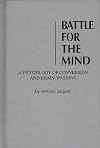
Battle for the Mind: A Physiology of Conversion and Brainwashing
by William Sargant
On This Page
Description
How can an evangelist convert a hardboiled sophisticate? Why does a POW sign a "confession" that he knows is false? How is a criminal pressured into admitting his guilt? Do the evangelist, the POW's captor, and the policeman use similar methods to gain their ends? These and other compelling questions are discussed in this definitive work by William Sargant. Sargant explains and illustrates the basic techniques used by evangelists, psychiatrists, and brain-washers to dissolve existing, show more established patterns of belief, and then substitute new beliefs and behaviors. show lessTags
Recommendations









































Member Reviews
Despite its publishers targeting a fresh market in 1957, at a time when American fear of communist brainwashing was at its height following the Korean War and 'Red scare' hysteria, this book is wider-ranging. It sets out to connect the growing 'political, religious and psychiatric' interest in converting beliefs. Its photographs, on the other hand, focus on baser attractions: the mind-bending effects of 'rhythmic drumming' for 'primitive religions' (8 photos) [and by implication rock-and-roll juvenile delinquents, too], and southern US evangelist revivals (13 photos). This was a relatively sober and careful popularisation launched into a rabidly anti-communist atmosphere, and I wonder how readers today would relate its claims to show more post-Trump America. show less
We have still much to learn as to the laws according to which the mind and body act on one another, and according to which one mind acts on another; but it is certain that a great part of this mutual action can be reduced to general laws, and that the more we know of such laws the greater our power to benefit others will be.
How can an evangelist convert a hardboiled sophisticate? Why does a POW sign a "confession" that he knows is false? How is a criminal pressured into admitting his guilt? Do the evangelist, the POW's captor, and the policeman use similar methods to gain their ends? These and other compelling questions are discussed in the definitive work by William Sargant, who for many years until his death in 1988 was a leading show more physician in psychological medicine. Sargant spells out and illustrates the basic techniques used by evangelists, psychiatrists, and brain-washers to disperse the patterns of belief and behavior already established in the minds of their hearers, and to substitute new patterns for them. show less
How can an evangelist convert a hardboiled sophisticate? Why does a POW sign a "confession" that he knows is false? How is a criminal pressured into admitting his guilt? Do the evangelist, the POW's captor, and the policeman use similar methods to gain their ends? These and other compelling questions are discussed in the definitive work by William Sargant, who for many years until his death in 1988 was a leading show more physician in psychological medicine. Sargant spells out and illustrates the basic techniques used by evangelists, psychiatrists, and brain-washers to disperse the patterns of belief and behavior already established in the minds of their hearers, and to substitute new patterns for them. show less
I am sure there was a point of this book but as a psychologist, I cannot even begin to imagine what it was. Also, the formatting on Kindle was quite strange as though they just scanned in a book making it more difficult to read.
Cited by Malise Ruthven in her review of Islamic State: The Digital Caliphate by Abdel Bari Atwan in NYRB July 9, 2015, p 74. She describes Sargant's book as a "classic study of religious conversion and 'brain-washing.'"
Ratings
Members
- Recently Added By
Author Information

6+ Works 246 Members
All Editions
Some Editions
Common Knowledge
- Original publication date
- 1957
- People/Characters
- Ivan Pavlov; Maya Deren; Robert Graves; Pierre Verger; Scott Henderson; Trophonius
- Important places
- London, England, UK
- Epigraph
- We have still much to learn as to the laws according to which the mind and body act on one another, and according to which one mind acts on another; but it is certain that a great part of this mutual action can be redu... (show all)ced to general laws, and that the more we know of such laws the greater our power to benefit others will be.
If, when, through the operation of such laws surprising events take place, (and) we cry out ... "Such is the will of God," instead of setting ourselves to inquire whether it was the will of God to give us power to bring about or prevent these results; then our conduct is not piety but sinful laziness.
George Salmon, D. D.
A Sermon on the WOrk of the Holy Spirit (1859) - First words
- (Preface by Charles Swencionis): WIlliam Sargant asked how the brain could change rapidly to adopt whole new world-views.
(Foreword): It must be emphasized as strongly as possible that this book is not concerned with the truth or falisty of any particular religious or political belief.
(Introduction): Politicians, priests, and psychiatrists often face the same problem: how to find the most rapid and permanent means of changing a man's beliefs.
In the course of over thirty years of research Pavlov accumulated a mass of observations on various methods of building up behaviour patterns in dogs and then breaking them down again. - Last words
- (Click to show. Warning: May contain spoilers.)Therefore the brain should not be abused by having forced upon it any religious or political mystique that stunts the reason, or any form of crude rationalism that stunts the religious sense.
Classifications
- Genres
- Nonfiction, General Nonfiction, Religion & Spirituality
- DDC/MDS
- 153.853 — Philosophy and Psychology Psychology Conscious mental processes and intelligence Decision Making And Persuasion Persuasion Brainwashing and Indoctrination
- LCC
- BF633 .S3 — Philosophy, Psychology and Religion Psychology Psychology Will. Volition. Choice. Control
- BISAC
Statistics
- Members
- 210
- Popularity
- 154,788
- Reviews
- 5
- Rating
- (3.25)
- Languages
- English, German
- Media
- Paper, Ebook
- ISBNs
- 8
- ASINs
- 11