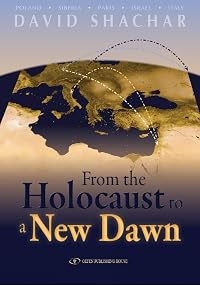
From the Holocaust to a New Dawn in English
by David Shachar
On This Page
Description
Through tragedy and war and a desire for peace, the life story of David Shachar serves as a model for our times. The memories of David Shachar are a journey through the tunnel of time: from wanderings in Poland to the life of a refugee in World War II, and on to a soldier's life fighting the Nazis. After the war, while studying radio electronics in Paris, David cut his studies short and came to Israel to fight in the War of Independence. A few years later, David and his wife, Chaya, answered show more Ben-Gurion's call to settle the country "from the city to the frontier", and they moved to the development town of Kiryat Shmona. He worked tirelessly to advance the developing city, using his qualifications and abilities to build up technology in the border area. Years later, David Shachar served as a senior representative of the Israel Aircraft Industries with the Ministry of Defense and did much to develop and advance Israel's defence industry. David never lost sight of his memories of World War II and devoted himself to memorialising the bravery of the 30,000 Jewish soldiers who fell in the Polish army. On his initiative, the outstanding monument in their memory was established at the military cemetery on Mount Herzl in Jerusalem. In the words of Ephraim Kaye of Yad Vashem, David's story of rebirth "is one of unprecedented creativity, courage and self-sacrifice that is the essence of Israel today". This inspiring autobiography is a must-read. show lessTags
Member Reviews
"From the Holocaust to a New Dawn" is an enjoyable read by Israeli citizen David Shachar. In this book, the author reveals his life during World War II and the efforts of his family to survive the Holocaust. The book is however, mostly about the man himself, his values, his struggles to provide for his nuclear family and his wish to make a significant contribution to his adopted homeland, Israel.
Born in Krasnosielec, Poland his father and other innocent Jews were brutally killed by Germans and their bodies burned and buried secretly near the synagogue. This incident happened when David was a youngster and he never forgot it. One of his dreams was to commemorate these victims which he managed to accomplish when he was older with the aid show more of an acquaintance, Mr. Sami Shamoon. The author has a strong sense of self and a strong desire to make a difference in society. In fact, he is instrumental in establishing a memorial on Mount Herzel in Jerusalem to honor Jewish soldiers who served in Polish armies. Whether he is serving in the Israeli army, working in Italy for a n Israeli water company or living in northern Israel on a kibbutz, he is an active, socially conscious individual.
What is most interesting about this book is how the author continues to keep the reader's interest while revealing his life story. It is a tale of an ordinary man who lives an ordinary life. During his lifetime every now and again he meets some extraordinary people and overcomes some unusual challenges. Shachar writes in a pleasant, easy-to-read manner As a reader, you will gain respect for a man like Shachar. He is typical of the many individuals who made significant sacrifices to build Israel into the great country it is today. show less
Born in Krasnosielec, Poland his father and other innocent Jews were brutally killed by Germans and their bodies burned and buried secretly near the synagogue. This incident happened when David was a youngster and he never forgot it. One of his dreams was to commemorate these victims which he managed to accomplish when he was older with the aid show more of an acquaintance, Mr. Sami Shamoon. The author has a strong sense of self and a strong desire to make a difference in society. In fact, he is instrumental in establishing a memorial on Mount Herzel in Jerusalem to honor Jewish soldiers who served in Polish armies. Whether he is serving in the Israeli army, working in Italy for a n Israeli water company or living in northern Israel on a kibbutz, he is an active, socially conscious individual.
What is most interesting about this book is how the author continues to keep the reader's interest while revealing his life story. It is a tale of an ordinary man who lives an ordinary life. During his lifetime every now and again he meets some extraordinary people and overcomes some unusual challenges. Shachar writes in a pleasant, easy-to-read manner As a reader, you will gain respect for a man like Shachar. He is typical of the many individuals who made significant sacrifices to build Israel into the great country it is today. show less
 This review was written for LibraryThing Early Reviewers.
Opening what looked to me like a textbook, I discovered the autobiography of a man who lived in five different countries during the course of his life, beginning with Poland, and ending in Israel. In this book, David Shachar tells about the twists and turns of fate that led him to also live in the Soviet Union, France, and Italy after life as he knew it in his native city of Krasnosielc, Poland, was suddenly interrupted with the invasion of the Nazis at the beginning of World War II. His large and religious family was driven apart as Jews at that time were either killed by the Nazis or became refugees taken into the Soviet Union.
This book was basically a list of lifetime events as with most autobiographies, but there were few events show more that pulled me out of the direct chronology of the story and into more of an understanding of individuals or relationships. I learned about David’s family, friends, and acquaintances but not in very great detail. Mostly I learned about David's education, jobs, and aspirations. It almost felt as if this book were written for David's own family and not for a wider audience. Nevertheless, I grew to like reading David's story more and more the faurther I progressed through its pages. I would not recommend this book for a general readership. However, for those who are familiar with modern Jewish history or would like to know more about it as well as for those who have a feeling of “knowing” Israelis, David does have an interesting story to tell.
Had I put this book together myself, I’d have given it a different binding – one which would display more of its being an autobiography. I’d have eliminated the Hebrew map since the rest of this book had no other Hebrew. Additionally, I would have more clearly identified the people in the group of pictures at the center of the book.
I found David’s life story fascinating and finished this book in only three days. However, each person who immigrates to Israel has his or her own amazing story. It’s just nice that David had captured and shared so many details of his own experiences.
Truthfully, what first interested me in reading this book at all was the fact that David lived for seven years in Kiryat Shmona, a development town in Northern Israel. I lived in that same town years later. In choosing to read this book, I really wanted to relive the feeling of being located in the lovely Hula Valley between Mount Naftali and Mount Hermon once again. As David Shachar put it, “I am again filled with gratitude for how well my fateful decision to move to Kiryat Shmona turned out.” I personally share that feeling. show less
This book was basically a list of lifetime events as with most autobiographies, but there were few events show more that pulled me out of the direct chronology of the story and into more of an understanding of individuals or relationships. I learned about David’s family, friends, and acquaintances but not in very great detail. Mostly I learned about David's education, jobs, and aspirations. It almost felt as if this book were written for David's own family and not for a wider audience. Nevertheless, I grew to like reading David's story more and more the faurther I progressed through its pages. I would not recommend this book for a general readership. However, for those who are familiar with modern Jewish history or would like to know more about it as well as for those who have a feeling of “knowing” Israelis, David does have an interesting story to tell.
Had I put this book together myself, I’d have given it a different binding – one which would display more of its being an autobiography. I’d have eliminated the Hebrew map since the rest of this book had no other Hebrew. Additionally, I would have more clearly identified the people in the group of pictures at the center of the book.
I found David’s life story fascinating and finished this book in only three days. However, each person who immigrates to Israel has his or her own amazing story. It’s just nice that David had captured and shared so many details of his own experiences.
Truthfully, what first interested me in reading this book at all was the fact that David lived for seven years in Kiryat Shmona, a development town in Northern Israel. I lived in that same town years later. In choosing to read this book, I really wanted to relive the feeling of being located in the lovely Hula Valley between Mount Naftali and Mount Hermon once again. As David Shachar put it, “I am again filled with gratitude for how well my fateful decision to move to Kiryat Shmona turned out.” I personally share that feeling. show less
This review was written for LibraryThing Early Reviewers.'From the Holocaust to a New Dawn,' begins with David Shachar's family genealogy, which caused me to immediately lose interest. It reminded me of being in a situation in which a friend wants you to view family vacation photos, but you have absolutely no interest in them. You politely sit through them and hope the time will pass by quickly. In addition, the beginning of Shachar's book includes a lot of Jewish and/or Polish terminology which made it extremely difficult for a non-Jewish person to understand. It would have been very helpful if the terminology had been defined or translated so that I might have been able to understand it more thoroughly.
I found the story extremely interesting when Shachar began telling of the events which show more took place when the Germans invaded Poland, the suffering which his family endured, and how they were given the option of remaining in Poland or traveling to Siberia. His description of the life he and his family experienced and how they survived the hardships was an engrossing account of survival.
David made the statement that when he moved to Israel, he found that he was not accepted by the Jews already living there. He stated that the Jews in Israel looked down on the Jews who had survived the Holocaust as "not having the sense to immigrate to Israel in time, for marching to our deaths as "sheep led to slaughter,' or even worse - for surviving the Holocaust only because we were egoistic manipulators or collaborators." What a terrible thing to be accused of after having already suffered so much.
Shachar goes on to tell how he worked toward the betterment of life for Jewish people and the state of Israel. However, near the end of the book, I began to feel that he was bragging of his achievements and that he wrote this book in order to show how he worked toward building a Jewish Memorial, while showing that others who were involved were only trying to profit from it. I found myself neither impressed nor interested in these events. show less
I found the story extremely interesting when Shachar began telling of the events which show more took place when the Germans invaded Poland, the suffering which his family endured, and how they were given the option of remaining in Poland or traveling to Siberia. His description of the life he and his family experienced and how they survived the hardships was an engrossing account of survival.
David made the statement that when he moved to Israel, he found that he was not accepted by the Jews already living there. He stated that the Jews in Israel looked down on the Jews who had survived the Holocaust as "not having the sense to immigrate to Israel in time, for marching to our deaths as "sheep led to slaughter,' or even worse - for surviving the Holocaust only because we were egoistic manipulators or collaborators." What a terrible thing to be accused of after having already suffered so much.
Shachar goes on to tell how he worked toward the betterment of life for Jewish people and the state of Israel. However, near the end of the book, I began to feel that he was bragging of his achievements and that he wrote this book in order to show how he worked toward building a Jewish Memorial, while showing that others who were involved were only trying to profit from it. I found myself neither impressed nor interested in these events. show less
This review was written for LibraryThing Early Reviewers.Obviously this is considered an important book by the publisher, family, and fellow citizens of Israel, and, as a record of the experiences of a Holocaust survivor, it also has an inherent historic and human importance.
However, I am not sure who were the intended audience for David’s autobiography outside of that particular circle, or why it is being published internationally, after translation. It reads as a textbook, perhaps to accompany a visit to the Mount Herzl memorial for the fallen Jewish and Polish soldiers that the author conceived, sponsored and saw to completion. In one of the opening letters of approbation, by a Knesset Member, one importance is recognized ‘that it be read by the youth in order that they know with what show more suffering this state (Israel) was established, and …it is because of people like David that it exists to this day’…and another Knesset member noted that the author ‘serve(s) as a model for our generation’.
His travels and travails took the author through Nazi-occupied Poland, Siberia, France, Italy and then, as part of the peopling of the Promised Land, as a settler to Israel. An interesting and challenging life then, but this reader felt that the book, written by David himself, failed to portray the excitement and drama and needed editing, restructuring and polishing in order to become more readable by those of us without his shared experiences. show less
However, I am not sure who were the intended audience for David’s autobiography outside of that particular circle, or why it is being published internationally, after translation. It reads as a textbook, perhaps to accompany a visit to the Mount Herzl memorial for the fallen Jewish and Polish soldiers that the author conceived, sponsored and saw to completion. In one of the opening letters of approbation, by a Knesset Member, one importance is recognized ‘that it be read by the youth in order that they know with what show more suffering this state (Israel) was established, and …it is because of people like David that it exists to this day’…and another Knesset member noted that the author ‘serve(s) as a model for our generation’.
His travels and travails took the author through Nazi-occupied Poland, Siberia, France, Italy and then, as part of the peopling of the Promised Land, as a settler to Israel. An interesting and challenging life then, but this reader felt that the book, written by David himself, failed to portray the excitement and drama and needed editing, restructuring and polishing in order to become more readable by those of us without his shared experiences. show less
This review was written for LibraryThing Early Reviewers.I hate to give a negative review to a memoir of a holocaust survivor as I feel that each and everyone of them has a story to tell, and David Shachar's story i different from most. Born to an Hasidic family in Poland, when the war bean his family fled east, not west, which may have saved his life. He lived in Eastern Siberia for most of the war, being sent to a rather fine school for Polish refugees, and at the end of the war, putting on a partisan uniform when he was only 14.
After the war, he made his way to Paris where he earned a certificate in electronics and subsequently emigrated to Israel where he helped establish the country in its early years and later represented their aircraft industry in Italy. Later in his life he organized show more a memorial to be erected to the Jews who were massacred by the Nazis in his hometown.
All of this should make for a compelling story, yet this book is written with all the style and emotion of a business report. The lack of any maps or a glossary for the myriad Hebrew and Yiddish terms is also confusing the to the reader not familiar with the Hasidic branch of the Jewish religion or the geography where the book is set. Perhaps because the book is being published by an Israeli publishing house that specializes in Jewish book (and textbooks seem to to predominate their publishing list) explains this and also the cheesy textbook-like binding.
I wish this author had had a better editor, or alternatively, in his polymath studies, had taken a few writing courses. show less
After the war, he made his way to Paris where he earned a certificate in electronics and subsequently emigrated to Israel where he helped establish the country in its early years and later represented their aircraft industry in Italy. Later in his life he organized show more a memorial to be erected to the Jews who were massacred by the Nazis in his hometown.
All of this should make for a compelling story, yet this book is written with all the style and emotion of a business report. The lack of any maps or a glossary for the myriad Hebrew and Yiddish terms is also confusing the to the reader not familiar with the Hasidic branch of the Jewish religion or the geography where the book is set. Perhaps because the book is being published by an Israeli publishing house that specializes in Jewish book (and textbooks seem to to predominate their publishing list) explains this and also the cheesy textbook-like binding.
I wish this author had had a better editor, or alternatively, in his polymath studies, had taken a few writing courses. show less
This review was written for LibraryThing Early Reviewers.This book follows the life of David before World War II to the present day. It discusses his studies as a child, the life of a refugee during and after World War II, his experiences in Israel and much more.
I found the book a bit hard to read. I am not Jewish, and often Hebrew phrases were used without explanation or definition. The book also seemed to have large gaps of time between stories, which made it more difficult to get an accurate picture of their life and struggles during World War II and afterward.
I found the book a bit hard to read. I am not Jewish, and often Hebrew phrases were used without explanation or definition. The book also seemed to have large gaps of time between stories, which made it more difficult to get an accurate picture of their life and struggles during World War II and afterward.
This review was written for LibraryThing Early Reviewers.From the Holocaust to a New Dawn is an autobiography of a man's life journey from being a child in Poland to living in Israel as a free man. He suffered through WWII living in a camp in Siberia under the auspices of the Soviet Union, but life there was hard and unforgiving. By reason of his gift of native intelligence he was accepted in several special schools and was in the military for a time. He received training in the radio technology of the time while in France after the war. However, the war to bring Israel into being drew him again into the military, this time with the forces fighting the Arabs (principally Egypt).After the successful conclusion of that conflict the author lived and worked in Tel Aviv, but he heeded the call to show more live and build the rural areas and he spent seven years in the northren regions of the country living in a small kibutiz. He returned to the city life, but found himself woefully behind in the most recent technologies. He returned to school and also worked with the Israeli navy to perfect a guided missle system. Later, he was choosen as a national representative to Italian manufacturers of component parts of the missle system and spent several years with a later promotion to supervisor over all systems manufactured in Italy for the Jewish state. He retired after this job ended. He lives in Israel with his wife Chaya and has three sons.
I stuggled to complete this book. I fund it very rote and dry to read, thiugh I am sure his life had a deal more intrigue and activity in it than he portrays. I wouldn't recommend this book. One star show less
I stuggled to complete this book. I fund it very rote and dry to read, thiugh I am sure his life had a deal more intrigue and activity in it than he portrays. I wouldn't recommend this book. One star show less
This review was written for LibraryThing Early Reviewers.Members
- Recently Added By
Lists

Tagged by Tim or Meh!
91 works; 9 members
Author Information

2 Works 16 Members
Common Knowledge
- Original publication date
- 2011/5771
- People/Characters
- David Shachar
- Important places
- Krasnosielc, Poland; Kiryat Shemona, Israel
- First words
- On a sunny September morning in the town of Krasnosielc, Poland, a midwife was summoned to come immediately to the house of Hinda Himmelfarb, the wife of the chohet and mohel Haim Himmelfarb. The midwife arrived... (show all) holding a big basin made of sheetmetal. The children of the family...
- Quotations
- We who came to Israel as volunteers with a wish to contribute, were deeply hurt by this alienating and patronizing attitude and felt very frustrated.
The mistakes I made in Hebrew amused the group.
I am again filled with gratitude for how well my fateful decision to move to Kiryat Shmona turned out...I have no regret over this chapter of my life in Kiryat Shmona.
Chaya...felt insulted by the liberties strangers, and especially the caregivers - who seemed like frustrated women to her - took in giving advice about how she should raise her own children.
I felt that the right step for me to take at the time was to move to a frontier settlement.
We were amazed to see people throw garbage from the windows into the streets. - Last words
- (Click to show. Warning: May contain spoilers.)All my life I have tried to maintain as close relations as possible with my brothers and sisters who have speread out to different countries. My family is very dear to me and despite the physical distance separating us and the different ways of life that we chose for ourselves we maintain close ties as we each, in our own ways, try to preserve the tradition that our parents of blessed memory bequeathed to us.
Note: These lines are from an unedited Early Reviewer edition of this book. Feel free to correct them later.
Classifications
- Genres
- Nonfiction, Biography & Memoir, History
- DDC/MDS
- 355 — Society, government, & culture Public administration & military science The Military - Land, Air & Sea / Warfare
- LCC
- DS134.72 .S53 .A3 — History of Europe, Asia, Africa and Oceania Asia History of Asia Israel (Palestine). The Jews Jews outside of Palestine
Statistics
- Members
- 15
- Popularity
- 1,597,149
- Reviews
- 7
- Rating
- (2.71)
- Languages
- English
- Media
- Paper
- ISBNs
- 1