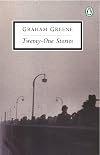
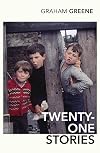
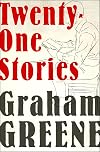
Twenty-One Stories
by Graham Greene 
On This Page
Description
In "The End of the Party," a game of hide-and-seek takes a terrifying turn in the dark. In "The Innocent," a romantic gets a rude awakening when he finds a hidden keepsake from a childhood crush. A husband's sexual indiscretion is revealed in a most public and embarrassing way in "The Blue Film." A rebellious teen's flight from her petit bourgeois life includes a bad boy, a gun, and a plan in "A Drive in the Country." In "A Little Place off the Edgware Road," a suicidal man's encounter with show more a stranger in a grubby cinema seals his fate. A young boy is ushered into a dark world when he discovers the secrets adults hide in "The Basement Room." And in "When Greek Meets Greek," a clever con between two scoundrels carries an unexpected sting. In these and more than a dozen other stories, Greene confronts his usual themes of betrayal and vengeance, love and hate, faith and doubt, guilt and grief, and pity and pursuit. show lessTags
Recommendations
























Member Reviews
Oh, Graham Greene, a man of so many stories and things to say. How I wish that my first interaction with him hadn’t been for my A-Levels, reading The Heart of the Matter, which I still haven’t found the courage to return to to this day. Not that it was taught to me terribly, but it’s so depressing.
Even though, let’s be real, his other work can be just as depressing, too.
But there’s something oddly whimsical about his short stories.
There are 21 short stories in this aptly-named collection, all dealing with vastly different themes. Not all of them are complete winners, but they’re all rather memorable. There’s a story about a man who’s stomach mimics the noises it hears, another about a group of hooligan boys who tear an show more old man’s house to shred simply because they can, and another about a man who contracts a deadly disease and lives long enough to speak about it before dying at a conference of that same disease. But in this review I’d like to talk to you about three of the stories in particular.
“When Greek Meets Greek” is a fantastically hilarious story about two men who think they are duping the other in a scam they have organized. One of the men has started up a fake university, which he will use to convince young men fighting wars abroad to enrol into for incredible amounts of money and then send them a degree that is, quite obviously, fake. He enlists his niece to help him do this, and she soon strikes up a relationship with their first student, a young man recently out of prison pretending to be one such soldier, all as a part of his father’s scheme to get him an education.
“The Blue Film” is one of the shortest in the collection, the story of an elderly couple on holiday in an Asian country (possibly India, although don’t hold me to it on that one) that decide to watch a raunchy ‘blue film’ (for all intents and purposes, a porno). While watching it, the wife suddenly realizes that the man in the film is her husband, decades younger. While he tries to explain to her that he only did it for the money, it is also revealed to the audience that he was also possibly in love with his co-star.
Finally, “The End of the Party” is the story of two twin brothers, quite young (eleven, I believe) who are invited to the birthday party. One of the brothers is terribly afraid of the dark, and the other is definitely the braver of the two. While at the party, a game of hide and seek ensues, and the brothers are separated. When the braver one finds his twin cowering in the dark, his twin telepathy tells him that something is amiss, and all is revealed when the lights come on again to help everyone see their way.
Honestly, all three of these stories sound completely different from each other, and they quite are, but Greene’s amazing writing style comes out in all of them, and the little twists and turns that the stories take, and amusing anecdotes that he writes, are so well-crafted.
I highly recommend this book, especially to someone who thinks that they don’t like Greene’s work, because I think that this might just change your mind. I give it a solid 4/5. show less
Even though, let’s be real, his other work can be just as depressing, too.
But there’s something oddly whimsical about his short stories.
There are 21 short stories in this aptly-named collection, all dealing with vastly different themes. Not all of them are complete winners, but they’re all rather memorable. There’s a story about a man who’s stomach mimics the noises it hears, another about a group of hooligan boys who tear an show more old man’s house to shred simply because they can, and another about a man who contracts a deadly disease and lives long enough to speak about it before dying at a conference of that same disease. But in this review I’d like to talk to you about three of the stories in particular.
“When Greek Meets Greek” is a fantastically hilarious story about two men who think they are duping the other in a scam they have organized. One of the men has started up a fake university, which he will use to convince young men fighting wars abroad to enrol into for incredible amounts of money and then send them a degree that is, quite obviously, fake. He enlists his niece to help him do this, and she soon strikes up a relationship with their first student, a young man recently out of prison pretending to be one such soldier, all as a part of his father’s scheme to get him an education.
“The Blue Film” is one of the shortest in the collection, the story of an elderly couple on holiday in an Asian country (possibly India, although don’t hold me to it on that one) that decide to watch a raunchy ‘blue film’ (for all intents and purposes, a porno). While watching it, the wife suddenly realizes that the man in the film is her husband, decades younger. While he tries to explain to her that he only did it for the money, it is also revealed to the audience that he was also possibly in love with his co-star.
Finally, “The End of the Party” is the story of two twin brothers, quite young (eleven, I believe) who are invited to the birthday party. One of the brothers is terribly afraid of the dark, and the other is definitely the braver of the two. While at the party, a game of hide and seek ensues, and the brothers are separated. When the braver one finds his twin cowering in the dark, his twin telepathy tells him that something is amiss, and all is revealed when the lights come on again to help everyone see their way.
Honestly, all three of these stories sound completely different from each other, and they quite are, but Greene’s amazing writing style comes out in all of them, and the little twists and turns that the stories take, and amusing anecdotes that he writes, are so well-crafted.
I highly recommend this book, especially to someone who thinks that they don’t like Greene’s work, because I think that this might just change your mind. I give it a solid 4/5. show less
There are two heavyweights in 21 Stories, a collection gathered from 25 years of Greene's career. The first of these is The Destructors. I must have read it close to ten times before. Its remaining regard in pop culture was established by it being the philosophical vertebrae for the film Donnie Darko. The other tower is The Basement Room which was the basis for Greene's screenplay for the film The Fallen idol. The riveting story of innocence and misunderstanding was later masterfully realized by Carol Reed. This was around the time that Reed and Green were globetrotting and gathering items for the Circus (MI-6).
The surprise of 21 Stories had to be Greek Meets Greek which oddly didn't concern the EU bailout but instead was a wartime show more encounter of schemers, which anticipates the ascent of online universities, and culminates in a hilarious doubled-edged farce. The remainder of the collection comprise an uneven lot, largely surrounding familiar themes in Greene's work: guilt, betrayal, greed and grief. show less
The surprise of 21 Stories had to be Greek Meets Greek which oddly didn't concern the EU bailout but instead was a wartime show more encounter of schemers, which anticipates the ascent of online universities, and culminates in a hilarious doubled-edged farce. The remainder of the collection comprise an uneven lot, largely surrounding familiar themes in Greene's work: guilt, betrayal, greed and grief. show less
“Bleak” is the way I’d describe the general tone here. Several stories are told from a child’s point of view: in “The Basement Room,” the boy Philip learns to betray the butler Baines, who’s befriended him, when the unpleasant Mrs. Baines is accidentally killed; in “The End of the Party,” a twin can still sense the fear of his brother after the brother has died of fright; and in “The Destructors,” we’re treated to the mind of an amoral fifteen-year old who destroys, with the help of his gang, a house possibly built by Christopher Wren. There is an element of supernatural horror in “The End of the Party” and in “A Little Place Off the Edgeware Road” reminiscent of M. R. James or H. P. Lovecraft. “The show more Hint of an Explanation” is Christian apologetics like The End of the Affair or Chesterton. “A Chance for Mr. Lever” has a middle-class character meeting the jungle à la Conrad or Maugham. A few of the stories are grimly funny, as when the children out-con the parents in “When Greek Meets Greek,” or when Mr. Ferraro is diddled out of the 36,892 days of plenary indulgence his secretary Miss Saunders is supposed to be amassing for him. show less
My favourite story here is "Across the Bridge". Yes, it's a gringo on the run in Latin America story and that can get tiring. But Greene does it better than most.
Greene employs a narrator, who meets the protagonist and then tells his story in a detached, unreliable way. He learnt this from Conrad I'd say. The main problem the narrator has with the conman protagonist is how he treats his dog. There is some local colour about sitting in the plaza - but this is Greene: he sketches the atmosphere and then gets us involved in the plot.
"The Basement Room' filmed as the "The Fallen Idol" is also excellent. I'm happy that the movies "Across the Bridge and "The Fallen Idol" have good reviews. I thought I'd seen all the good Graham Greene film show more adaptions already.
"The Destructors" is good. It reminded me of Robert Westall's "The Machine Gunners". Beyond that the stories, many of them about Catholic doubts and childhood fears, range from pretty good average.
Update: the movie "Over the Bridge" starts with Greene's idea and develops it a great deal. Could have been a great novel. Rod Steiger plays the protagonist. He must be one of the few American actors to star in movies both as a German (Over the Bridge) and as a German (Last Days of Mussolini). show less
Greene employs a narrator, who meets the protagonist and then tells his story in a detached, unreliable way. He learnt this from Conrad I'd say. The main problem the narrator has with the conman protagonist is how he treats his dog. There is some local colour about sitting in the plaza - but this is Greene: he sketches the atmosphere and then gets us involved in the plot.
"The Basement Room' filmed as the "The Fallen Idol" is also excellent. I'm happy that the movies "Across the Bridge and "The Fallen Idol" have good reviews. I thought I'd seen all the good Graham Greene film show more adaptions already.
"The Destructors" is good. It reminded me of Robert Westall's "The Machine Gunners". Beyond that the stories, many of them about Catholic doubts and childhood fears, range from pretty good average.
Update: the movie "Over the Bridge" starts with Greene's idea and develops it a great deal. Could have been a great novel. Rod Steiger plays the protagonist. He must be one of the few American actors to star in movies both as a German (Over the Bridge) and as a German (Last Days of Mussolini). show less
Graham Greene is a much better novelist than short story writer. In my youth I loved his tales of dispirited, tired old men. Now that I am a tired old man, not so much.
Mostly tales from the Depression and the blitz focusing on lower class London. Graham writes so well he made these alomost bearable. The Mexico story was the best.
With so much historical fiction on offer, it has been a pleasure to read some contemporary books too. The quality of the stories in this collection varies, but this has been an enjoyable, if dark, read.
Members
- Recently Added By
Author Information

356+ Works 87,436 Members
Born in 1904, Graham Greene was the son of a headmaster and the fourth of six children. Preferring to stay home and read rather than endure the teasing at school that was a by-product of his father's occupation, Greene attempted suicide several times and eventually dropped out of school at the age of 15. His parents sent him to an analyst in show more London who recommended he try writing as therapy. He completed his first novel by the time he graduated from college in 1925. Greene wrote both entertainments and serious novels. Catholicism was a recurring theme in his work, notable examples being The Power and the Glory (1940) and The End of the Affair (1951). Popular suspense novels include: The Heart of the Matter, Our Man in Havana and The Quiet American. Greene was also a world traveler and he used his experiences as the basis for many books. One popular example, Journey Without Maps (1936), was based on a trip through the jungles of Liberia. Greene also wrote and adapted screenplays, including that of the 1949 film, The Third Man, which starred Orson Welles. He died in Vevey, Switzerland in 1991. (Bowker Author Biography) show less
Graham Greene has a Legacy Library. Legacy libraries are the personal libraries of famous readers, entered by LibraryThing members from the Legacy Libraries group.
Series
Belongs to Publisher Series
Gyldendals Tranebøger (129)
Work Relationships
Common Knowledge
- Canonical title
- Twenty-One Stories
- Alternate titles
- 21 Stories
- Original publication date
- 1954
- People/Characters
- Philip; Baines; Mr. Lever; Mr. Ferraro; Miss Saunders
- Important places
- USA; Havana, Cuba
- Quotations
- Frau Schmidt had reached an age when she had a great yearning to sit
quietly with another woman knitting something or other for her grandchildren
and talking about their latest maladies. You can't do that at ease with a... (show all)
man continually on the go to a cellar for another litre. There's a man's
atmosphere and a woman's atmosphere, and they don't mix ...
Frau Schmidt took her trouble to Frau Muller who suffered in just the same
manner as herself. Frau Muller was a stronger type of woman and she set out
to build an organisation. She found four
other women starved of female company and female interests, and they
arranged to forgather once a week with their sewing and take their evening
coffee together. They took it in turn to act hostess and make the cakes. - Original language
- English
- Disambiguation notice
- Please do not combine Twenty-One Stories with the anthology "Collected Short Stories", which combines "Twenty-One" with "May We Borrow Your Husband?" and "A Sense of Reality".
Classifications
Statistics
- Members
- 713
- Popularity
- 40,035
- Reviews
- 11
- Rating
- (3.54)
- Languages
- Danish, Dutch, English, Spanish
- Media
- Paper, Audiobook, Ebook
- ISBNs
- 15
- ASINs
- 22