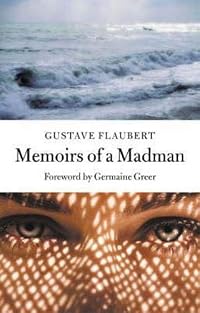
Memoirs of a Madman
by Gustave Flaubert 
On This Page
Description
One of Flaubert's earliest writings, but published only after his death, Memoirs of a Madman presents us with a young man as he reflects - alternating between musings on the present and memories of the past - on the years that have brought him to 'madness', recalling the innocence of his boyhood, the first stirrings of sexual awakening and his abrupt initiation into the adult world. Also included in this volume is another, similarly themed early work, the autobiographical novella November, show more which Nadine Gordimer called 'an unsurpassed testament of adolescence'. show lessTags
Recommendations


























Member Reviews
Finally getting my first taste of Flaubert in the original French, and I decided to start with something shorter to build myself up to finally getting to read Bovary (which is part of the final motivation for me to begin this attempt to learn to read French to begin with). Mémoires d'un fou is a strange little tome - Flaubert wrote it when he was 17, and once you know this you find it unmistakably the work of a teenage boy... and yet already there were the first shoots of what was to become a great talent.
The book is structured quite oddly - there's a main story of sorts, a first (and frustrated) love that shapes the first person narrator indelibly, yet this also contains plenty of other remembrances/reflections on youth that feel more show more like something from a personal journal, as well as some adolescent philosophy along the way. The last of these three is definitely the worst of the structures and moods the story explores, sometimes becoming quite tedious or trite even though the core mode of thinking is one Flaubert would more or less stick to for the rest of his life with much more development and nuance (and if you ever doubt the extent to which Emma Bovary was in good part a personalisation of Flaubert himself, and his own scathing and mordant wit a kind of self-criticism, you can find it here in barrels). The more nostalgic and melancholic sections on the other hand feel oddly as if they're in an early lineage with what Nerval would do in Sylvie 20 years or so later and which would eventually form the basis of Proust's project, a commonality it's difficult to find between the two great French writers elsewhere.
Already the core elements of the kind of romanticist/realist blend Flaubert would master are in evidence and if at times this made me double-take or roll my eyes, I found that in the closing chapters I was quite moved and that at points the great writer who could turn a phrase as if wielding a dagger into your heart was already in evidence this early on. As much as this is juvenilia, a first draft of a confessional novel that feels very obviously a first draft, it's times like this I'm reminded that however good my own writing may one day get I'm operating a thousand leagues below what Gustave was capable of before he was even fully an adult... depressing for me but at least we all got to experience the benefits.
Also if you're into psychoanalysis you'll get a lot of grist for the mill out of all the sexual elements at play here. Be prepared.
________
Found this a really gentle read that I completed in a single day - had to do some word look-ups but this came close to extensive reading. show less
The book is structured quite oddly - there's a main story of sorts, a first (and frustrated) love that shapes the first person narrator indelibly, yet this also contains plenty of other remembrances/reflections on youth that feel more show more like something from a personal journal, as well as some adolescent philosophy along the way. The last of these three is definitely the worst of the structures and moods the story explores, sometimes becoming quite tedious or trite even though the core mode of thinking is one Flaubert would more or less stick to for the rest of his life with much more development and nuance (and if you ever doubt the extent to which Emma Bovary was in good part a personalisation of Flaubert himself, and his own scathing and mordant wit a kind of self-criticism, you can find it here in barrels). The more nostalgic and melancholic sections on the other hand feel oddly as if they're in an early lineage with what Nerval would do in Sylvie 20 years or so later and which would eventually form the basis of Proust's project, a commonality it's difficult to find between the two great French writers elsewhere.
Already the core elements of the kind of romanticist/realist blend Flaubert would master are in evidence and if at times this made me double-take or roll my eyes, I found that in the closing chapters I was quite moved and that at points the great writer who could turn a phrase as if wielding a dagger into your heart was already in evidence this early on. As much as this is juvenilia, a first draft of a confessional novel that feels very obviously a first draft, it's times like this I'm reminded that however good my own writing may one day get I'm operating a thousand leagues below what Gustave was capable of before he was even fully an adult... depressing for me but at least we all got to experience the benefits.
Also if you're into psychoanalysis you'll get a lot of grist for the mill out of all the sexual elements at play here. Be prepared.
________
Found this a really gentle read that I completed in a single day - had to do some word look-ups but this came close to extensive reading. show less
"I'm fourteen and this is deep".
Un libro che ti rapisce. Io ho una mia particolare triade ed è anche quella che credo mi abbia formato a livello letterario. Flaubert, Rimbaud e Joyce.
In questo caso Flaubert mi ha rapito letteralmente e Memorie di un pazzo è un 'opera da leggere assolutamente. Stelline piene ovviamente.
In questo caso Flaubert mi ha rapito letteralmente e Memorie di un pazzo è un 'opera da leggere assolutamente. Stelline piene ovviamente.
Mar 22, 2010Italian
1
Ratings
Members
- Recently Added By
Author Information

557+ Works 49,169 Members
Born in the town of Rouen, in northern France, in 1821, Gustave Flaubert was sent to study law in Paris at the age of 18. After only three years, his career was interrupted and he retired to live with his widowed mother in their family home at Croisset, on the banks of the Seine River. Supported by a private income, he devoted himself to his show more writing. Flaubert traveled with writer Maxime du Camp from November 1849 to April 1851 to North Africa, Syria, Turkey, Greece, and Italy. When he returned he began Madame Bovary, which appeared first in the Revue in 1856 and in book form the next year. The realistic depiction of adultery was condemned as immoral and Flaubert was prosecuted, but escaped conviction. Other major works include Salammbo (1862), Sentimental Education (1869), and The Temptation of Saint Antony (1874). His long novel Bouvard et Pecuchet was unfinished at his death in 1880. After his death, Flaubert's fame and reputation grew steadily, strengthened by the publication of his unfinished novel in 1881 and the many volumes of his correspondence. (Bowker Author Biography) show less
Gustave Flaubert has a Legacy Library. Legacy libraries are the personal libraries of famous readers, entered by LibraryThing members from the Legacy Libraries group.
Series
Belongs to Publisher Series
Work Relationships
Common Knowledge
- Canonical title
- Memoirs of a Madman
- Original title
- Mémoires d'un Fou
- Original publication date
- 1838
Classifications
Statistics
- Members
- 242
- Popularity
- 134,466
- Reviews
- 3
- Rating
- (3.07)
- Languages
- 8 — English, French, German, Italian, Portuguese, Slovenian, Spanish, Turkish
- Media
- Paper, Ebook
- ISBNs
- 26
- ASINs
- 3