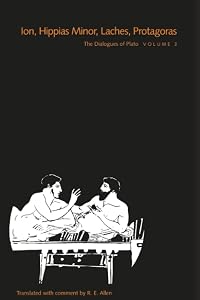
The Dialogues of Plato. Volume 3: Ion, Hippias Minor, Laches, Protagoras
by Plato, R. E. Allen
Dialogues of Plato (3)
52 Members (4.50)
On This Page
Description
R.E. Allen's superb new translations of four Socratic dialogues-Ion, Hippias Minor, Laches, and Protagoras-bring these classic texts to life for modern readers. Allen introduces and comments on the dialogues in an accessible way, inviting the reader to reexamine the issues continually raised in Plato's works. In his detailed commentary, Allen closely examines the major themes and central arguments of each dialogue, with particular emphasis on Protagoras. He clarifies each of Plato's show more arguments and its refutation; places the themes in historical perspective; ties each theme to interpretations of rival translations; and links the philosopher's thought to trends in late modern philosophy. Topics discussed include: whether virtue is an art, whether wisdom and courage are logically equivalent, whether virtue is knowledge, and whether to know the good is to do it. Allen connects his discussion of these issues to the Benthamite tradition of hedonism and utilitarianism and to the ethical theories of Mill, Sidgwick, Moore, and Freud. show lessTags
Recommendations







Member Reviews
Members
- Recently Added By
Author Information

2,727+ Works 100,637 Members
Plato was born c. 427 B.C. in Athens, Greece, to an aristocratic family very much involved in political government. Pericles, famous ruler of Athens during its golden age, was Plato's stepfather. Plato was well educated and studied under Socrates, with whom he developed a close friendship. When Socrates was publically executed in 399 B.C., Plato show more finally distanced himself from a career in Athenian politics, instead becoming one of the greatest philosophers of Western civilization. Plato extended Socrates's inquiries to his students, one of the most famous being Aristotle. Plato's The Republic is an enduring work, discussing justice, the importance of education, and the qualities needed for rulers to succeed. Plato felt governors must be philosophers so they may govern wisely and effectively. Plato founded the Academy, an educational institution dedicated to pursuing philosophic truth. The Academy lasted well into the 6th century A.D., and is the model for all western universities. Its formation is along the lines Plato laid out in The Republic. Many of Plato's essays and writings survive to this day. Plato died in 347 B.C. at the age of 80. (Bowker Author Biography) show less
8 Works 120 Members
Series

Common Knowledge
- Canonical title
- The Dialogues of Plato. Volume 3: Ion, Hippias Minor, Laches, Protagoras
Classifications
Statistics
- Members
- 52
- Popularity
- 583,480
- Rating
- (4.50)
- Languages
- English
- Media
- Paper, Ebook
- ISBNs
- 3