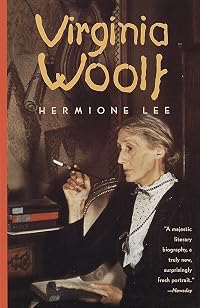
Virginia Woolf
by Hermione Lee
On This Page
Description
Hermione Lee has created a portrait - rich in detail, epic in scope - that lets us know Virginia Woolf as we never have before: how she looked, how she sounded, how she dressed and behaved, how she wrote. This book gives us a vivid sense of the texture of Woolf's daily life - her houses and habits, money and servants, parties and talk. And through her own words and newly published letters between family members and friends, we gain a fresh and penetrating understanding. Of Woolf's formative show more personal relationships: with her parents and siblings; with her husband, Leonard; with writers she edgily admired, such as T.S. Eliot and Katherine Mansfield; and with the women who changed her life, including Vita Sackville-West and Ethel Smyth. Lee casts aside the misleading received images of Woolf as an ethereal and emotionally dependent creature, and takes us deep inside her inner being. We see a brave, powerfully intelligent woman who suffered. From a terrifying chronic illness and wrestled with the contradictions of her own character. And we see a tougher Woolf than we have previously known: a woman acutely alert to the realities of her times, a committed feminist, an opponent of every sort of political and intellectual fascism. At the same time, Lee offers an unequalled insight into the connections between Woolf's life and work. show lessTags
Recommendations
















Member Reviews
https://nwhyte.livejournal.com/2920196.html
Lee's biography of Woolf was published in 1996, and I see there have been a couple more since; but this is pretty comprehensive, covering 59 years in 770 pages. Woolf bitterly regretted not having had a formal education, but maybe her more chaotic intellectual upbringing was a necessary precursor for her genius to take the shape that it did. Certainly being brought up with and mixing with writers gave her a keen understanding for the writer's life. Lee does a really good job of mapping the literary interactions between Woolf and her family, friends and lovers, from the day she was born to the day she died. I learned a lot about the micro-geography of Bloomsbury and its satellite territories, show more and it was all very interesting.
Lee devotes appropriate but not obsessional attention to Virginia's half-brother's sexual abuse of her and her sister; she rightly puts more time into elucidating Woolf's experience of mental illness, which hit her repeatedly as an adult and prompted her suicide at the fear of yet another debilitating breakdown. I feel a lot of Woolf's work is translucently teetering on the edge of experience, and this was a good explanation of how that came to be. Though of course, a lot of other people have similar experiences and do not achieve the same fame; it doesn't explain how she became a great writer, but it does I think help explain why she became the great writer that she did.
My one minor disappointment with Lee's book is that I didn't feel Woolf's feminism was really put into context, apart from her fleeting engagement with the suffragettes and her later entanglement with Dame Ethel Smyth. Did she interact with or influence other feminist writings of the day? Were her friends and lovers (other than Ethel Smyth) also feminists? She is portrayed here as rather a lone voice in the wilderness.
However, otherwise this was a very satisfying read about someone I had wished I knew more about, and whose books I will now read with greater understanding and even more enthusiasm. show less
Lee's biography of Woolf was published in 1996, and I see there have been a couple more since; but this is pretty comprehensive, covering 59 years in 770 pages. Woolf bitterly regretted not having had a formal education, but maybe her more chaotic intellectual upbringing was a necessary precursor for her genius to take the shape that it did. Certainly being brought up with and mixing with writers gave her a keen understanding for the writer's life. Lee does a really good job of mapping the literary interactions between Woolf and her family, friends and lovers, from the day she was born to the day she died. I learned a lot about the micro-geography of Bloomsbury and its satellite territories, show more and it was all very interesting.
Lee devotes appropriate but not obsessional attention to Virginia's half-brother's sexual abuse of her and her sister; she rightly puts more time into elucidating Woolf's experience of mental illness, which hit her repeatedly as an adult and prompted her suicide at the fear of yet another debilitating breakdown. I feel a lot of Woolf's work is translucently teetering on the edge of experience, and this was a good explanation of how that came to be. Though of course, a lot of other people have similar experiences and do not achieve the same fame; it doesn't explain how she became a great writer, but it does I think help explain why she became the great writer that she did.
My one minor disappointment with Lee's book is that I didn't feel Woolf's feminism was really put into context, apart from her fleeting engagement with the suffragettes and her later entanglement with Dame Ethel Smyth. Did she interact with or influence other feminist writings of the day? Were her friends and lovers (other than Ethel Smyth) also feminists? She is portrayed here as rather a lone voice in the wilderness.
However, otherwise this was a very satisfying read about someone I had wished I knew more about, and whose books I will now read with greater understanding and even more enthusiasm. show less
This was an interesting and fascinating read and one that that attempts to rescue Woolf from the literary mythology that has grown around her. I really felt that I understood more about Woolf the woman and the writer and the demons that chased her.
Lee (English, Univ. of York, England) has succeeded in presenting a different side of Woolf somewhat overlooked in previous studies. Aspects of Woolf's personal life like her childhood abuse by her stepbrother and her stormy family life are already well documented (see Louise DeSalvo's Virginia Woolf, Ballantine, 1990, and Panthea Reid's Art and Affection, respectively); and literary studies abound (see James King's Virginia Woolf, and Lyndall Gordon's Virginia Woolf, Norton, 1993). By making use of Woolf's extensive correspondence, diaries, and works, Lee strives to present her not as a fragile, eccentric victim, as has been done often, but as a complex, sometimes troubled, yet brilliant artist who overcame much to accomplish what she show more did. What results is a biography that is part social history, part literary analysis, and overall a fuller picture of Woolf. Lee's eye for detail allows us to get closer than ever to knowing who she was. While the subject may not be new, this biography is well worth a close reading. show less
This weighty tome is often cited as the definitive Woolf biography, and with good reason. Lee's densely detailed portrait is rigorously sourced and referenced - she does not indulge in baseless speculation, yet still unearths many intriguing nuggets concerning her subject. Woolf's achievements seem all the more astonishing in light of these reflections on her often tragic and turbulent life. A must-read for her fans, and for lovers of top-shelf biographies.
An amazing, voluminous, illuminating biography that ultimately reveals the difficulty in writing the life of someone so intelligent and complicated.
Finally done!
This book is a masterpiece of research and insight and evocation of character and I’m so glad I read it. But for the last three hundred pages or so, I felt like it would never be over. It needed to be as long as it is, but it was a labor to finish it!
This book is a masterpiece of research and insight and evocation of character and I’m so glad I read it. But for the last three hundred pages or so, I felt like it would never be over. It needed to be as long as it is, but it was a labor to finish it!
I gave up on this book about 300 pages in... This is well-written and full of information -- maybe too much information! It is more of an analysis of how Woolf's life affected her writing than a biography. Or perhaps it would be more accurate to say it felt like reading an academic treatise on Woolf's life, full of references to her novels and letters (both hers and those of friends and family). Although I found it mildly interesting, it was very slow reading and never absorbed me, so when it was due back to the library I returned it even though not finished.
Members
- Recently Added By
Lists

Best Biographies, Autobiographies and Memoirs
465 works; 160 members

20th Century Literature
1,161 works; 54 members

Art of Reading
188 works; 5 members
Club Read's Recommended Nonfiction Written by Women
618 works; 30 members

Best Biographies of Notable Women
279 works; 101 members

In Our Time books
4,934 works; 2 members
Author Information

27+ Works 2,992 Members
Hermione Lee is the first woman Goldsmiths' Professor of English Literature at Oxford University.
Awards and Honors
Common Knowledge
- Canonical title
- Virginia Woolf
- Original title
- Virginia Woolf
- Original publication date
- 1996
- People/Characters
- Virginia Woolf; Leonard Woolf; Vanessa Bell; Clive Bell; Quentin Bell; Angelica Garnett (show all 8); Vita Sackville-West; Lytton Strachey
- Important places
- London, England, UK; River Ouse, England, UK
- Important events
- World War I; World War II; Virginia Woolf's suicide
- Epigraph
- 'I meant to write about death, only life came breaking in as usual'.
Diary, 17 February 1922 - Dedication
- For John Barnard
- First words
- 'My God, how does one write a Biography?' Virginia Woolf's question haunts her own biographers. How do they begin?
- Blurbers
- Cunningham, Michael; Hastings, Selina; Walter, Natasha; Fitzgerald, Penelope; McCrum, Robert; Lessing, Doris
- Original language
- English
Classifications
Statistics
- Members
- 1,053
- Popularity
- 24,413
- Reviews
- 9
- Rating
- (4.26)
- Languages
- English, French, German
- Media
- Paper, Ebook
- ISBNs
- 10
- ASINs
- 4