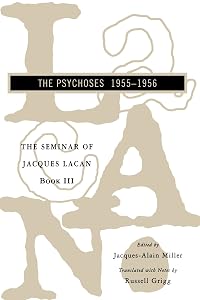
The Seminar of Jacques Lacan, Book III: The Psychoses, 1955-1956
by Jacques Lacan
The Seminar of Jacques Lacan (3)
178 Members (4.00)
On This Page
Description
During the third year of his famous seminar, Jacques Lacan gives a concise definition of psychoanalysis: 'Psychoanalysis should be the science of language inhabited by the subject. From the Freudian point of view man is the subject captured and tortured by language.' Since psychosis is a special but emblematic case of language entrapment, Lacan devotes much of this year to grappling with distinctions between the neuroses and the psychoses. As he compared the two, relationships, symmetries, show more and contrasts emerge that enable him to erect a structure for psychosis. Freud's famous case of Daniel Paul Schreber is central to Lacan's analysis. In demonstrating the many ways that the psychotic is `inhabited, possessed by language', Lacan draws upon Schreber's own account of his psychosis and upon Freud's notes on this 'case of paranoia'. The analysis of language is both fascinating and enlightening. show lessTags
Recommendations
























Member Reviews
Members
- Recently Added By
Author Information

205+ Works 6,084 Members
Jacques Lacan was born into an upper-middle-class Parisian family. He received psychiatric and psychoanalytic training, and his clinical training began in 1927. His doctoral thesis, "On Paranoia and Its Relation to Personality," already indicated an original thinker; in it he tried to show that no physiological phenomenon could be adequately show more understood without taking into account the entire personality, including its engagement with a social milieu. Practicing in France, Lacan led a "back to Freud" movement in the most literal sense, at a time when others were trying to interpret Sigmund Freud (see also Vol. 3) broadly. He emphasized the role of the image and the role of milieu in personality organization. Seeking to reinterpret Freud's theories in terms of structural linguistics, Lacan believed that Freud's greatest insight was his understanding of the "talking cure" as revelatory of the unconscious. By taking Freud literally, Lacan led a psychoanalytic movement that evolved into a very specific school of interpretation. Often embroiled in controversy, in the 1950s he opposed the standardization of training techniques, the classification of psychoanalysis as a medical treatment, and the then emerging school of ego psychology. Although general readers may find Lacan difficult to read, his works are provocative and rewarding. (Bowker Author Biography) show less
Series

Common Knowledge
- Canonical title
- The Seminar of Jacques Lacan, Book III: The Psychoses, 1955-1956
Classifications
- Genres
- Nonfiction, Philosophy, General Nonfiction
- DDC/MDS
- 150.195 — Philosophy & psychology Psychology Emotions, Relationships, & Family Theory And Instruction Systems, schools, viewpoints Psychoanalytic systems
- LCC
- BF173 .L14613 — Philosophy, Psychology and Religion Psychology Psychology Psychoanalysis
- BISAC
Statistics
- Members
- 178
- Popularity
- 184,398
- Rating
- (4.00)
- Languages
- 7 — English, French, German, Italian, Polish, Portuguese, Spanish
- Media
- Paper, Ebook
- ISBNs
- 14
- ASINs
- 2