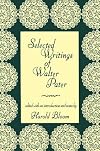
Selected Writings of Walter Pater
by Walter Pater, Harold Bloom (Editor)
82 Members (3.40)
On This Page
Description
Harold Bloom's selection of Pater's writings brings together in one volume the most important sections and passages from The Renaissance, Imaginary Portraits, Appreciations, Plato and Platonism, Greek Studies, and Sketches and Reviews, as well as "The Child in the House." Pater, the chief aesthetician and literary critic of Victorian England, brought his powerful imagination to bear on a wide range of subjects: from the drama of Euripides to the painters of the Renaissance, from the Romantic show more poets to the pre-Raphaelites, from Plato to Oscar Wilde. In the twentieth century, Pater's theories of art and literature exerted a strong inluence on the work of Yeats, Pound, Eliot, Joyce, and Stevens. show lessTags
Recommendations









Member Reviews
Members
- Recently Added By
Author Information

48+ Works 2,838 Members
Walter Pater (born August4, 1839) was an Englaish essayist, critic and writer of fiction. He attended Queen's College, Oxford. His earliest work, an essay on Samuel Taylor Coleridge, appeared in 1866 in The Westminster Review; Pater soon became a regular contributor to a number of serious reviews, especially The Fortnightly, which published his show more essays on Leonardo da Vinci, Pico Della Mirandola, Botticelli, and the poetry of Michelangelo. All were included in his first, and perhaps most influential, book, Studies in the History of the Renaissance (1873; reissued as The Renaissance, 1877). In 1885 Pater's only novel, Marius the Epicurean, appeared. Ostensibly, Marius is a historical novel, set in the time of Marcus Aurelius and tracing the philosophical development of its young protagonist and his gradual approach to Christianity. Practically, however, Marius is more a meditation of the philosophical choices that confronted Pater, or any thinker, during the late Victorian period. In light of the work's underrealized characterizations and the lack of any but intellectual action, it is difficult to justify calling it a novel in the usual sense of the term. Yet, as a highly polished prose piece, and as an argument for an austere yet intensely experienced way of life, it holds a singular place in Victorian literature. On July 30, 1894 Pater died suddenly in his Oxford home of heart failure brought on by rheumatic fever, at the age of 54. He was buried at Holywell Cemetery, Oxford. (Bowker Author Biography) show less

Harold Bloom was born on July 11, 1930 in New York City. He earned his Bachelor of Arts from Cornell in 1951 and his Doctorate from Yale in 1955. After graduating from Yale, Bloom remained there as a teacher, and was made Sterling Professor of Humanities in 1983. Bloom's theories have changed the way that critics think of literary tradition and show more has also focused his attentions on history and the Bible. He has written over twenty books and edited countless others. He is one of the most famous critics in the world and considered an expert in many fields. In 2010 he became a founding patron of Ralston College, a new institution in Savannah, Georgia, that focuses on primary texts. His works include Fallen Angels, Till I End My Song: A Gathering of Last Poems, Anatomy of Influence: Literature as a Way of Life and The Shadow of a Great Rock: A Literary Appreciation of The King James Bible. Harold Bloom passed away on October 14, 2019 in New Haven, at the age of 89. (Bowker Author Biography) show less
Classifications
Statistics
- Members
- 82
- Popularity
- 388,984
- Rating
- (3.40)
- Languages
- English
- Media
- Paper
- ISBNs
- 2
- ASINs
- 4