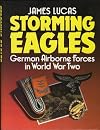
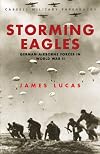
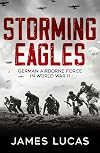
Storming Eagles: German Airborne Forces in World War II
by James Lucas
On This Page
Description
Unstoppable and deadly, this is the gripping story of some of the most feared soldiers in the war The daring, courage and skill of the highly-trained men who spearheaded German assaults in the blitzkrieg of 1940, dropping from the air to seize and overwhelm key invasion points, showed to an alarmed world that a new dimension had been added to the science of warfare. One spectacular success was the invasion and capture of Crete in May 1941, all be it achieved at a terrible price. The German show more paratroopers were an elite, justifying again and again their great reputation for courage and hard fighting in Russia, North Africa and Italy. Bestselling military historian James Lucas has researched deeply in Allied and German archives and interviewed many of the leading members of the Fallschirmjaegar who survived the war. This is an unmissable and dramatic account of the Second World War's most frightening elite, perfect for readers of James Holland and Max Hastings. show lessTags
Recommendations
























Member Reviews
I picked this book up because I have recently read an account of the Nazi invasion of the Netherlands in May 1940 (Ryan Noppen's Holland 1940; the Luftwaffe's first setback in the West), which looked at Fall Gelb ('Case Yellow') from the point of view of the Dutch air defences. Noppen was a neutral author, and painted a picture of Fall Gelb that is rather at variance with the standard history of the Blitzkrieg in the West. I immediately looked to see what perspective this book offered on the same subject.
Lucas' book is written from a different perspective, using accounts from many of the German Fallschirmjäger (paratroops) themselves. It came as little surprise, then, to find that this gave an account of the campaign in the Netherlands show more that reinforced the German view that victory was achieved through the shock tactics of force projection and the rapid support of forward airborne forces by the timely movement of armoured forces in support.
Noppen's account suggests otherwise. The Dutch possessed an effective centralised air defence network which was able to alert airfields to Luftwaffe formation movements in the initial stages of the attack. This meant that air defences were alerted to the threat and were able to mount an effective defence. In the five days of Fall Gelb, 455 of the German aircraft deployed were put out of action by the Dutch, 69% of which were the Junkers Ju.52 transports that the Germans intended to rely upon for the insertion of the second wave of airborne assaults (let alone the subsequent invasion of Britain). Only 35% of the intended total of German troops were landed by the end of the day one of the operation, and many of those were out of position in relation to their objectives; more than 2,700 out of 3,500 of those troops became either casualties or prisoners of war. The PoWs were handed over to the British, who had facilities for handling captives; hence these troops were not returned to service after the Netherlands fell.
So this history, at least as far as the invasion of the Netherlands is concerned, is definitely written by those who survived the initial wave of the attack, who were quite happy to relate their account of their eventual victory and their part in it. The real reason for the Dutch surrender - that Goering threatened to reduce both Rotterdam and Utrecht to rubble through aerial bombardment if the Netherlands did not surrender - was way beyond the level of those who provided their account of the victory for this book. The surviving foot soldiers' view of victory or defeat is based wholly on what they saw, and only reinforced by what they are told later. So we get accounts of individuals seeing Ju.52s damaged by opposition fire - but they saw the ones that made it back to base, not the ones left burning on beaches.
As far as the invasion of the Netherlands is concerned, then, this is definitely history written by (or in this case, on behalf of) the winners. It simply reinforces the German propaganda of the invincibility of those who planned and carried out Blitzkrieg. It should be read with that in mind.
Be aware however, that this is my initial reaction based on the chapter I read because another account of the same action was fresh in my mind. A deeper review will follow my more detailed reading of the whole book. show less
Lucas' book is written from a different perspective, using accounts from many of the German Fallschirmjäger (paratroops) themselves. It came as little surprise, then, to find that this gave an account of the campaign in the Netherlands show more that reinforced the German view that victory was achieved through the shock tactics of force projection and the rapid support of forward airborne forces by the timely movement of armoured forces in support.
Noppen's account suggests otherwise. The Dutch possessed an effective centralised air defence network which was able to alert airfields to Luftwaffe formation movements in the initial stages of the attack. This meant that air defences were alerted to the threat and were able to mount an effective defence. In the five days of Fall Gelb, 455 of the German aircraft deployed were put out of action by the Dutch, 69% of which were the Junkers Ju.52 transports that the Germans intended to rely upon for the insertion of the second wave of airborne assaults (let alone the subsequent invasion of Britain). Only 35% of the intended total of German troops were landed by the end of the day one of the operation, and many of those were out of position in relation to their objectives; more than 2,700 out of 3,500 of those troops became either casualties or prisoners of war. The PoWs were handed over to the British, who had facilities for handling captives; hence these troops were not returned to service after the Netherlands fell.
So this history, at least as far as the invasion of the Netherlands is concerned, is definitely written by those who survived the initial wave of the attack, who were quite happy to relate their account of their eventual victory and their part in it. The real reason for the Dutch surrender - that Goering threatened to reduce both Rotterdam and Utrecht to rubble through aerial bombardment if the Netherlands did not surrender - was way beyond the level of those who provided their account of the victory for this book. The surviving foot soldiers' view of victory or defeat is based wholly on what they saw, and only reinforced by what they are told later. So we get accounts of individuals seeing Ju.52s damaged by opposition fire - but they saw the ones that made it back to base, not the ones left burning on beaches.
As far as the invasion of the Netherlands is concerned, then, this is definitely history written by (or in this case, on behalf of) the winners. It simply reinforces the German propaganda of the invincibility of those who planned and carried out Blitzkrieg. It should be read with that in mind.
Be aware however, that this is my initial reaction based on the chapter I read because another account of the same action was fresh in my mind. A deeper review will follow my more detailed reading of the whole book. show less
I found the book to be one dimensional w no background info on any of the characters. Research seemed to be limited to personal accounts and official reports. No maps were included though they would have been enormously helpful and enhanced the narrative. No index at end of book nor any list of chapter titles. No evidence of any editing.
Regardless it contains some interesting historical content.
Regardless it contains some interesting historical content.
Ratings
Members
- Recently Added By
Author Information
54+ Works 1,844 Members
James Lucas fought with the British infantry in the Second World War. After the war he developed close contacts with German ex-servicemen, enabling him to undertake the extensive research that underlies the success of his many books. Lucas received international acclaim as one of the leading experts on all aspects of German military conduct in show more WWII. show less
Series
Belongs to Publisher Series
Common Knowledge
- Important places
- Germany
- Important events
- World War II (1939 | 1945)
- Original language
- English
Classifications
Statistics
- Members
- 114
- Popularity
- 286,527
- Reviews
- 2
- Rating
- (3.57)
- Languages
- English
- Media
- Paper, Ebook
- ISBNs
- 7
- ASINs
- 4