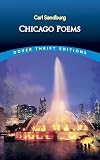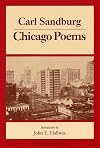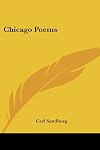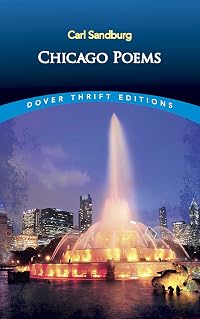
Chicago Poems
by Carl Sandburg 
On This Page
Description
Chicago Poems (1916) was Carl Sandburg's first-published book of verse. Written in the poet's unique, personal idiom, these poems embody a soulfulness, lyric grace, and a love of and compassion for the common man that earned Sandburg a reputation as a "poet of the people."Among the dozens of poems in this collection are such well-known verses as "Chicago," "Fog," "To a Contemporary Bunkshooter," "Who Am I?" and "Under the Harvest Moon," as well as numerous others on themes of war, immigrant show more life, death, love, loneliness, and the beauty of nature. These early poems reveal the simplicity of style, honesty, and vision that characterized all of Sandburg's work and earned him enormous popularity in the 1920s and '30s and a Pulitzer prize in poetry in 1951.
. show less
Tags
Recommendations



Member Recommendations
Member Reviews
From the city of broad shoulders to clouds moving in on cat’s paws this collection is Sandburg’s love letter to the city of Chicago. It’s a collection of tough blue collars workers, immigrants, questions on war (WWI) and suspicions of government. It is written in plain language of the people he represents and hits with a punch but at the same time eloquent.
A handful of really outstanding poems, but the rest were just average. Lots about the working man and social justice. But he uses the n-word several times, so I had to drop the rating. I think I would have gotten more out of the book with footnotes or something, but I don't care enough to bother.
Through his experiences, Carl Sandburg observed the dichotomy between rich and poor and developed a strong sympathy for the “plight of the worker,” a sympathy obvious in his first book of poetry, Chicago Poems, first published in 1916.
While Sandburg’s poetry isn’t my favorite style nor does it focus on favorite subjects, I enjoyed reading Chicago Poems, and I loved the historical context of his poetry. He made the people of early twentieth-century Chicago real as he wrote of their plight. This was Chicago a hundred years ago: child factory workers, poor people dying of sickness and starvation, and the tragedy of every-day death.
More thoughts on my blog
While Sandburg’s poetry isn’t my favorite style nor does it focus on favorite subjects, I enjoyed reading Chicago Poems, and I loved the historical context of his poetry. He made the people of early twentieth-century Chicago real as he wrote of their plight. This was Chicago a hundred years ago: child factory workers, poor people dying of sickness and starvation, and the tragedy of every-day death.
More thoughts on my blog
This is Sandburg's first book published in 1916. In additions to the famous poems in praise of the city and "Fog" there are meditations on lost love, death, and the squalor of urban life.
Carl Sandburg was a master wordsmith. Chicago poems takes the reader into Sandburg's political leanings as well as the giving a real glimpse into the past.
This poem is about a man looking in the mirror and seeing all this wonderful things about a man. But he doesnt realize that this man was his own reflection in the mirror.
While this man looks in the mirror he only sees whats on the outside which stops him from realizing that good things come from the inside.
Classroom extension: What we see on the outside is not who we are on the inside. Be more optimistic.
While this man looks in the mirror he only sees whats on the outside which stops him from realizing that good things come from the inside.
Classroom extension: What we see on the outside is not who we are on the inside. Be more optimistic.
So far, it's my favorite book of Sandburg's.
Members
- Recently Added By
Lists

First published in 1916
68 works; 4 members
Author Information

236+ Works 13,052 Members
The son of Swedish immigrants, Sandburg was born in Galesburg, Illinois. At age 13 he left school to roam the Midwest; he remained on the road for six years, working as a day laborer. Sandburg served in the Spanish-American War and then, from 1898 to 1902, attended Lombard College in Galesburg. After college, he went to Milwaukee, where he worked show more as a journalist; he also married Lillian Steichen there in 1908. During World War I, he served as a foreign correspondent in Stockholm; after the war he returned to Chicago and continued to write about America, especially the common people. Sandburg's first poems to gain wide recognition appeared in Poetry magazine in 1914. Two years later he published his Chicago Poems (1916), and Cornhuskers appeared in 1918. Meanwhile, Sandburg set out to become an authority on Abraham Lincoln (see Vol. 3). His exhaustive biography of the president, which took many years to complete, appeared as Abraham Lincoln: The Prairie Years (2 vols., 1926) and Abraham Lincoln: The War Years (4 vols., 1939), which won a Pulitzer Prize. Sandburg's poetry is untraditional in form. Drawing on Whitman as well as the imagists, its rhymeless and unmetered cadences reflect Midwestern speech, and its diction ranges from strong rhetoric to easygoing slang. Although he often wrote about the uncouth, the muscular, and the primitive, there was a pity and loving kindness that was a primary motive for his poetry. At Sandburg's death, Mark Van Doren, Archibald MacLeish, and President Lyndon Johnson delivered eulogies. In his tribute, President Johnson said that "Carl Sandburg was more than the voice of America, more than the poet of its strength and genius. He was America. . . . He gave us the truest and most enduring vision of our own greatness." The N.Y. Times described Sandburg as "poet, newspaper man, historian, wandering minstrel, collector of folk songs, spinner of tales for children, [whose] place in American letters is not easily categorized. But it is a niche that he has made uniquely his own." Sandburg was the labor laureate of the United States. Sandburg received the Pulitzer Prize for poetry in 1951 for his Complete Poems (1950). Among his many other awards were the gold medal for history and biography (1952) from the American Academy of Arts and Letters; the Poetry Society of America's gold medal (1953) for distinguished achievement; and the Boston Arts Festival Award (1955) in recognition of "continuous meritorious contribution to the art of American poetry." In 1959 he traveled under the auspices of the Department of State to the U.S. Trade Fair in Moscow, and to Stockholm, Paris, and London. In 1960 he received a citation from the U.S. Chamber of Commerce as a great living American for the "significant and lasting contribution which he has made to American literature." (Bowker Author Biography) show less
Carl Sandburg has a Legacy Library. Legacy libraries are the personal libraries of famous readers, entered by LibraryThing members from the Legacy Libraries group.
Awards and Honors
Notable Lists
Series
Belongs to Publisher Series
Work Relationships
Is contained in
Common Knowledge
- Canonical title
- Chicago Poems
- Original publication date
- 1916
- Important places
- Chicago, Illinois, USA
- Original language
- English
Classifications
Statistics
- Members
- 678
- Popularity
- 42,470
- Reviews
- 10
- Rating
- (3.93)
- Languages
- English
- Media
- Paper, Ebook
- ISBNs
- 24
- UPCs
- 2
- ASINs
- 7