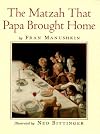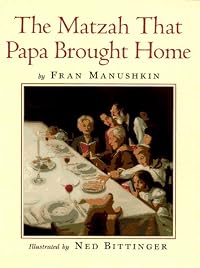
The Matzah That Papa Brought Home
by Fran Manushkin
On This Page
Description
A cumulative rhyme in the style of "The House That Jack Built" describes the traditions connected to a family's celebration of the Passover seder.Tags
Recommendations






Member Reviews
Using a cumulative form similar to that found in the classic nursery rhyme The House That Jack Built, Fran Manushkin creates a rollicking Passover poem in this engaging picture-book, one which offers a joyful celebration of family love and tradition at the holidays. "This is me standing tall and proud / to ask the Four Questions nice and loud / during the Passover Seder we shared / to eat the feast that Mama made / with the matzah that Papa brought home," it reads at one point, adding more and more on to the rhyme, as the evening passes and the narrator's family observes all the rituals of their Seder together.
This lighthearted book is the second Passover title from Fran Manushkin that I have read this year, following upon her Miriam's show more Cup, which focuses on the female experience in the biblical Passover and Exodus stories. In this contemporary title we see a family celebrating together, and are treated to a fun rhyming tale. The beautiful oil paintings by artist Ned Bittinger, done in the "alla prima" style - this method requires the artist to finish his work in one sitting, before the paint dries - are full of light and motion, beautifully capturing the life of the family in the story. I particularly liked the antics of the family dog, who is always underfoot as the night progresses. Recommended to young readers looking for lighthearted, contemporary books set at Passover. show less
This lighthearted book is the second Passover title from Fran Manushkin that I have read this year, following upon her Miriam's show more Cup, which focuses on the female experience in the biblical Passover and Exodus stories. In this contemporary title we see a family celebrating together, and are treated to a fun rhyming tale. The beautiful oil paintings by artist Ned Bittinger, done in the "alla prima" style - this method requires the artist to finish his work in one sitting, before the paint dries - are full of light and motion, beautifully capturing the life of the family in the story. I particularly liked the antics of the family dog, who is always underfoot as the night progresses. Recommended to young readers looking for lighthearted, contemporary books set at Passover. show less
I liked this book for two reasons. First, I liked how the author wrote as if she were captioning each picture in the book. Each sentence begins with “This is me...” or “This is the…” The reader is drawn to look at the illustrations after reading this, while the author’s writing still includes a substantial amount of information about Passover. Additionally, I liked the illustrations in this book. The illustrator used rich dark colors to paint very life-like images. The images also took up each page entirely, but the author’s written text is still easy to read. The text is either white with black background, or black with white background. The illustrations also fit the style of the written text well. The main idea of this show more story is to inform readers about timeless traditions that take place during the Passover holiday. show less
A nice book about the Jewish holiday of Passover. Good to read and learn more and everyone can relate to the lovely depiction of family life.
This book was interesting. I've been looking for more multicultural books that talk about the family, so this is why I chose this one. This story all had to do with the story of Passover and what you do on it. It was a story that added on to each sentence as you went along. The first sentence was "this is the matzah that Papa brought home". Then each page added on to that sentence, until at the end of the book it had a long passage that explained everything from the time Papa came home with the matzah to when her family left after Passover. I liked it because it gave details for the whole night and what the Jewish traditions are. It also gives words such as "Dayenu" and "afikoman" that describe terms that come from the Jewish religion. show more I liked that part because children who read this book will get a true sense of how Passover is celebrated if they have route words to look at. Also, every other sentence rhymed. For instance, a sentence read "this is the afikoman I found by searching the house and running around, after the matzah ball soup that we sipped after the bitter herbs that we dipped". The whole book goes along like this. The illustrations were detailed but cloudy and looked very old, but every page had a new activity that the family was doing to celebrate Passover. At the end of the book it gives an explanation of "The Story of Passover" which I thought to be very helpful for people who are unfamiliar. I liked this book because it describes a tradition in a fun way. show less
Cumulative poem that includes the highlights of a Passover seder. The watercolors, although lovely, are a bit dark. Using gestures, that children can imitate perhaps, for each verse helps keep the attention of young ones. Reflects the cumulative aspects of the seder: Dayenu, Had Gadya, Ehad Mi Yodea? as well as the counting of the Omer.
Summary: A Jewish family follows the tradition of Passover, completing each important step in the holiday, and telling about each one's significance.
This book is written in a form called "Cumulative Rhyme". Each page of the book adds something more to the previous pages. This style is effective because it draws the reader into the story. It is entertaining to listen to, and children like rhyming text.
This is an informational book because it tells the reader about the Passover. It uses the girl and her family as a way to demonstrate the traditions of Passover. At the end of the book the author has included more information about the Passover and definitions and explainations for the different words and customs.
Media: oil paint and linen
This is an informational book because it tells the reader about the Passover. It uses the girl and her family as a way to demonstrate the traditions of Passover. At the end of the book the author has included more information about the Passover and definitions and explainations for the different words and customs.
Media: oil paint and linen
Members
- Recently Added By
Author Information

193+ Works 11,567 Members
All Editions
Awards and Honors
Common Knowledge
- Dedication
- The Brodell Family (1) For the Children of LJCRS! Happy Passover! Fran Manushkin (2) The Haberers (3)
Classifications
Statistics
- Members
- 498
- Popularity
- 60,268
- Reviews
- 13
- Rating
- (3.39)
- Languages
- English
- Media
- Paper
- ISBNs
- 7
- ASINs
- 2