On This Page
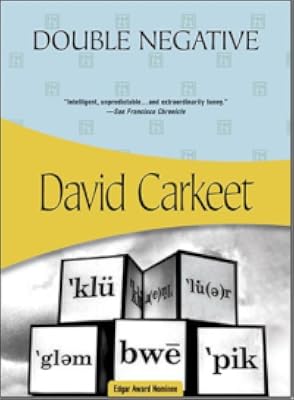
Description
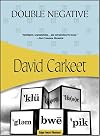
When one of his colleagues at the Wabash Institute for the study of the verbal skills of toddlers is bludgeoned to death, socially clueless scholar Jeremy Cook becomes the prime suspect and must solve the case to clear his name.Tags
Recommendations




















Member Reviews
Pop Quiz: What book has these plot points?
1. The unlikely protagonist is a quirky academic.
2. The protagonist works in a environment with an assortment of other quirky academics.
3. The protagonist's boss is a self-interested bore.
4. The protagonist has a love interest for whom there is a rival.
5. The protagonist is assigned by his boss to write and deliver a lecture that he does not wish to do.
If you answered Kingsley Amis's Lucky Jim you would be absolutely correct. But, if you answered David Carkeet's "Double Negative" you would also be absolutely correct.
Although quirky academic characters and locales probably feature in dozens of novels, I read "Double Negative" with increasing enjoyment as the parallels kept falling into place and show more by the time of the assigned lecture I was firmly convinced that Carkeet was following Amis's overall "Lucky Jim" plot arc.
Instead of Amis's English university, Carkeet places his story at the fictional Wabash Institute in southern Indiana, USA. a combined child care facility and linguistic studies centre. The academics are linguists studying the speech of young children. "Double Negative" shares a mostly comic tone with "Lucky Jim" except for the murder mystery element.
There seemed to be a lot of plot points that weren't properly tied-up at the end so Carkeet doesn't really fit the model of genre mystery writer. Nevertheless, this was a very entertaining read made even more so by the between the lines homage to Kingsley Amis.
Notes
Quirky characters are one thing, but a lot of quirky names makes for a hard to follow book. I ended up doing my own cast of characters list to help out, so here it is for others if needed:
Wabash Institute
Walter Wach: administrator at the Wabash Institute
Mary: Secretary to Walter Wach
Jeremy (called Jay by some) Cook: linguist, protagonist of the story
Ed Woeps: linguist, Cook’s main friend at the Institute
Arthur Stiph: older linguist, sleeps often at the office
Emory Milke: linguist, romantic rival to Jeremy Cook
Adam Aaskhugh: linguist, gossips, snoops
Clyde Orffmann: linguist, laughs very loudly
Miss Pristam: linguist, out of town
Sally Good: chief caretaker (child care worker)
Paula Nouvelles: new caretaker, potential love interest of Jeremy Cook
various others
Non-Wabash Institute
Henry Philpot: journalist, researching a story on the Wabash Institute
Mrs. Adelle Stiph: wife of Arthur Stiph
Mrs. Helen Woeps: wife of Ed Woeps
Wally Woeps: 16-month old son of Ed & Helen Woeps, Jeremy Cook is doing a study of his speech
Amy Woeps: daughter of Ed & Helen Woeps
Lieutenant Leaf: Police detective
Stray Observations
• I did not notice the phrase "Double Negative" used at all in the book, but I assume its use in the title is meant as a reference to the two murders.
• The closest thing to "Lucky Jim"'s faces (Jim makes mock faces of other people behind their backs) seemed to be Jeremy Cook making odd phone calls with abrupt hangups.
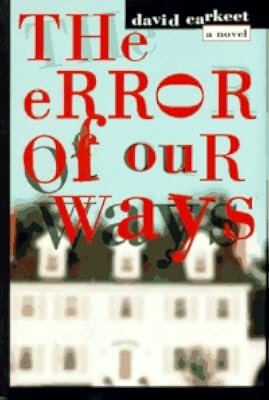
• David Carkeet wrote two more books featuring linguist Jeremy Cook, The Full Catastrophe: A Novel and The Error of Our Ways, but they aren’t murder mysteries.
• Although the "Lucky Jim" inspiration isn't mentioned in the 1982 Penguin Crime edition, I found that the online "Discussion Questions" by Overlook Press for the 2010 edition http://www.overlookpress.com/rg/doublenegative.pdf has this to say:
"The author has acknowledged his debt to three books that influenced the writing of Double Negative. One is Learning How To Mean: Explorations In The Development Of Language, a scholarly monograph by British linguist M.A.K. Halliday, who studied “idiophenomena” in his toddler son just as Cook studied them in Wally. Another is Peter Dickinson’s The Poison Oracle, a mystery about linguistic research in a primate center. The third is Kingsley Amis’ classic comic novel, Lucky Jim. You might know Dickinson’s or Amis’ novels. If so, can you point to similarities between them and Double Negative?" show less
1. The unlikely protagonist is a quirky academic.
2. The protagonist works in a environment with an assortment of other quirky academics.
3. The protagonist's boss is a self-interested bore.
4. The protagonist has a love interest for whom there is a rival.
5. The protagonist is assigned by his boss to write and deliver a lecture that he does not wish to do.
If you answered Kingsley Amis's Lucky Jim you would be absolutely correct. But, if you answered David Carkeet's "Double Negative" you would also be absolutely correct.
Although quirky academic characters and locales probably feature in dozens of novels, I read "Double Negative" with increasing enjoyment as the parallels kept falling into place and show more by the time of the assigned lecture I was firmly convinced that Carkeet was following Amis's overall "Lucky Jim" plot arc.
Instead of Amis's English university, Carkeet places his story at the fictional Wabash Institute in southern Indiana, USA. a combined child care facility and linguistic studies centre. The academics are linguists studying the speech of young children. "Double Negative" shares a mostly comic tone with "Lucky Jim" except for the murder mystery element.
There seemed to be a lot of plot points that weren't properly tied-up at the end so Carkeet doesn't really fit the model of genre mystery writer. Nevertheless, this was a very entertaining read made even more so by the between the lines homage to Kingsley Amis.
Notes
Quirky characters are one thing, but a lot of quirky names makes for a hard to follow book. I ended up doing my own cast of characters list to help out, so here it is for others if needed:
Wabash Institute
Walter Wach: administrator at the Wabash Institute
Mary: Secretary to Walter Wach
Jeremy (called Jay by some) Cook: linguist, protagonist of the story
Ed Woeps: linguist, Cook’s main friend at the Institute
Arthur Stiph: older linguist, sleeps often at the office
Emory Milke: linguist, romantic rival to Jeremy Cook
Adam Aaskhugh: linguist, gossips, snoops
Clyde Orffmann: linguist, laughs very loudly
Miss Pristam: linguist, out of town
Sally Good: chief caretaker (child care worker)
Paula Nouvelles: new caretaker, potential love interest of Jeremy Cook
various others
Non-Wabash Institute
Henry Philpot: journalist, researching a story on the Wabash Institute
Mrs. Adelle Stiph: wife of Arthur Stiph
Mrs. Helen Woeps: wife of Ed Woeps
Wally Woeps: 16-month old son of Ed & Helen Woeps, Jeremy Cook is doing a study of his speech
Amy Woeps: daughter of Ed & Helen Woeps
Lieutenant Leaf: Police detective
Stray Observations
• I did not notice the phrase "Double Negative" used at all in the book, but I assume its use in the title is meant as a reference to the two murders.
• The closest thing to "Lucky Jim"'s faces (Jim makes mock faces of other people behind their backs) seemed to be Jeremy Cook making odd phone calls with abrupt hangups.
• David Carkeet wrote two more books featuring linguist Jeremy Cook, The Full Catastrophe: A Novel and The Error of Our Ways, but they aren’t murder mysteries.
• Although the "Lucky Jim" inspiration isn't mentioned in the 1982 Penguin Crime edition, I found that the online "Discussion Questions" by Overlook Press for the 2010 edition http://www.overlookpress.com/rg/doublenegative.pdf has this to say:
"The author has acknowledged his debt to three books that influenced the writing of Double Negative. One is Learning How To Mean: Explorations In The Development Of Language, a scholarly monograph by British linguist M.A.K. Halliday, who studied “idiophenomena” in his toddler son just as Cook studied them in Wally. Another is Peter Dickinson’s The Poison Oracle, a mystery about linguistic research in a primate center. The third is Kingsley Amis’ classic comic novel, Lucky Jim. You might know Dickinson’s or Amis’ novels. If so, can you point to similarities between them and Double Negative?" show less
I don’t usually read academic mysteries; my actual experience as a college teacher provided me with more laughs and puzzles than the books could. But David Carkeet’s Double Negative, about a bunch of linguists studying the development of language in small children, is different. For one thing, these people are not in a college setting; they work in a day-care center that is also an observing laboratory called the Wabash Institute.
The main character here, Jeremy Cook, reminds me of Kingsley Amis’s comic hero in Lucky Jim. That book isn’t a mystery, but the title character is an academic type whose comic bumbling includes a disastrous speech before a group he despises. There’s a similar scene in this book.
Although they show more aren’t at a college, there’s still plenty of academic infighting among the linguists at the Wabash Institute, and at one point they all contemplate with horror the possibility that, if their funding dries up, they might have to teach. The local police lieutenant who comes to investigate the murders at Wabash regards with contempt the linguist’s jealousies and what he sees as their cowardly fear of judgment. Lieutenant Leaf is one of Carkeet’s more interesting characters—funny, shrewd, and full of odd expressions that continually surprise Jeremy Cook: “the whole boiling” is Leaf’s phrase for “the whole thing,” and at one point he says “the law can’t let everyone run around rantum-scantum,” meaning presumably “harum-scarum,” except that rantum-scantum is really an archaic expression for sexual intercourse, and I assume a little joke of the linguist author.
Some of the characters have names indicating their dispositions or habits: Jeremy’s friend, who is accident-prone, is named Ed Woeps; and the gossip-monger of the group, always asking you questions so that he has something to pass on to the next person, is named Aaskhugh.
The fear of judgment that Lieutenant Leaf despises in these academics is really a theme of the book. Carkeet explores personal likes and dislikes, the wish to be liked, and the flimsy, sometimes misguided reasons on which affections or aversions get formed. The mystery is finally solved when Jeremy figures out the private linguistic forms by which one toddler indicates the people he likes or dislikes. And the crimes begin with an accident turns into a hit-and-run because the driver is afraid of the public exposure his recklessness will bring. The book ends with the little group of linguists, their number reduced by one who was murdered and one who has been jailed for it, reexamining and trying to modify their judgments of each other. show less
The main character here, Jeremy Cook, reminds me of Kingsley Amis’s comic hero in Lucky Jim. That book isn’t a mystery, but the title character is an academic type whose comic bumbling includes a disastrous speech before a group he despises. There’s a similar scene in this book.
Although they show more aren’t at a college, there’s still plenty of academic infighting among the linguists at the Wabash Institute, and at one point they all contemplate with horror the possibility that, if their funding dries up, they might have to teach. The local police lieutenant who comes to investigate the murders at Wabash regards with contempt the linguist’s jealousies and what he sees as their cowardly fear of judgment. Lieutenant Leaf is one of Carkeet’s more interesting characters—funny, shrewd, and full of odd expressions that continually surprise Jeremy Cook: “the whole boiling” is Leaf’s phrase for “the whole thing,” and at one point he says “the law can’t let everyone run around rantum-scantum,” meaning presumably “harum-scarum,” except that rantum-scantum is really an archaic expression for sexual intercourse, and I assume a little joke of the linguist author.
Some of the characters have names indicating their dispositions or habits: Jeremy’s friend, who is accident-prone, is named Ed Woeps; and the gossip-monger of the group, always asking you questions so that he has something to pass on to the next person, is named Aaskhugh.
The fear of judgment that Lieutenant Leaf despises in these academics is really a theme of the book. Carkeet explores personal likes and dislikes, the wish to be liked, and the flimsy, sometimes misguided reasons on which affections or aversions get formed. The mystery is finally solved when Jeremy figures out the private linguistic forms by which one toddler indicates the people he likes or dislikes. And the crimes begin with an accident turns into a hit-and-run because the driver is afraid of the public exposure his recklessness will bring. The book ends with the little group of linguists, their number reduced by one who was murdered and one who has been jailed for it, reexamining and trying to modify their judgments of each other. show less
I had read in several sources that this was a wittily funny mystery, so I was eager to read it. Maybe my expectations were too high. Whatever the reason, I didn't enjoy the book very much. I didn't think the humor or the mystery was successful.
The setting is unusual - a university-affiliated linguistics institute combined with a preschool/daycare center for the purpose of studying language development in children. The way in which the murderer's identity is discovered is unusual, too. That's about all I liked about the book.
I can imagine a lot of possibilities for humor in the interaction between the linguists and the children they observe. It's too bad the children were barely present in the book. The book focuses almost exclusively on show more the linguists and their interrelationships. I didn't like the main character, linguist Jeremy Cook. He was as obnoxious as Dr. House (of the Fox TV series), only he managed to hide his disdain for almost everyone else better than House does. The mystery left several elements of the crime unexplained. In fact, near the end of the book, after the murderer has been identified, two characters talked about some of the things still left unexplained. Their conclusion? "It doesn't matter, really. We solved it without solving all of that."
Not recommended. show less
The setting is unusual - a university-affiliated linguistics institute combined with a preschool/daycare center for the purpose of studying language development in children. The way in which the murderer's identity is discovered is unusual, too. That's about all I liked about the book.
I can imagine a lot of possibilities for humor in the interaction between the linguists and the children they observe. It's too bad the children were barely present in the book. The book focuses almost exclusively on show more the linguists and their interrelationships. I didn't like the main character, linguist Jeremy Cook. He was as obnoxious as Dr. House (of the Fox TV series), only he managed to hide his disdain for almost everyone else better than House does. The mystery left several elements of the crime unexplained. In fact, near the end of the book, after the murderer has been identified, two characters talked about some of the things still left unexplained. Their conclusion? "It doesn't matter, really. We solved it without solving all of that."
Not recommended. show less
Double Negative by David Carkeet
My rating: 3 of 5 stars
In my opinion the best of Carkeet's 3 novels featuring intrepid linguist Jeremy Cook is The Full Catastrophe (second in the series), and one wouldn't necessarily need to have read this first installment to get Full Enjoyment from it. This, however, was an enjoyable read and filled in a bit of background on the main characters. Readers with a taste for quirky academic humor (masking some sharp insights into human nature and the ways it unwittingly reveals itself in the communication process) should find this a satisfying addition to their shelves.
My rating: 3 of 5 stars
In my opinion the best of Carkeet's 3 novels featuring intrepid linguist Jeremy Cook is The Full Catastrophe (second in the series), and one wouldn't necessarily need to have read this first installment to get Full Enjoyment from it. This, however, was an enjoyable read and filled in a bit of background on the main characters. Readers with a taste for quirky academic humor (masking some sharp insights into human nature and the ways it unwittingly reveals itself in the communication process) should find this a satisfying addition to their shelves.
Nancy Pearl recommended this literary mystery, and I am rarely disappointed by her picks. Double Negative is no exception. A murder at a daycare/linguistics research lab throws the whole facility into an uproar. Fittingly, the key to solving the mystery is found in a toddler's vocalizations.
Funny and ingenious mystery at a language acquisition institute in Southern Indiana. A clever solution.
I don't like mysteries, but this one was bearable.
Members
- Recently Added By
Lists

Novels featuring language professionals
98 works; 12 members

BingoDOG - Language in Fiction
35 works; 12 members
Author Information

12+ Works 707 Members

David Carkeet is a LibraryThing Author, an author who lists their personal library on LibraryThing.
Some Editions
Awards and Honors
Awards
Series

Belongs to Publisher Series
Work Relationships
Is contained in
Common Knowledge
- Canonical title
- Double Negative
- Original title
- Double Negative
- Original publication date
- 1980
- People/Characters
- Jeremy Cook; Walter Wach; Ed Woeps; Adam Aaskhugh; Arthur Stiph; Emory Milke
- Important places
- Indiana, USA
- Dedication
- To Barbara
- First words
- "Just what do you do with these babies, anyway?"
Classifications
Statistics
- Members
- 308
- Popularity
- 103,424
- Reviews
- 10
- Rating
- (3.34)
- Languages
- English, French, German
- Media
- Paper, Ebook
- ISBNs
- 14
- ASINs
- 10