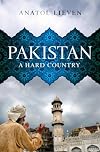
Pakistan: A Hard Country
by Anatol Lieven
On This Page
Description
In this profound and sophisticated analysis of Pakistan's history and its social, religious and political structures, Lieven argues strongly against U.S. actions that would risk destroying that state in the illusory search for victory in Afghanistan.Tags
Recommendations




Member Reviews
This book is a truly illuminating study of modern Pakistan, a very large country about which far too little seems to be generally understood by U.S. analysts and policymakers. Pakistan is too often dismissed as a "failed state", and/or analyzed purely in terms of its value (or lack of value) to the U.S. as an ally in the "War on Terror". Instead, it is a highly complex amalgam of many different societies, where strong divisive pressures strain against powerful unifying forces. One of those is a broad anti-Americanism among the Pakistani people, due in large part to U.S. policies since 2001. In regard to Pakistan, Lieven argues, those policies should be reconsidered, given the long-term risks of increasing Pakistani instability.
Anatol show more Lieven is admirably qualified to deal with the topic: he is both a journalist (reporting on Pakistan and Afghanistan for the London Times) and an academic/thinktank scholar. His book combines the readability and color of good journalism with the thorough research of scholarly work. It is also based on extensive interviews with many Pakistanis from all walks of life, and all regions of the country, which gives it an engrossing human dimension.
The book starts off with an overview of the Pakistani system, which he describes as "weak state, stong societies". He examines the critical role of kinship and patronage relationships, from an anthropological as well as a political view. And he briefly reviews Pakistan's history since Partition. Here, I found myself turning to Wikipedia etc. to fill in missing links, since the author's review assumed more knowledge than I had -- possibly because I'm an American, a British reader would probably be more familiar with this material.
Next, he turns to the basic structures of modern Pakistan -- justice, religion, politics, and above all the military -- devoting a chapter to each. Then, in a section which I found most useful, he devotes a chapter to each of Pakistan's provinces -- the Punjab, Sindh (and Karachi), Balochistan, and the Pathans (that is, the North West Frontier and the Federally Administered Tribal Areas). In each, he looks at the social and ethnic differences within and between regions, and at how that is reflected politically.
The final section is on the Taleban -- the Afghani Taleban, the Pakistani Taleban, and the attitude of Pakistan's people and government to both.
In his conclusion, Lieven says that "it has been above all the US-led campaign in Afghanistan which has been responsible for increasing Islamist insurgency and terrorism in Pakistan since 2001". Earlier, he has established that insurgency as perhaps the most critical problem facing Pakistan's government. U.S. policy with affect the way in which this plays out.
All in all, I found this a very informative, interesting, and readable book, which I would strongly recommend to anyone interested in South Asia, or, indeed, in US policy. show less
Anatol show more Lieven is admirably qualified to deal with the topic: he is both a journalist (reporting on Pakistan and Afghanistan for the London Times) and an academic/thinktank scholar. His book combines the readability and color of good journalism with the thorough research of scholarly work. It is also based on extensive interviews with many Pakistanis from all walks of life, and all regions of the country, which gives it an engrossing human dimension.
The book starts off with an overview of the Pakistani system, which he describes as "weak state, stong societies". He examines the critical role of kinship and patronage relationships, from an anthropological as well as a political view. And he briefly reviews Pakistan's history since Partition. Here, I found myself turning to Wikipedia etc. to fill in missing links, since the author's review assumed more knowledge than I had -- possibly because I'm an American, a British reader would probably be more familiar with this material.
Next, he turns to the basic structures of modern Pakistan -- justice, religion, politics, and above all the military -- devoting a chapter to each. Then, in a section which I found most useful, he devotes a chapter to each of Pakistan's provinces -- the Punjab, Sindh (and Karachi), Balochistan, and the Pathans (that is, the North West Frontier and the Federally Administered Tribal Areas). In each, he looks at the social and ethnic differences within and between regions, and at how that is reflected politically.
The final section is on the Taleban -- the Afghani Taleban, the Pakistani Taleban, and the attitude of Pakistan's people and government to both.
In his conclusion, Lieven says that "it has been above all the US-led campaign in Afghanistan which has been responsible for increasing Islamist insurgency and terrorism in Pakistan since 2001". Earlier, he has established that insurgency as perhaps the most critical problem facing Pakistan's government. U.S. policy with affect the way in which this plays out.
All in all, I found this a very informative, interesting, and readable book, which I would strongly recommend to anyone interested in South Asia, or, indeed, in US policy. show less
A very comprehensive and illuminating study of Pakistan, focusing less on its conflicts than on the things that bind it together. In his introduction Lieven states that he was originally going to call the book "Why Pakistan works"; I think he should have done as too often all we hear is of Islamic extremism and its imminent failure. In fact, as Lieven points out, Pakistan is very unlikely to fail apart whilst the glue that holds it together is in place. This is not to brush the many problems Pakistan faces aside - from its unsustainable birthrate to ecological challenges as well as the strategic problems of the Pakistan Taliban, Afghanistan, India and US interference in the region - but to place them into a meaningful context.
Lieven has show more several main themes. 1. Pakistan is bound together by clan and family structures especially in its powerful "feudal" landowning families that are far more influential than those of religion - this is problematic in itself but makes the prospect of increased influence of the Pakistan Taliban beyond the tribal agencies unlikely. 2. Most Pakistani's support the Afghan Taliban as freedom fighters defending their country from invasion, but that doesnt mean they support the Pakistan Taliban 3. The army is what holds the whole country together 4. Central government is weak so local power holds sway and 5. Allegiance to ethnic culture identity (eg being a Pashtun) overides everything
I found the book erudite, readable, exhaustive and occasionally exhausting. Should be read by anyone with an interest in this most strategically vital of countries show less
Lieven has show more several main themes. 1. Pakistan is bound together by clan and family structures especially in its powerful "feudal" landowning families that are far more influential than those of religion - this is problematic in itself but makes the prospect of increased influence of the Pakistan Taliban beyond the tribal agencies unlikely. 2. Most Pakistani's support the Afghan Taliban as freedom fighters defending their country from invasion, but that doesnt mean they support the Pakistan Taliban 3. The army is what holds the whole country together 4. Central government is weak so local power holds sway and 5. Allegiance to ethnic culture identity (eg being a Pashtun) overides everything
I found the book erudite, readable, exhaustive and occasionally exhausting. Should be read by anyone with an interest in this most strategically vital of countries show less
Excellent and profoundly revealing book about Pakistan. Investigates the country very thoroughly from many angles (ethnic/regional, religious, military, political, economic, environmental, and the relationship with the Taliban).
Analyzes the diverse ethnic groups and demystifies them - their concerns are only too familiar. Many deep-seated problems are shown here, but also the peerless endurance and strength of will of the people itself. Required reading for anybody who has an interest in current events.
Analyzes the diverse ethnic groups and demystifies them - their concerns are only too familiar. Many deep-seated problems are shown here, but also the peerless endurance and strength of will of the people itself. Required reading for anybody who has an interest in current events.
I wonder if the author is indeed a native masquerading under the guise of an anglicized name a la headley. He is really bending over backwards to paint this flattering picture of a soon to be failed state by drawing parallels with India and countries in the neighborhood. Let us see how much more nonsense this guy has to dish out in the remaining pages.
This book has very interesting commentary on the various forces that are in play such as the various political parties, the PPP, PML, MQM, ANP etc. Surprisingly enough some of these parties have very strong ideologies and disciplined cadres, the MQM for instance who want to tranform Karachi into the Singapore south Asia. The Army seems to be the strongest, most disciplined and the saving show more grace for the country due to which it's existence is even possible. When all else is lost and things seem utterly hopeless, it is the Army that has to step in and save the day for everyone. It is very much a true statement is one says that Pakistan is an Army with a country. show less
This book has very interesting commentary on the various forces that are in play such as the various political parties, the PPP, PML, MQM, ANP etc. Surprisingly enough some of these parties have very strong ideologies and disciplined cadres, the MQM for instance who want to tranform Karachi into the Singapore south Asia. The Army seems to be the strongest, most disciplined and the saving show more grace for the country due to which it's existence is even possible. When all else is lost and things seem utterly hopeless, it is the Army that has to step in and save the day for everyone. It is very much a true statement is one says that Pakistan is an Army with a country. show less
I wonder if the author is indeed a native masquerading under the guise of an anglicized name a la headley. He is really bending over backwards to paint this flattering picture of a soon to be failed state by drawing parallels with India and countries in the neighborhood. Let us see how much more nonsense this guy has to dish out in the remaining pages.
This book has very interesting commentary on the various forces that are in play such as the various political parties, the PPP, PML, MQM, ANP etc. Surprisingly enough some of these parties have very strong ideologies and disciplined cadres, the MQM for instance who want to tranform Karachi into the Singapore south Asia. The Army seems to be the strongest, most disciplined and the saving show more grace for the country due to which it's existence is even possible. When all else is lost and things seem utterly hopeless, it is the Army that has to step in and save the day for everyone. It is very much a true statement is one says that Pakistan is an Army with a country. show less
This book has very interesting commentary on the various forces that are in play such as the various political parties, the PPP, PML, MQM, ANP etc. Surprisingly enough some of these parties have very strong ideologies and disciplined cadres, the MQM for instance who want to tranform Karachi into the Singapore south Asia. The Army seems to be the strongest, most disciplined and the saving show more grace for the country due to which it's existence is even possible. When all else is lost and things seem utterly hopeless, it is the Army that has to step in and save the day for everyone. It is very much a true statement is one says that Pakistan is an Army with a country. show less
Reading this book must be eaqual to attending to a scholarship in asian studies - how to understand a non-european world. The corruption, the weak state, the river, the feudal and personal power, the rural reforms - all this gives us pieces from a rather complicated and streneous puzzle. Just when reaching a nearly complete picture, someone stumbles into the puzzle and all the pieces are torn and split. We than have to start it all over again. This needs reading and rereading several times to catch the almost uncatchable.
This is very nice book for current affairs and International Relations. There could be some objections in this but overall there is a actual view of country.
Members
- Recently Added By
Lists

Non-Fiction Worth Reading
1,015 works; 260 members

Islam & the Middle East
127 works; 1 member
Author Information

11+ Works 831 Members
Anatol Lieven is a Senior Associate at the Carnegie Endowment in Washington, DC.
Awards and Honors
Awards
Distinctions
Notable Lists
Common Knowledge
- Important places
- Pakistan
- Original language
- English
Classifications
Statistics
- Members
- 392
- Popularity
- 79,168
- Reviews
- 12
- Rating
- (4.25)
- Languages
- English, Norwegian (Bokmål)
- Media
- Paper, Ebook
- ISBNs
- 11
- ASINs
- 11