The Best Tales of Hoffmann
by E. T. A. Hoffmann
On This Page
Description
Ten of Hoffmann's greatest tales, enormously popular in Europe but rarely seen in the United States: "The Golden Flower Pot," "Automata," "Nutcracker and the King of Mice," "The Sand Man," and 6 others. Edited and corrected by E. F. Bleiler. Features 7 drawings by Hoffmann.Tags
Recommendations
























Member Reviews
Hoffman is an undiscovered genius - mad perhaps - but definitely a genius. Of course, he was quite well known in the Nineteenth Century, garnering a well-deserved reputation as a writer of bizarre, macabre, gothic tales full of the unexpected and unexplainable. Originally written in German, these tales are mined from the same dark rich earth that gave birth to Goethe and Kafka, Jung and Freud, Hegel and Mesmer - something of a heavy burden to carry.
This volume, consisting as it does of the "best" tales of Hoffman, contains a wealth of eclectic stories peopled with fractured and tortured characters. It includes, of course, the well known story of the Nutcracker and the King of Mice, although your typical ballet lover might find the story show more a shade darker and more menacing than contemporary stagings of Tschaikovsky: Godpappa Drosselmeier is a somewhat sinister figure, for example. Still, the tale of the Nutcracker is light fare when compared to works such as the Mines of Falun in which a sailor turns miner at the urgings of a shadowy mentor and pledges his soul to the underworldly Queen of the Mine. This tale becomes more and more sinister with the black pit of the mine eventually swallowing the protagonist in a rock fall, exacting revenge on him for falling in love with human woman. The tale ends when his petrified body is recovered 50 years later.
Of course, all is not as it seems in most of these tales. They can be read as fanciful fairy tales - albeit very dark, adult ones - or they can be seen as investigations of the dark areas of the human psyche, at the edge of madness, where vaguely unusual events suddenly become twisted into disturbing patterns. In the Sandman, for example, the bringer of sleep is given a menacing aspect since his arrival heralds a darkening mood in a little boy's parents. The boy eventually learns that his mother sends him off to bed whenever an alchemist visits his father to perform occult experiments, eventually causing the father's death. The little boy grows up, falls in love with an animated doll and eventually commits suicide in the presence of the "Sandman".
Not all of the tales in the book are unrelentingly dark. Some deal with obsession (The Golden Flower Pot), some are love stories (Tobias Martin, Master Cooper) while others are comic and vaguely satirical (The King's Betrothed). Signor Formica, which apparently was written to explain a painting by Salvator Rosa, has not a drop of the supernatural in it while Automata and A New Year's Adventure have it as their epicenters. Rath Krespel, a story about Hoffman's greatest love, music, leads the reader to think there is something otherworldly occurring but eventually all is explained naturally.
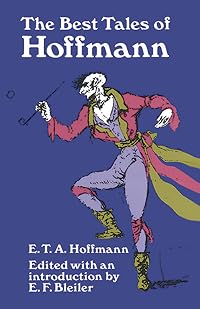
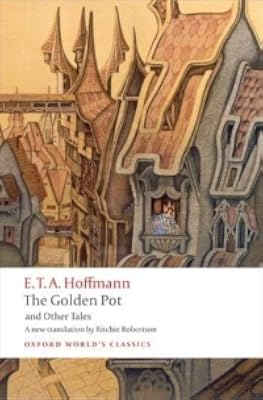
A word about the nature of this edition. It contains a lengthy introduction explaining the context of Hoffman's work and some of his themes and sources. Somewhat to my chagrin, the introduction reveals at it very end, that various writers are responsible for the translation of these tales. While this is not so bad, we are then informed that the author of the introduction has translated the translations into modern English, eliminating anachronistic thee's and thou's. So we are really reading a double translation. While this may make the book a bit easier to follow, it is a bit like looking at an airbrushed photo, taken in dim light, of a reproduction painting. Another minor complaint I have is that the cover artwork of is pink and purple and leaves a distinctly cotton-candy feel to what is, in reality, a gathering of dark, angst-ridden, sturm und drang filled episodes.
Still, the stories are mesmerizing, wonderfully inventive, and full of unexpected twists and intellectual challenges. Their archetypes have inspired many operas and still resonate today in movies such as Bladerunner and Edward Scissorhands. show less
This volume, consisting as it does of the "best" tales of Hoffman, contains a wealth of eclectic stories peopled with fractured and tortured characters. It includes, of course, the well known story of the Nutcracker and the King of Mice, although your typical ballet lover might find the story show more a shade darker and more menacing than contemporary stagings of Tschaikovsky: Godpappa Drosselmeier is a somewhat sinister figure, for example. Still, the tale of the Nutcracker is light fare when compared to works such as the Mines of Falun in which a sailor turns miner at the urgings of a shadowy mentor and pledges his soul to the underworldly Queen of the Mine. This tale becomes more and more sinister with the black pit of the mine eventually swallowing the protagonist in a rock fall, exacting revenge on him for falling in love with human woman. The tale ends when his petrified body is recovered 50 years later.
Of course, all is not as it seems in most of these tales. They can be read as fanciful fairy tales - albeit very dark, adult ones - or they can be seen as investigations of the dark areas of the human psyche, at the edge of madness, where vaguely unusual events suddenly become twisted into disturbing patterns. In the Sandman, for example, the bringer of sleep is given a menacing aspect since his arrival heralds a darkening mood in a little boy's parents. The boy eventually learns that his mother sends him off to bed whenever an alchemist visits his father to perform occult experiments, eventually causing the father's death. The little boy grows up, falls in love with an animated doll and eventually commits suicide in the presence of the "Sandman".
Not all of the tales in the book are unrelentingly dark. Some deal with obsession (The Golden Flower Pot), some are love stories (Tobias Martin, Master Cooper) while others are comic and vaguely satirical (The King's Betrothed). Signor Formica, which apparently was written to explain a painting by Salvator Rosa, has not a drop of the supernatural in it while Automata and A New Year's Adventure have it as their epicenters. Rath Krespel, a story about Hoffman's greatest love, music, leads the reader to think there is something otherworldly occurring but eventually all is explained naturally.
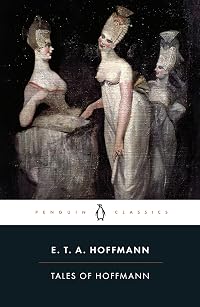
A word about the nature of this edition. It contains a lengthy introduction explaining the context of Hoffman's work and some of his themes and sources. Somewhat to my chagrin, the introduction reveals at it very end, that various writers are responsible for the translation of these tales. While this is not so bad, we are then informed that the author of the introduction has translated the translations into modern English, eliminating anachronistic thee's and thou's. So we are really reading a double translation. While this may make the book a bit easier to follow, it is a bit like looking at an airbrushed photo, taken in dim light, of a reproduction painting. Another minor complaint I have is that the cover artwork of is pink and purple and leaves a distinctly cotton-candy feel to what is, in reality, a gathering of dark, angst-ridden, sturm und drang filled episodes.
Still, the stories are mesmerizing, wonderfully inventive, and full of unexpected twists and intellectual challenges. Their archetypes have inspired many operas and still resonate today in movies such as Bladerunner and Edward Scissorhands. show less
From "The Golden Flower Pot" in which the narrator describes to the reader how the Student Anselmus feels when he is held captive inside a corked crystal bottle:
"You are drowned in dazzling splendour; everything around you appears illuminated and begirt with beaming rainbow hues: in the sheen everything seems to quiver and waver and clang and drone. You are swimming, but your are powerless and cannot move, as if you were imbedded in a firmly congealed ether which squeezes you so tightly that it is in vain that your spirit commands your dead and stiffened body. Heavier and heavier the mountainous burden lies on you; more and more every breath exhausts the tiny bit of air that still plays up and down in the tight space around you; your show more pulse throbs madly; and cut through with horrid anguish, every nerve is quivering and bleeding in your dead agony.
"Favourable reader, have pity on the Student Anselmus! This inexpressible torture seized him in his glass prison: but he felt too well that even death could not release him, for when he had fainted with pain, he awoke again to new wretchedness when the morning sun shone into the room. He could move no limb, and his thoughts struck against the glass, stunning him with discordant clang; and instead of the words which the spirit used to speak from within him he now heard only the stifled din of madness." Kindle location 1584
Compare this to J.B. Ballard's "The Crystal World."
https://www.librarything.com/work/2386083/summary/113935158 show less
"You are drowned in dazzling splendour; everything around you appears illuminated and begirt with beaming rainbow hues: in the sheen everything seems to quiver and waver and clang and drone. You are swimming, but your are powerless and cannot move, as if you were imbedded in a firmly congealed ether which squeezes you so tightly that it is in vain that your spirit commands your dead and stiffened body. Heavier and heavier the mountainous burden lies on you; more and more every breath exhausts the tiny bit of air that still plays up and down in the tight space around you; your show more pulse throbs madly; and cut through with horrid anguish, every nerve is quivering and bleeding in your dead agony.
"Favourable reader, have pity on the Student Anselmus! This inexpressible torture seized him in his glass prison: but he felt too well that even death could not release him, for when he had fainted with pain, he awoke again to new wretchedness when the morning sun shone into the room. He could move no limb, and his thoughts struck against the glass, stunning him with discordant clang; and instead of the words which the spirit used to speak from within him he now heard only the stifled din of madness." Kindle location 1584
Compare this to J.B. Ballard's "The Crystal World."
https://www.librarything.com/work/2386083/summary/113935158 show less
Only "Der Sandmann."
Ratings
Members
- Recently Added By
Lists

Best Fantasy Originally Published in a Language Other Than English
84 works; 25 members

Jones and Newman's Horror: The 100 Best Books
100 works; 4 members

Best Horror Mega-List
342 works; 6 members
Author Information

German writer, composer, and painter ErnstTheodor Amadeus Hoffman was born in Konigsberg, Prussia in 1776. After beginning a career in the law, Hoffman turned to music, working as a conductor, music director, and critic, and later composing a ballet, an opera, and other works. He established himself as a writer with the four-volume story show more collection Phatasiestucke in Callier Manier (Fantasy Stories in the Manner of Callot), which was published in 1814-1815. Even though he published several novels and story collections, including Nachtstucke (Hoffman's Strange Stories, 1817) and Die Serapionsbruder (The Serapion Brethren, 1819-1821), Hoffman continued to support himself as a legal official in Berlin. This struggle between artistry and bureaucracy is played out in many of his works. Hoffman died of progressive paralysis in 1822. (Bowker Author Biography) show less
Some Editions
Series
Belongs to Publisher Series
Work Relationships
Common Knowledge
- Canonical title
- The Best Tales of Hoffmann
- Original publication date
- 1979-04-01
- Important places
- Germany; Dresden, Saxony, Germany
- First words
- On Ascension Day, about three o’clock in the afternoon in Dresden, a young man dashed through the Schwarzthor, or Black Gate, and ran right into a basket of apples and cookies which an old and very ugly woman had set out fo... (show all)r sale.
- Last words
- (Click to show. Warning: May contain spoilers.)But as to whether Herr Dapsul’s union with the Sylph Nehabilah ever actually came to anything the Chronicle of Dapsulheim is silent.
- Original language
- German
- Disambiguation notice
- The Best Tales of Hoffmann, edited by E. F. Bleiler, is not the same as Tales of Hoffmann. They should not be combined.
Classifications
- Genres
- Fiction and Literature, General Fiction, Fantasy, Horror
- DDC/MDS
- 833.6 — Literature & rhetoric German & related literatures German fiction 1750-1832 : 18th century, classical period, romantic period
- LCC
- PZ3 .H677 .B — Language and Literature Fiction and juvenile belles lettres Fiction and juvenile belles lettres Fiction in English
- BISAC
Statistics
- Members
- 328
- Popularity
- 96,996
- Reviews
- 3
- Rating
- (4.27)
- Languages
- English
- Media
- Paper, Ebook
- ISBNs
- 3
- UPCs
- 1
- ASINs
- 4