On This Page
Description
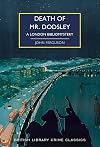
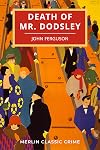
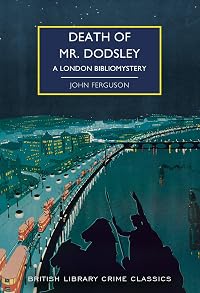
Mr. Richard Dodsley, owner of a fine second-hand bookshop on Charing Cross Road, has been found murdered in the cold hours of the morning. Shot in his own office, few clues remain besides three cigarette ends, two spent matches and a few books on the shelves which have been rearranged. In an investigation spanning the second-hand bookshops of London and the Houses of Parliament - since an MP's new crime novel DEATH AT THE DESK appears to have some bearing on the case - John Ferguson's series show more sleuth MacNab is at hand to assist Scotland Yard in an atmospheric and ingenious fair-play bibliomystery. show lessTags
Recommendations


























Member Reviews
A new author to me (or at least not one I have read before).
First published in 1937, it is described in the British Library Crime Classics series as A Londo Bibliomystery. Whilst the murder is of a bookseller and it occurs in a book shop, save for one clue, this is not a reading that is highly contingent on a lot of book lore.
There are the competing detective: public - Scotland Yard of course and private - McNab, apparently a recurring sleuth in at least some of Ferguson's novels. They interact with each other than would would expect today (they apparently did things differently in those days- at least in fiction) but don't play completely openly with each other, but my assessment is that both the author plays fair with readers and the show more public and private detectives with each other.
There are a small number of suspects and even fewer important other participants. The clues, as usual, are contradictory and constantly evolving.
The author explicitly has McNab and one of the people adopt an informal Holmes/Watson relationship and [SPOILER HERE] not explicitly, one of the devices from an early Christie.
A heavy class element appears in a minor aspect of the overall story. Nothing that would shock a reader, other than to be dismayed that such attitudes would exist amongst a very few characters.
One pet peeve: there is a drawing of what one learns by osmosis may be the interior layout of the book store in which the murder takes place. I suspect it appeared in the original publication (as it appears after the author's dedication, which Martin Edwards references in his (as usual) informative Introduction. The drawing does not match at least my understanding of what the novel depicts. But in the end, the layout does not really play must in the detection.
It is an easy read. and having found two more of his books in my library I am tempted to try some more.
Big Ship
10/12/2024 show less
First published in 1937, it is described in the British Library Crime Classics series as A Londo Bibliomystery. Whilst the murder is of a bookseller and it occurs in a book shop, save for one clue, this is not a reading that is highly contingent on a lot of book lore.
There are the competing detective: public - Scotland Yard of course and private - McNab, apparently a recurring sleuth in at least some of Ferguson's novels. They interact with each other than would would expect today (they apparently did things differently in those days- at least in fiction) but don't play completely openly with each other, but my assessment is that both the author plays fair with readers and the show more public and private detectives with each other.
There are a small number of suspects and even fewer important other participants. The clues, as usual, are contradictory and constantly evolving.
The author explicitly has McNab and one of the people adopt an informal Holmes/Watson relationship and [SPOILER HERE] not explicitly, one of the devices from an early Christie.
A heavy class element appears in a minor aspect of the overall story. Nothing that would shock a reader, other than to be dismayed that such attitudes would exist amongst a very few characters.
One pet peeve: there is a drawing of what one learns by osmosis may be the interior layout of the book store in which the murder takes place. I suspect it appeared in the original publication (as it appears after the author's dedication, which Martin Edwards references in his (as usual) informative Introduction. The drawing does not match at least my understanding of what the novel depicts. But in the end, the layout does not really play must in the detection.
It is an easy read. and having found two more of his books in my library I am tempted to try some more.
Big Ship
10/12/2024 show less
Ratings
Members
- Recently Added By
Lists

Books Read in 2025
4,091 works; 97 members
Author Information
8+ Works 238 Members
Series

Belongs to Publisher Series
British Library Crime Classics (Novel)
Common Knowledge
- Canonical title
- Death Of Mr Dodsley
- Original title
- Death Of Mr Dodsley
- Original publication date
- 1937
- First words
- Commander Male, after recording his vote on clause five, loitered about for a moment or two in the Lobby.
- Last words
- (Click to show. Warning: May contain spoilers.)"If Dodsley was a rat, I am no lion; and anyway, in these days prophets are scarce."
Classifications
Statistics
- Members
- 99
- Popularity
- 326,114
- Reviews
- 2
- Rating
- (3.00)
- Languages
- English
- Media
- Paper, Audiobook, Ebook
- ISBNs
- 7
- ASINs
- 7