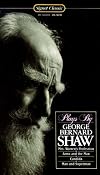
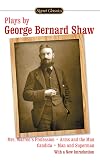
Plays by George Bernard Shaw
by George Bernard Shaw
On This Page
Description
These four classic plays by the great playwright satirize society, military heroism, marriage, and the pursuit of man by woman. Includes "Mrs. Warren's Profession, Arms and the Man, Candida," and "Man and Superman," along with a new Introduction. Reissue.Tags
Recommendations



















Member Reviews
I am about to finish this book but I thought that I had so much to say, so decided to write a review. It's a coincidence that I am discovering GBS after reading Nietzsche, as it's clear that GBS was greatly marked by Nietzsche's works in developing his characters.
GBS' women, I feel are quite particular: In Man and Superman, Ann is the conniving, intelligent and yet pretentious woman with an independent mind while in Mrs Warren's Profession, Vivie is a businesslike, no nonsense type, who rejects marriage and social conventions to turn into a cold-hearted Margaret Thatcher like figure (although with certain anti-capitalist beliefs). Despite these nuances, what's common to GBS' women is that they are all strong and independent, and what I show more found remarkable was that I could relate to many of the motives that GBS attributed to their actions and objectives in the plays.
Man and Superman was a lot about Nietzsche and I must say that I was reminded once again of the truth that most of what has been produced after Nietzsche, and inspired by him, has merely been an interpretation or extension of his own thoughts or philosophies on various subjects. With GBS, it feels that way -- there is nothing new. All that GBS does is apply Nietzschean thoughts to his characters. What is perhaps beyond that, is when GBS comments on Nietzsche's legacy and warns the reader through the mouthpiece of one of his characters, that one should not take the concept of the Superman to heart, because if one does so, he might be embittered with man... And of course in the same play, GBS seems to ridicule what Nietzsche really was, by sending him not to hell, where one would think he ought to be, but "to heaven". In this we find the need or yearning on the part of GBS to detach himself from Nietzsche, although he would have been clearly enamored by his works. True to Nietzschean preachings, GBS understood that to really understand Nietzsche, one should not be his follower or disciple, but to be oneself.
A final note on characterization: I notice how GBS succeeds in conveying how boot licking, or brown nosing, or in simpler terms, trying to commend oneself to another, is a trait that Nietzsche despised. (quite rightly so). I found it really amusing that GBS managed to convey this through his characters -- especially when pompous men come across his really bold and no nonsense type of women in the plays (e.g.. Vivie meeting Praed).
Women writers are often criticized for not daring to venture out of the house in their storytelling. GBS restores that confidence to women (and men) by showing that you can very well be Nietzschean and apply those concepts to what goes on in society, or inside the house. show less
GBS' women, I feel are quite particular: In Man and Superman, Ann is the conniving, intelligent and yet pretentious woman with an independent mind while in Mrs Warren's Profession, Vivie is a businesslike, no nonsense type, who rejects marriage and social conventions to turn into a cold-hearted Margaret Thatcher like figure (although with certain anti-capitalist beliefs). Despite these nuances, what's common to GBS' women is that they are all strong and independent, and what I show more found remarkable was that I could relate to many of the motives that GBS attributed to their actions and objectives in the plays.
Man and Superman was a lot about Nietzsche and I must say that I was reminded once again of the truth that most of what has been produced after Nietzsche, and inspired by him, has merely been an interpretation or extension of his own thoughts or philosophies on various subjects. With GBS, it feels that way -- there is nothing new. All that GBS does is apply Nietzschean thoughts to his characters. What is perhaps beyond that, is when GBS comments on Nietzsche's legacy and warns the reader through the mouthpiece of one of his characters, that one should not take the concept of the Superman to heart, because if one does so, he might be embittered with man... And of course in the same play, GBS seems to ridicule what Nietzsche really was, by sending him not to hell, where one would think he ought to be, but "to heaven". In this we find the need or yearning on the part of GBS to detach himself from Nietzsche, although he would have been clearly enamored by his works. True to Nietzschean preachings, GBS understood that to really understand Nietzsche, one should not be his follower or disciple, but to be oneself.
A final note on characterization: I notice how GBS succeeds in conveying how boot licking, or brown nosing, or in simpler terms, trying to commend oneself to another, is a trait that Nietzsche despised. (quite rightly so). I found it really amusing that GBS managed to convey this through his characters -- especially when pompous men come across his really bold and no nonsense type of women in the plays (e.g.. Vivie meeting Praed).
Women writers are often criticized for not daring to venture out of the house in their storytelling. GBS restores that confidence to women (and men) by showing that you can very well be Nietzschean and apply those concepts to what goes on in society, or inside the house. show less
Man & Superman
Arms & the Man
Mrs. Warren's Profession
Candida
Arms & the Man
Mrs. Warren's Profession
Candida
Ratings
Members
- Recently Added By
Lists

Irish writers
87 works; 17 members

Tom's Bookstore
346 works; 2 members
Author Information

757+ Works 32,193 Members
Renowned literary genius George Bernard Shaw was born on July 26, 1856 in Dublin, Ireland. He later moved to London and educated himself at the British Museum while several of his novels were published in small socialist magazines. Shaw later became a music critic for the Star and for the World. He was a drama critic for the Saturday Review and show more later began to have some of his early plays produced. Shaw wrote the plays Man and Superman, Major Barbara, and Pygmalion, which was later adapted as My Fair Lady in both the musical and film form. He also transformed his works into screenplays for Saint Joan, How He Lied to Her Husband, Arms and the Man, Pygmalion, and Major Barbara. Shaw won the Nobel Prize for Literature in 1925. George Bernard Shaw died on November 2, 1950 at Ayot St. Lawrence, Hertfordshire, England. (Bowker Author Biography) show less
All Editions
Series
Belongs to Publisher Series
Work Relationships
Contains
Common Knowledge
- Important places
- Sierra Nevada, Andalusia, Spain; London, England, UK
- Disambiguation notice
- This collection includes: Man and Superman; Candida; Arms and the Man; Mrs Warren's Profession. Please don't combine it with other collections.
Classifications
Statistics
- Members
- 547
- Popularity
- 54,444
- Reviews
- 2
- Rating
- (3.83)
- Languages
- English, Serbian
- Media
- Paper, Ebook
- ISBNs
- 17
- ASINs
- 8