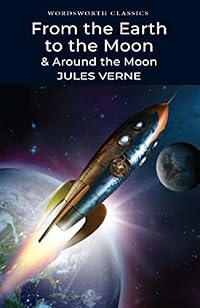
From the Earth to the Moon / Around the Moon
by Jules Verne
Gun Club trilogy (Collections and Selections — Omnibus 1-2), The Extraordinary Voyages (Collections and Selections — 04, 07)
On This Page
Description
In The Moon Voyage, famed author Jules Verne, best known for works such as A Journey to the Center of the Earth, Twenty Thousand Leagues Under the Sea, and Around the World in Eighty Days, sets his sights on the prospect of interstellar travel. Adeptly combining humor and science fiction, Verne's fictional account of the journey to the moon presciently presages many aspects of the trip that the Apollo astronauts took a century after the text's publication..
Tags
Recommendations




























Member Reviews
Originally published in instalments in the popular Parisien newspaper (Journal des débats politiques et llttéraires) between September and October 1865 after the more famous Journey to the Centre of the Earth a year earlier. The Encyclopedia of Science Fiction claims that Verne was one of the two pre-eminent authors in the field of science fiction in the nineteenth century the other being H G Wells. Verne wrote his From the Earth to the Moon some 36 years before Wells’ First Men in the Moon and easily beats it for scientific facts and figures and while Verne might not have had the literary style of Wells he still paints an effective portrait of America just at the end of the Civil War. It is a portrait laced with satire and while show more the straightforward plot bears no deviation from its title (not a single female character) it still manages to hugely entertain.
The novel opens with a meeting of the American Gun Club in Baltimore and its members are worried about the future, The war has ended, nobody is using artillery, nobody is ordering guns, arms manufactures are losing money: what can be done. The members explore the possibilities of a new war, of wars in foreign countries, but everyone is at peace; something must be done. Its president Impey Barbicane comes up with an idea that will save the club, they will oversee the production of a massive gun that will fire a shell from the earth to the moon. When he announces the new project he is carried shoulder high around the town as the whole of America is gripped with moon fever. Much of the first part of the novel concerns the logistics of building the canon and disputes over the calculation of distances, range and dimensions. Then a telegram is received from Paris sent by Michel Arden who says he is on his way to America and wants the shape of the bullet changed so that it can be hollowed and they can travel inside to the moon. Arden arrives he is a larger than life character and Verne uses him to satirise the french. Arden we learn is a “breaker of windows” an adventurous, courageous, proud man who has no time for details. His enthusiasm matches the Americans and soon they are in agreement to travel together to the moon.
I read the Livre de Poche edition which features 41 illustrations by Henri de Montaut which captures the text superbly and heightens the satire. The illustration of the inner circle of the gun club shows them all with crutches, wooden appendages, hooks instead of hands and steel plated craniums. The pictures of Michel Arden who towers over the Americans are brilliant and really I found myself lost in the details of these pen and ink drawings. Jules Verne’s parodies of Americans and French make great characters, the English it appears are beneath contempt hardly worth the bother as they pour cold water on the magnificent adventure. Part of the interest in reading science fiction before it was called science fiction is to check off the more accurate predictions of the future and Verne seems to have known enough science to make a reasonable stab. Of interest to me was the devastation caused to the earth and its atmosphere by the firing of the huge gun, this was an unexpected consequence of the gung-ho adventurers. Verne’s mix of science, adventure and humour which sometimes turns black hit the right note for me and I am looking forward to reading more of his ‘Voyages extraordinaires 4 stars. show less
The novel opens with a meeting of the American Gun Club in Baltimore and its members are worried about the future, The war has ended, nobody is using artillery, nobody is ordering guns, arms manufactures are losing money: what can be done. The members explore the possibilities of a new war, of wars in foreign countries, but everyone is at peace; something must be done. Its president Impey Barbicane comes up with an idea that will save the club, they will oversee the production of a massive gun that will fire a shell from the earth to the moon. When he announces the new project he is carried shoulder high around the town as the whole of America is gripped with moon fever. Much of the first part of the novel concerns the logistics of building the canon and disputes over the calculation of distances, range and dimensions. Then a telegram is received from Paris sent by Michel Arden who says he is on his way to America and wants the shape of the bullet changed so that it can be hollowed and they can travel inside to the moon. Arden arrives he is a larger than life character and Verne uses him to satirise the french. Arden we learn is a “breaker of windows” an adventurous, courageous, proud man who has no time for details. His enthusiasm matches the Americans and soon they are in agreement to travel together to the moon.
I read the Livre de Poche edition which features 41 illustrations by Henri de Montaut which captures the text superbly and heightens the satire. The illustration of the inner circle of the gun club shows them all with crutches, wooden appendages, hooks instead of hands and steel plated craniums. The pictures of Michel Arden who towers over the Americans are brilliant and really I found myself lost in the details of these pen and ink drawings. Jules Verne’s parodies of Americans and French make great characters, the English it appears are beneath contempt hardly worth the bother as they pour cold water on the magnificent adventure. Part of the interest in reading science fiction before it was called science fiction is to check off the more accurate predictions of the future and Verne seems to have known enough science to make a reasonable stab. Of interest to me was the devastation caused to the earth and its atmosphere by the firing of the huge gun, this was an unexpected consequence of the gung-ho adventurers. Verne’s mix of science, adventure and humour which sometimes turns black hit the right note for me and I am looking forward to reading more of his ‘Voyages extraordinaires 4 stars. show less
This contemporary translation by Edward Roth is more entertaining than the other version of Journey to the Moon I have read and reviewed on LT (which though described as unabridged, was only two thirds of the length of this one). There are still large parts of these stories that are dry and technical and the sense of exuberance and naivety exhibited by the characters is quite hilarious and a bit wearing in the post-space age era. Worth reading as an example of 19th century SF adventure rather than anything else, perhaps.
Verne Gyula klasszikusa egy olyan korban hívta az embert űrutazásra, amikor még nem hogy modern rakéták, de belső égésű motorok sem voltak. Az ágyúgolyó holdbajuttatása egy igazi vernei meseregény: egyszerre szórakoztat és közben fizikai és tudományos ismereteket is elővesz a maga bájos hibáival. A leghagyományosabb értelemben vett science fiction.
This is only about 25% a novel (or really two novels), and 75% an excuse to show off calculations and scientific knowledge. Then again, this is hardly the first science fiction novel I've read with that problem. If there are any characters, my favorite character is J.T. Marston, over-enthusiastic, clumsy, ridiculous, and generally very endearing.
After the War of Rebellion the Gun Club of America was upset with no war to build guns for or to invent new guns for use. Someone came up with the idea to use a gun to send a projectile to the moon. Lots of astronomical and physical and mathematical calculations later they are ready, when a Frenchman arrives saying to change the shape from a ball to a cylinder so he can go. Lots of arguing later they change the projectile and the Gun Club President and his rival decide to accompany the Frenchman. They are sent off but things don't go as planned and they don't quite make the moon. The second book is told from the point of view of the travelers, how they survive and what they see in their travels. Verne had some things right and lots show more wrong in his story. I found it rather tedious and the attitudes of all the players very arrogant. Glad I read this classic but not interested in pursuing much else by Verne. show less
Yes, this is an old classic, so the science is a bit dated as are the views, actions and behaviour of the characters. But this is still fun to read. It is a bit slow and over-burdened in places with descriptions of everything, from Florida to the Moon, but the dialogue is also sometimes fun and quirky. This is a slightly comical book as Verne pokes fun at the American ideal of enterprise and offsets it with the more stuffy response from Britain and Europe. You can understand why Steampunk and the Victorian age appeal so strongly when you read classics of the time like this. They have such potential. Engaging!
First half Verne is very interested in the logistics of firing a vehicle to the moon. He spends a lot of time doing the math.
The second half is more about the people and how they deal with the situation.
The second half is more about the people and how they deal with the situation.
Members
- Recently Added By
Lists

Evan's Reading List 2020
12 works; 1 member
Author Information

2,777+ Works 111,946 Members
Jules Verne was born on February 8, 1828 in Nantes, France. He wrote for the theater and worked briefly as a stockbroker. He is considered by many to be the father of science fiction. His most popular novels included Journey to the Center of the Earth, Twenty Thousand Leagues Under the Sea, and Around the World in Eighty Days. Several of his works show more have been adapted into movies and TV mini-series. In 1892, he was made a Chevalier of the Legion of Honor in France. He died on March 24, 1905 at the age of 77. (Bowker Author Biography) Jules Verne (1828-1905) is the author of numerous adventure stories grounded in popularizations of science. (Publisher Provided) show less
All Editions
Some Editions
Series

Gun Club trilogy
3 works (Collections and Selections — Omnibus 1-2)

The Extraordinary Voyages
56 works (Collections and Selections — 04, 07)
Belongs to Publisher Series
Work Relationships
Contains
Common Knowledge
- Canonical title
- From the Earth to the Moon / Round the Moon; From the Earth to the Moon and Around the Moon; From the Earth to the Moon [Abridged]; From the Earth to the Moon / Around the Moon
- Original title
- De la Terre à la Lune ; Autour de la Lune
- Original publication date
- 1865 (De la Terre a Lune) (De la Terre a Lune); 1870 (Autour de la Lune) (Autour de la Lune)
- Important places
- Florida, USA; St. Petersburg, Florida, USA
- First words
- De la terre à la lune : Pendant la guerre fédérale des États-Unis, un nouveau club très influent De la terre à la lune : Pendant la guerre fédérale des États-Unis, un nouveau club très influent s’établit dans la ... (show all)ville de Baltimore, en plein Maryland. On sait avec quelle énergie l’instinct militaire se développa chez ce peuple d’armateurs, de marchands et de mécaniciens.
- Last words
- (Click to show. Warning: May contain spoilers.)De la terre à la lune : «Nous correspondrons avec eux, disait-il à qui voulait l’entendre, dès que les circonstances le permettront. Nous aurons de leurs nouvelles et ils auront des nôtres! D’ailleurs, je les connais, ce sont des hommes ingénieux. A eux trois ils emportent dans l’espace toutes les ressources de l’art, de la science et de l’industrie. Avec cela on fait ce qu’on veut, et vous verrez qu’ils se tireront d’affaire!
- Original language
- French
- Disambiguation notice
- Abridged versions should not be combined with unabridged or unknown versions.
Classifications
Statistics
- Members
- 899
- Popularity
- 29,747
- Reviews
- 15
- Rating
- (3.60)
- Languages
- 13 — Chinese, Danish, Dutch, English, Finnish, French, German, Hungarian, Italian, Portuguese (Brazil), Spanish, Swedish, Turkish
- Media
- Paper, Audiobook, Ebook
- ISBNs
- 89
- ASINs
- 72