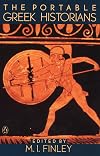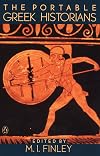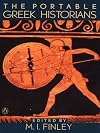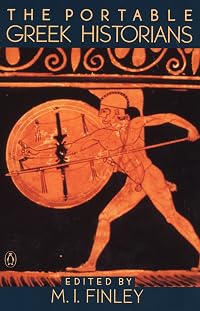
The Portable Greek Historians
by M. I. Finley (Editor)
On This Page
Description
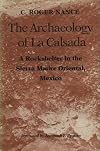
On a remote mountainside 2,000 meters above sea level in the northern Sierra Madre Oriental, the rockshelter at La Calsada has yielded basic archaeological data for one of the least understood regions of prehistoric North America, the state of Nuevo Leøn in northern Mexico. This comprehensive site report, with detailed information on artifacts and stratigraphy, provides baseline data for further explorations in the region and comparisons with other North American hunter-gatherer groups. show more Radiocarbon dating traces the earliest component at the site to 8600-7500 B.C., giving La Calsada arguably the earliest well-dated lithic complex in Mexico. Nance describes some 1,140 recovered stone tools, with comparisons to the archaeology of southern and southwestern Texas, as well as reported sites in Tamaulipas, Coahuila, and Nuevo Leøn, Mexico. From the lithic and stratigraphic analysis, Nance deduces occupational patterns at the site, beginning with Paleo-Indian cultures that lived in the area until about 7500 B.C. Through changes in tool technology, he follows the rise of the Abasolo tradition around 3000 B.C. and the appearance of a new culture with a radically different lithic industry around 1000 A.D. show lessTags
Recommendations












Member Reviews
http://nwhyte.livejournal.com/1980032.html
A Penguin collection of extracts from Herodotus, Thucydides, Xenophon and Polybius, showing the start and early evolution of historical writing. As I am less familiar than I would like with the historical background, a lot of this sailed over my head (I would have liked more footnotes and maps), but I appreciated the raw approach of Herodotus, the critical attitude of all of them to other writers (not that this stopped them making stuff up themselves) and the closing passage from Polybius comparing the Roman constitution with the constitutions of less successful states (he singles out Rome's institutionalisation of religion as a key factor).
A Penguin collection of extracts from Herodotus, Thucydides, Xenophon and Polybius, showing the start and early evolution of historical writing. As I am less familiar than I would like with the historical background, a lot of this sailed over my head (I would have liked more footnotes and maps), but I appreciated the raw approach of Herodotus, the critical attitude of all of them to other writers (not that this stopped them making stuff up themselves) and the closing passage from Polybius comparing the Roman constitution with the constitutions of less successful states (he singles out Rome's institutionalisation of religion as a key factor).
I originally purchased this book when I started college to prepare for my Senior Oral Exam, I skimmed but didn't really retain much of each writer's style save perhaps Herodotus. After thoroughly reading the excerpted selections for these four writers, I can say the my decision to skim it originally was the correct one. If M. I. Finley, the selector of this volume, gave an accurate representation of each writer through the excerpts he chose then Herodotus and Xenophon are the best readings while Thucydides gets bogged down in speeches and Polybius in the discourse of governmental comparisons. However if the excerpts aren't representative of each writer than the fault is with Finley.
One of my favorite books from college.
Edition: // Descr: vi, 501 p. 18 cm. // Series: The Viking Portable Library Call No. { 948 F43 2 } Selected and Edited by M.I. Finley. // //
Ratings
Members
- Recently Added By
Lists

Will Durant's 100 Books: An Update
46 works; 4 members
Author Information

M. I. Finley, FBA, (1912-1986), was a major scholar of classics and ancient history. He taught at Columbia University and the City College of New York, where he was influenced by exiled members of the Frankfurt School, before taking a position at Rutgers University. Finley moved to England in 1955, taught classics at Cambridge, and became a master show more at Darwin College. His numerous works include the classic texts Aspects of Antiquity and The Ancient Economy. Finley was knighted by the queen for his contributions to scholarship in 1979. show less
All Editions
Series
Belongs to Publisher Series
Common Knowledge
- Canonical title
- The Portable Greek Historians
- Original publication date
- 1959
- People/Characters
- Herodotus; Thucydides; Xenophon; Polybius
- Original language
- Greek (Ancient) (Ancient)
Classifications
- Genres
- History, Nonfiction, General Nonfiction
- DDC/MDS
- 938.0072022 — History & geography History of ancient world (to ca. 499) Greece to 323 Greece to 323 Greek Stone & Bronze Age, Greek tribes (Ancient) Cycladic civilization
- LCC
- DF12 .F5 — History of Europe, Asia, Africa and Oceania Greece History of Greece General
- BISAC
Statistics
- Members
- 611
- Popularity
- 47,812
- Reviews
- 4
- Rating
- (3.61)
- Languages
- English
- Media
- Paper, Ebook
- ISBNs
- 8
- ASINs
- 8